
Panama Geisha Coffee: What It Is, Why It Costs More, and Why Your Morning Is Worth It

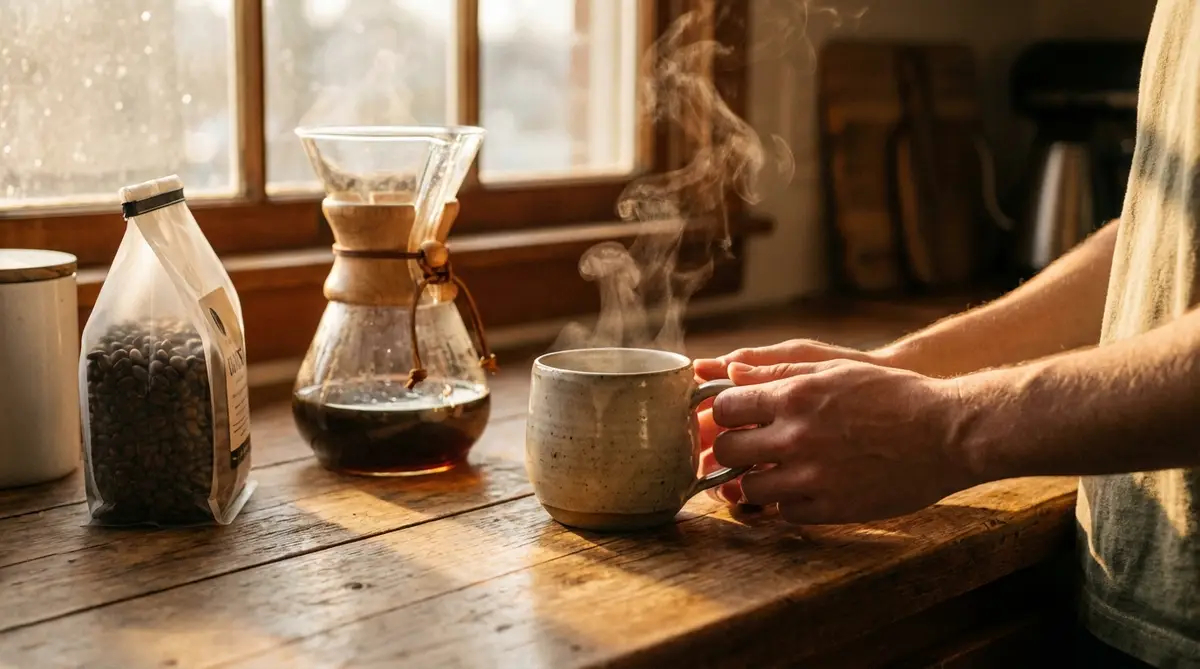
Pour a cup of Grumpy Dad Morning Tolerance and let it cool for two minutes before you drink it.
Not because it’s too hot. Because Geisha tastes different warm than it does hot. The jasmine opens up. The stone fruit — peach, apricot, something between the two — comes forward. The finish stretches out long and clean, with no bitterness trailing it.
Most coffee doesn’t do that. Most coffee gets harsher as it cools.
That right there — that first cool sip — is the argument for Panama Geisha coffee in one sentence. The rest of this article is just the explanation.
Your Morning Deserves One Honest Decision
Here’s something nobody says out loud: most people aren’t drinking coffee. They’re drinking a habit wearing coffee’s clothes.
Same bag, same machine, same mug, every day. It works. It caffeates. It’s fine. And fine is quietly the most expensive thing you can settle for, because it compounds. A thousand fine mornings is a thousand mornings where the one part of the day that belonged entirely to you got autopiloted.
The first 20 minutes before the house wakes up — or before the commute, or before the calls start — those minutes are yours. What goes in them matters more than people admit.
This isn’t about buying expensive coffee to feel sophisticated. It’s simpler than that. It’s about deciding that one thing — one cup, one ritual — is going to be done right. Not because someone told you to. Because you’ve earned the right to stop drinking bad coffee, and you know it.
Morning Tolerance is built for that decision.
Where Geisha Coffee Comes From
The Geisha variety — sometimes spelled Gesha — is a genetic lineage of Coffea arabica that traces back to a forest in Ethiopia, near the town of Gesha in the Kaffa region. It was collected in the 1930s, moved through research stations in Tanzania and Costa Rica, and eventually arrived in Panama in the 1960s.
Farmers in Panama’s Chiriquí Highlands planted it for one practical reason: it was resistant to coffee leaf rust, a fungal disease that can wipe out an entire farm in a season. Nobody was trying to discover the world’s most complex coffee. They were just trying to keep their crops alive.
For four decades, Geisha grew quietly at altitude and mostly got ignored.
Then in 2004, Hacienda La Esmeralda in Boquete entered their Geisha lot into the Best of Panama competition. It won by a margin that confused the judges. The cup was floral and layered and precise — unlike anything else on the table. The bidding at auction started at prices nobody had seen before for Panama coffee, and it kept going.
Word spread fast. The specialty coffee world paid attention.
What nobody mentioned at the time: the coffee had always been there. The variety wasn’t new. The farms weren’t new. What was new was someone paying enough attention to realize what they had.
That’s a useful reminder. The best things tend not to announce themselves.
Why Panama. Why Volcán, Chiriquí.
Panama doesn’t compete on volume. Brazil, Colombia, Vietnam — those countries move coffee by the container ship. Panama’s entire annual coffee output is smaller than a single large Brazilian estate.
What Panama competes on is precision. Specific microclimates. Specific altitudes. Specific farms that have been quietly doing the work for generations without needing a marketing department.
Morning Tolerance is sourced from Volcán, in the Chiriquí province — at 1,600 to 1,900 meters above sea level.
Altitude is not a detail. Altitude is the mechanism — and if you want the full breakdown, how coffee altitude affects flavor is explained in plain English here.
At high elevation, average temperatures are lower. Coffee cherries ripen more slowly. A slower-ripening cherry has more time to develop sugars, acidity, and aromatic compounds — the things that create a complex cup. It’s the same principle as low-and-slow barbecue. You can’t rush the chemistry. You either give it time or you accept a lesser result.
The Chiriquí Highlands sit at the southwestern corner of Panama, in the shadow of the Barú Volcano — the highest peak in the country. The soil is volcanic, which means it’s mineral-rich and well-drained. Cloud cover is consistent. Rainfall is reliable. The diurnal temperature swing — warm days, cool nights — adds another layer to cherry development.
This isn’t luck. It’s a convergence of geography that took millions of years to arrange itself, and a variety that happens to express it better than almost anything else on earth.
Volcán, specifically, sits slightly outside the Boquete region that gets most of the press. That’s worth mentioning because less marketing pressure means farms in Volcán are still producing for quality rather than reputation. The name hasn’t been inflated yet. The coffee has.
All of which explains why the place is right. What it doesn’t explain is why this particular variety — planted here, at this altitude, in this soil — produces a cup that stops people mid-sip. For that, you have to understand what Geisha actually is at a genetic level.
What Makes Geisha Different From Every Other Arabica
Arabica is a species, not a quality guarantee. There are hundreds of Arabica varieties — Typica, Bourbon, Caturra, Catuai, SL28 — and they vary significantly in flavor, yield, and disease resistance. Most of the world’s specialty coffee is Arabica. Most of it doesn’t taste like Geisha.
The Geisha plant is visually distinct. The beans are elongated and narrow compared to most commercial varieties. The plant itself is tall and rangy — hard to harvest efficiently, low-yielding, and unwilling to cooperate with high-density farming. You can’t scale Geisha the way you’d scale a Caturra lot.
That’s why it costs what it costs. It’s not artificial scarcity. It’s a variety that demands more from everyone involved and doesn’t apologize for it.
What Geisha produces — particularly at high altitude under good processing — is an unusually high concentration of aromatic compounds. Linalool, a compound associated with floral and citrus notes. Geraniol, which contributes stone fruit character. The combination produces a cup that reads less like coffee and more like something that grew somewhere specific, at a specific time, under specific conditions.
Which is exactly what it is.
The Washed Process: Why It’s the Right Choice for Geisha
Morning Tolerance is a washed coffee. That’s a processing decision, and it’s the right one for this variety. If you want the full comparison, what washed, natural, and honey processing actually does to your cup is worth reading before you go further.
After harvest, coffee cherries go through one of three main processes before the beans are dried and exported. Each method changes what ends up in your cup.
Natural (dry) process leaves the whole cherry intact during drying. The bean sits inside the fruit — sometimes for weeks — absorbing sugars and fermentation byproducts. The result is a heavy-bodied, fruit-forward cup. Blueberry, red wine, tropical fruit. Expressive and sometimes funky. Great in the right context. Not what you want when the goal is clarity.
Honey process removes the outer skin but leaves varying amounts of the sticky mucilage on the bean during drying. Yellow honey, red honey, black honey — each retains more fruit contact and produces a progressively richer cup. Somewhere between natural and washed.
Washed (wet) process removes all the fruit before drying. The beans ferment briefly in water tanks to dissolve the remaining mucilage, then are washed clean and dried on raised beds — often for two to three weeks — until moisture content stabilizes.
The washed process is the most labor-intensive of the three. It uses more water. It requires more precision in fermentation timing — too short and the mucilage isn’t fully removed, too long and off-flavors develop. Getting it right is the kind of thing that takes years to learn and daily attention to execute.
What it produces is the cleanest possible cup. No fruit processing noise. Just the bean, the variety, and the terroir.
For Geisha, washed processing is essential. The floral aromatics, the stone fruit acidity, the tea-like precision — all of it comes through uninterrupted. When you smell jasmine and taste peach in your Morning Tolerance, that’s the Geisha variety expressing itself through a processing method that was disciplined enough to get out of the way.
Single Origin: Why the Traceability Matters
Morning Tolerance is a single origin coffee. That label is doing more work than it appears to.
Most commercial coffee — including bags marketed as “premium” at grocery stores — is a blend. Blending isn’t inherently bad; skilled roasters build blends intentionally, targeting specific flavor profiles for espresso or drip. But blending also allows inconsistency to hide. A below-average harvest lot gets absorbed into a consistent product. The cup tastes the same regardless of what went into it.
Single origin removes that insulation. When a coffee names its region — Volcán, Chiriquí, Panama — you can trace it. You know the altitude range, the climate zone, the processing station. That traceability is accountability. The farm can’t hide behind a blend. The roaster can’t compensate for a weak harvest with a stronger lot from somewhere else.
It also means the cup changes slightly year to year, harvest to harvest. That’s not a bug. That’s what honesty tastes like.
How to Brew It Without Wasting What You Bought
Panama Geisha at this altitude and process is not a forgiving coffee if you treat it like a bag of grocery store medium roast. It doesn’t need much, but it needs the right things.
Start with a burr grinder. A blade grinder chops unevenly — some powder, some chunks — and the result is a mix of over-extracted bitterness and under-extracted flatness in the same cup. A basic burr grinder like the Baratza Encore or a manual conical burr grinder like the TIMEMORE Chestnut C2S gives you consistent particle size. Grind fresh, right before brewing. The aromatics in Geisha are volatile. Pre-ground specialty coffee is expensive disappointment.
Use a pour-over. A Hario V60 ceramic pour-over dripper or Chemex lets you control the extraction rate in a way a drip machine doesn’t. Bloom the grounds first — pour twice the coffee’s weight in hot water, wait 30 seconds, let the CO2 off-gas. Then pour slowly and evenly, in concentric circles, over about three minutes total. A gooseneck kettle gives you the control you need here; a standard kettle works but requires more care.
Mind the water temperature. Boiling water scorches light-medium roasts and blows out the delicate compounds. Let the kettle sit 30 to 45 seconds off the boil. If you have a temperature-controlled kettle, set it to 200°F. If you don’t, 30 seconds off the boil puts you close enough.
Use filtered water. Hard tap water with high mineral content fights the coffee’s flavor. You don’t need distilled — some minerals help extraction — but if your tap water tastes like anything, your coffee will too.
Drink it black, at least once. Add your cream and sugar after you’ve tasted it straight. You paid for the flavor. At least meet it.
The whole process takes about eight minutes. There are people online who will tell you it takes 45 — different bloom ratios, precise gram weights, specific pouring patterns with names. Those people are not wrong, exactly. They’re just solving a problem you don’t have yet. Get the basics right first. The cup will tell you when it wants more attention.
What This Cup Is Really About
There’s a version of a man who buys the cheapest version of everything his whole life and then, sometime in his 40s, replaces everything. The cheap knife that never held an edge. The thin pan that warped after six months. The coffee that was always just fine.
He doesn’t do it because he got rich. He does it because he got tired of replacing things. Because he did the math and realized that the cheaper version always cost more in the end — in money, in time, in the quiet frustration of tools that don’t do what they’re supposed to.
Morning Tolerance is 60% organic Geisha from Volcán, Chiriquí — medium roast, washed process. It’s a daily driver for the person who has finished making compromises before noon.
It won’t fix the alarm clock. It won’t make the commute shorter. It won’t make anyone in your house less loud at 7 a.m.
But it will be a good cup of coffee. Every single morning. Without any of the usual disappointment.
That’s not a small thing.
Add Morning Tolerance to your cart. You already know why.
Grumpy Dad Co. — Built for people who’ve stopped settling.
Explore Morning Tolerance and the full Coffee, Tea & Espresso collection at grumpydadco.com