
How Coffee Altitude Affects Flavor: The Science, Plain English

There’s a number on specialty coffee bags that most people walk right past.
It says something like 1,600–1,900 MASL — or sometimes just high grown or shade grown at altitude. It sits between the roast date and the processing method and looks like a specification nobody asked for.
It’s not. It’s one of the most useful pieces of information on the bag.
MASL stands for meters above sea level. And the altitude at which a coffee plant grows shapes the flavor in your cup more directly than almost any other single factor — more than the roast level, more than the brewing method, sometimes more than the variety itself. If you’re just getting into specialty coffee, the honest dad’s guide to brewing specialty coffee at home is a good place to start before diving into altitude numbers.
Here’s how it works. No jargon. No padding.
The Basic Mechanism: Temperature and Time
Coffee is a fruit crop. The bean inside the cherry is a seed, and like any seed, it develops based on the conditions surrounding it.
At lower elevations — say, below 1,000 MASL — temperatures are warmer. Coffee cherries ripen fast. Fast-ripening cherries don’t have as much time to build complex sugars, acids, and aromatic compounds. The resulting bean is straightforward. It produces a cup that’s simple, often flat, sometimes bitter. It works for mass-market blends. It’s not what you’re looking for in a specialty bag.
At higher elevations — above 1,500 MASL, and especially above 1,800 — temperatures drop. Cool nights slow the entire ripening process. A coffee cherry that might take four months to ripen at low elevation can take six or seven months at altitude. That extra time isn’t just time sitting there doing nothing. That’s weeks of continuous sugar development. Weeks of the plant producing and concentrating aromatic precursors in the seed.
It’s the same reason a slow-smoked brisket at 225°F beats one blasted at 350°F. The lower temperature doesn’t just slow the clock — it changes the chemistry. Different compounds develop. Different textures form. You end up with something fundamentally more complex because the process had room to complete itself.
That’s altitude in a sentence: it gives coffee the time it needs to become what it’s supposed to be.
What Altitude Actually Does to Bean Chemistry
The temperature-and-time explanation is the simple version. The chemistry underneath it is worth understanding because it explains why the flavor differences are so consistent and so significant.
Sugar development. Coffee cherries produce sucrose throughout ripening. At altitude, the longer ripening window means more sucrose accumulates in the cherry — and therefore in the bean. When that bean gets roasted, sucrose undergoes Maillard reactions and caramelization, producing the sweet, complex flavor compounds that distinguish a good cup from a flat one. Low-altitude beans with less accumulated sugar produce a simpler roast. High-altitude beans have more to work with.
Acidity. High-altitude coffees are almost universally higher in acidity than low-altitude coffees — and that acidity is a feature, not a flaw. The organic acids that develop during slow cherry ripening — citric, malic, tartaric — are the same acids that give fruit its brightness. They’re what makes a cup taste alive rather than flat. A well-balanced high-altitude coffee with good acidity is like a good squeeze of lemon on fish: it doesn’t overpower, it lifts.
Bean density. Beans grown at high altitude are denser than low-altitude beans. This is partly because the cell walls of the cherry develop more slowly and therefore more completely. Dense beans roast more evenly — the heat penetrates uniformly rather than scorching the outside before the center is done. Dense beans also hold their flavor longer post-roast. If you’ve ever noticed that cheap coffee goes stale faster, altitude is part of that equation.
Aromatic compounds. The precursors to the floral, fruity, and nuanced aromatic notes in specialty coffee — linalool, geraniol, and dozens of others — develop during cherry ripening. More ripening time means more of these compounds in the final bean. This is why high-altitude Geisha from Panama can produce jasmine aromatics intense enough to smell across the room before you even brew it, while a low-altitude Arabica from the same country might smell like ordinary roasted grain. (For more on why this particular variety commands such attention, Panama Geisha and what makes it worth the price breaks it down without the fluff.)
The Altitude Classifications (What the Numbers Actually Mean)
The specialty coffee industry uses altitude ranges as rough quality indicators. Here’s how to read them:
Below 1,000 MASL: Robusta territory, mostly. Lower-grown Arabica exists here but tends toward mild, simple cups. The bulk of commercial coffee — the grocery store stuff — is grown in this range or just above it.
1,000–1,500 MASL: Where the quality curve starts turning upward. You’ll find decent Arabica from Latin America and parts of Africa in this range. Some solid coffees live here. Not the exceptional ones.
1,500–1,800 MASL: High grown. This is where specialty coffee starts showing real complexity. Most of the well-regarded Guatemalan, Colombian, and Honduran coffees come from this range. Acidity increases. Sweetness increases. The cup has dimension.
Above 1,800 MASL: Strictly high grown. Ethiopian highland coffees. High-altitude Kenyan lots. The best Peruvian and Bolivian microlots. And the Geisha farms of Panama’s Chiriquí Highlands, where Morning Tolerance is sourced at 1,600 to 1,900 MASL. At this elevation, the cool nights are dramatic, the ripening season is long, and the beans that come off those plants are among the densest and most aromatic in the world.
The number on the bag is a map coordinate. It tells you roughly where on the quality curve the coffee lives before you open it.
Why Panama’s Chiriquí Highlands Are Different
Not every mountainous coffee region produces the same quality, even at equivalent altitudes. The altitude creates the conditions — but other factors determine whether those conditions are fully used.
Panama’s Chiriquí province, in the shadow of the Barú Volcano, checks several boxes simultaneously.
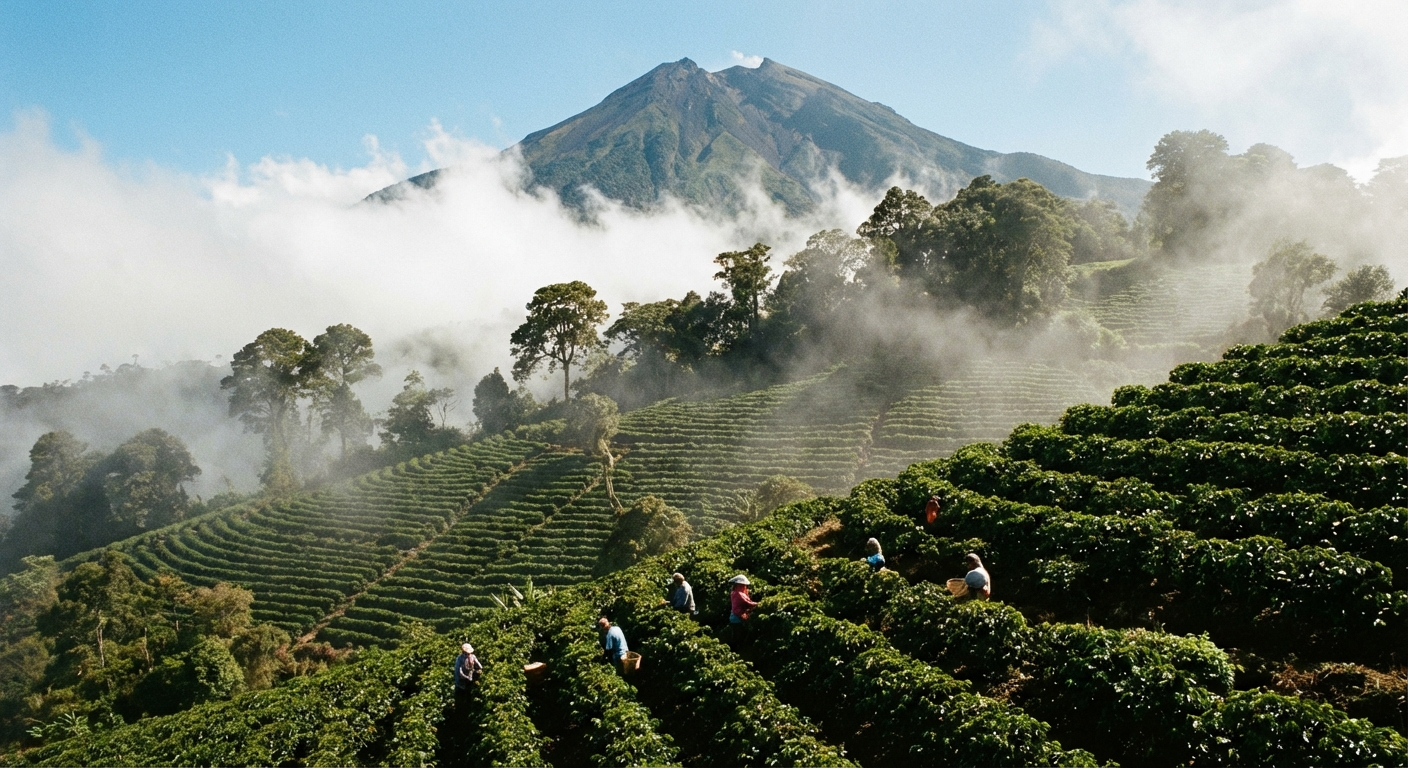
The altitude is genuine. 1,600 to 1,900 MASL is not a marketing number. The Barú Volcano rises to 3,474 meters — the highest point in Panama — and the farms on its slopes sit at elevations that produce the slow ripening cycles that matter.
The temperature swing is significant. Days in the Chiriquí Highlands are warm enough to drive photosynthesis. Nights drop to near-cool temperatures. That diurnal range — the difference between day and night temperatures — is a secondary driver of complexity on top of altitude itself. The plant works during the day and consolidates sugars at night.
The soil is volcanic. Volcanic soil is mineral-rich and free-draining. It feeds the plant without waterlogging the roots. The drainage is particularly important at altitude, where heavy cloud cover and consistent rainfall could easily oversaturate lower-quality soils.
The cloud cover is natural shade. Coffee plants are understory plants by nature — they evolved under a forest canopy and prefer filtered light. The consistent cloud cover in the highlands acts as natural shade, further slowing cherry development and reducing plant stress. Stressed coffee plants produce lower-quality fruit. Comfortable coffee plants take their time and do the work.
All of this converges in the cup. The altitude at Volcán doesn’t just produce a good environment — it produces a specific environment that expresses itself in flavor in ways you can actually taste.
Altitude vs. Roast: Which Matters More
Here’s where a lot of people go wrong.
They buy a genuinely good high-altitude coffee and then roast the life out of it. Dark roast, almost black, pulled until the oils surface and the bean smells like an ashtray. And they wonder why it tastes like every other dark roast.
Because they burned off everything the altitude built.
The complex sugars, the delicate aromatics, the bright acidity — all of it develops at altitude over months. A dark roast destroys most of those compounds in minutes. You’re left with the Maillard reaction products of the roast itself — the caramel, the smoke, the carbon — which are the same regardless of what bean went in.
Dark roast has its place. It’s not the enemy. But dark roasting a high-altitude Geisha is roughly equivalent to buying a good Japanese chef’s knife and using it to pry open paint cans. The tool had a purpose. You just chose a different one.
Morning Tolerance is medium roast. That’s a deliberate decision to preserve what the altitude produced. The roaster’s job was to develop the bean fully without overwriting the origin character. Medium roast lets the Chiriquí terroir and the Geisha variety come through clearly — the floral notes, the stone fruit, the clean acidity. You can taste where it came from.
A good coffee scale helps here, more than most people expect — knowing exactly how much coffee and how much water you’re using lets you dial in the extraction without guessing. Same with a temperature-controlled kettle: brewing high-altitude, medium-roast coffee at 210°F because that’s where your kettle lands by default is doing the altitude a disservice. And the grind matters just as much — a Timemore Chestnut C2S manual burr grinder gives you the consistency to let the bean’s altitude character actually come through.
High Altitude Coffee vs. Low Altitude Coffee: Side by Side
If you’ve ever wondered whether the altitude claims on specialty coffee bags are real or just marketing, here’s the simplest test: buy two coffees from the same general region, one low-grown and one high-grown, and brew them back to back under identical conditions.
Low-grown (under 1,000 MASL), typical commercial Arabica:
- Flat, simple aroma
- Muted acidity, sometimes rough
- Thin to medium body
- Short finish, often bitter at the end
- Tastes the same hot as it does cold
High-grown (1,600+ MASL), quality specialty:
- Aromatic before you even grind it
- Bright, fruit-forward acidity that reads as sweetness, not sharpness
- Clean body with real texture
- Long finish that stays pleasant as the cup cools
- Tastes different — and often better — as the temperature drops
That’s not the roaster’s skill. That’s altitude.
What to Look for When You’re Buying
When you’re evaluating a specialty coffee bag and altitude is listed, use it:
Under 1,200 MASL: Fine for everyday blends. Don’t expect complexity.
1,200–1,500 MASL: Solid territory. Good acidity, some complexity. Worth the step up from commercial coffee.
1,500–1,800 MASL: Where you start getting genuinely interesting cups. Most of the respected origin coffees live here.
Above 1,800 MASL: This is where you’re paying for something specific. The bean density, the aromatic development, the acidity — all of it is dialed up. Make sure the roast and processing match. A natural-processed coffee at 1,900 MASL will be one of the most expressive cups you’ve ever had. A dark-roasted coffee at the same elevation will taste like a dark roast.
The altitude tells you what was possible. The processing and roast tell you what the farm and roaster decided to do with it.
The Bottom Line
Altitude is not a number on a bag. It’s a description of conditions — temperature, ripening time, soil drainage, cloud cover, diurnal swing — that combine to produce a denser, more aromatic, more complex bean than lower-elevation farming can achieve.
When a coffee is grown at 1,600 to 1,900 MASL, in volcanic soil, in the Chiriquí Highlands of Panama, and processed with enough care to let the bean express that altitude honestly — you end up with something that tastes like where it came from.
Morning Tolerance is that coffee. Medium roast. Washed process. Geisha variety. High altitude.
Pour it. Let it cool two minutes. Notice the difference.
You won’t go back to whatever was in the cabinet before.
Grumpy Dad Co. — Built for people who’ve stopped settling. Explore Morning Tolerance and the full Coffee, Tea & Espresso collection at grumpydadco.com