Knife Storage 101: Block, Magnetic Strip, or Drawer — What Won’t Wreck Your Edges

Most home cooks spend more on a single knife than they ever spend on storing it. Then they shove the thing back in a drawer next to a corkscrew, a melon baller, and a mystery whisk that’s been there since 2019. The corkscrew is winning. The knife is losing.
Where you keep your knives matters more than the brand stamped on the bolster. Bad storage dulls edges faster than dull cutting boards. It chips tips. It rusts carbon steel. It quietly turns a $200 chef’s knife into a $40 chef’s knife with marketing. (Not sure which knife deserves that real estate? Our honest kitchen knife buying guide for 2026 cuts through the noise.)
This is the no-nonsense breakdown. The four main options. What each protects, what each ruins. The hygiene problem nobody talks about. And how to set up a storage system for under $40 that’ll keep good knives sharp for a decade.
The 30-second answer
Best for one or two great knives: magnetic strip. Best for a working set of 4–8 knives: in-drawer organizer. Best for a kitchen that needs to look “finished” on the counter: narrow universal block. Best for traveling or specialty blades: saya (wood sheath).
The thing in your kitchen right now? Probably the worst of the four.
Why storage matters more than people admit
A knife edge is microscopically thin. Anything harder than the edge — another blade, a metal utensil, a granite counter, a ceramic bowl — dulls it on contact. One careless drawer rummage can roll an edge that took 20 minutes on a whetstone to refine.
Storage isn’t just about keeping the kitchen tidy. It’s about not undoing the work of every honing session. (If you haven’t read it yet, our Honing vs Sharpening guide explains why edge contact is the silent killer.)
Option 1: The classic countertop block
Wood block, slots cut for specific knife shapes, sits on the counter, came free with the knife set. The default for 70% of American kitchens.
What it gets right
- Knives have homes — kids see the slot, kids put it back.
- Edges don’t touch other metal.
- Looks like a “real kitchen” to your in-laws.
What it gets wrong
- The hygiene problem. Slots are vertical wood channels you can’t clean. Crumbs, water, microscopic food residue settle at the bottom. Mold grows. You never see it.
- Edge-down storage dulls knives. The cutting edge rests on the slot floor. Every time you slide the knife in or out, the edge scrapes wood.
- Locked-in slot count. The block was made for the set it shipped with. Add a single new knife? It doesn’t fit. Lose interest in the bread knife? Empty slot forever.
- Counter real estate. A 16-slot block eats prime workspace.
If you’re buying one anyway
Look for edge-up universal blocks with bristle inserts (Kapoosh, Schmidt Brothers) or plastic rods. The knife slides in any orientation, the edge doesn’t rest on wood, and inserts can be removed and washed in the dishwasher.
Option 2: Wall-mounted magnetic strip
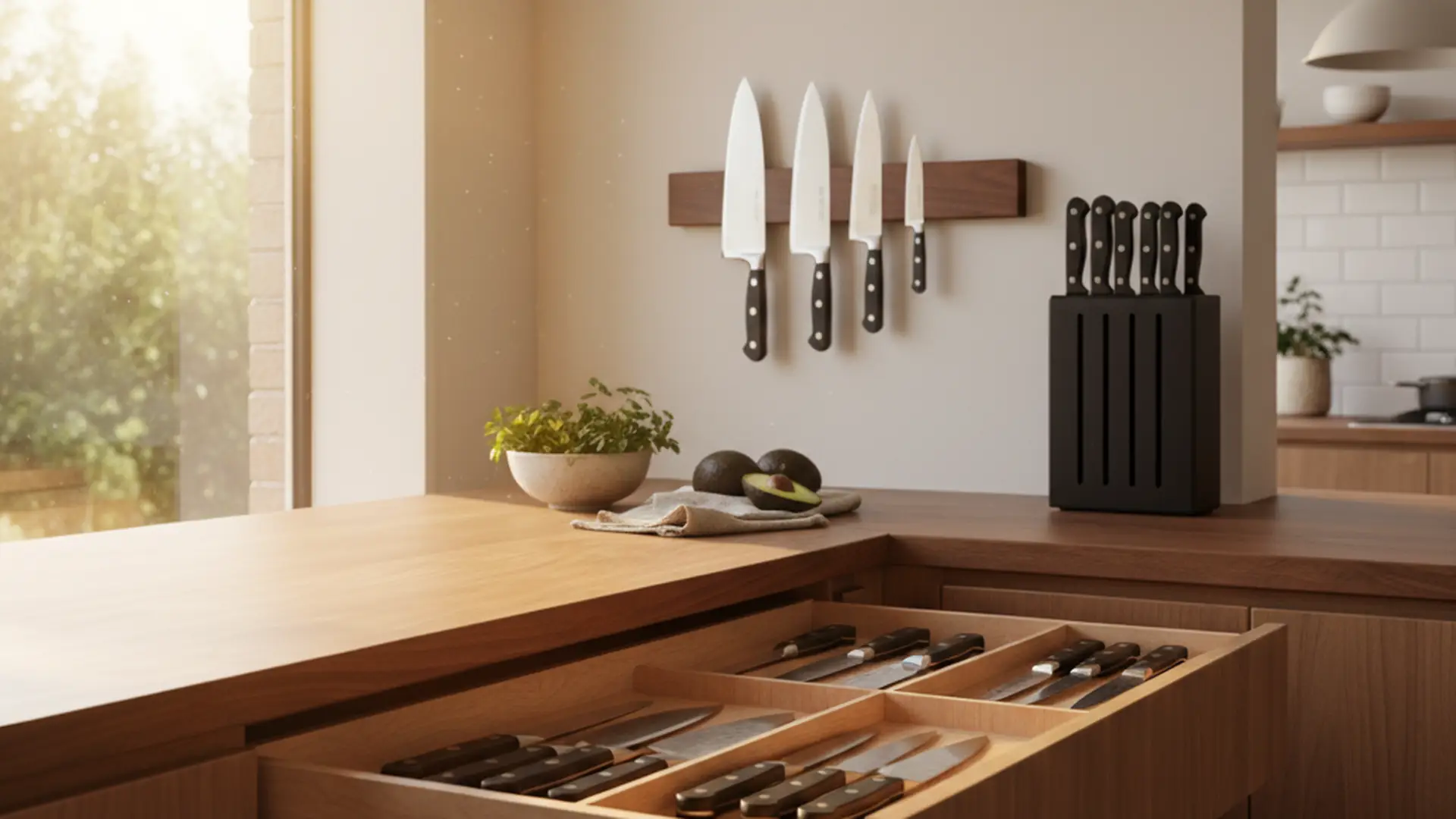
A wood or steel bar, mounted to the wall (or backsplash, or upper cabinet bottom), with magnets running its length. Knives stick to it. Done.
What it gets right
- Edges hang free — nothing touches them.
- Easy to clean. The strip is right there.
- You see what you have, you grab what you need.
- Adapts to any knife size or count. Add or remove knives without buying new hardware.
- Looks great. Genuinely. A walnut magnetic strip with 4 nice knives is the cleanest knife storage in any kitchen.
What it gets wrong
- Knife shock on placement. Slap the knife on the magnet and you can chip a thin Japanese tip. Approach spine-first, then rotate the edge in. Always.
- Kid-height issues. If small kids reach the strip, you have a problem. Mount above 60 inches or skip this option.
- Wall mounting. Studs preferred. Magnetic strips with knives on them get heavy fast.
- Splatter zone. Don’t mount directly behind the cooktop. Grease lands on knives, dries, becomes its own science project.
What to buy
Solid wood (walnut, oak) magnetic bars from a small workshop on Etsy run $35–$70 and outlast plastic-housed strips by decades. If you want something that doubles as a countertop display, a double-sided magnetic block in acacia and blue resin gives you the magnet benefits without drilling into the wall. Length: 12–18 inches for most home setups. Avoid stamped stainless strips with weak magnets — knives slide off.
Option 3: In-drawer knife organizer
A wood or bamboo tray with angled slots that sits in a drawer. Knives lay flat or at a slight angle, edges protected, hidden from view.
What it gets right
- Hidden, so kitchen looks clean and uncluttered.
- Edges fully protected — no contact with any surface.
- Holds more knives than a magnetic strip with no visible clutter.
- Kid-safe. Drawers can be locked or simply out of reach.
- Adapts to any knife collection.
What it gets wrong
- Costs a drawer. If you have a small kitchen, that’s real estate.
- You don’t see the knives, so you forget what you own. (This is sometimes a feature.)
- Cheap organizers split or warp in 18 months. Pay for solid wood once.
What to buy
Look for solid bamboo or oak organizers with adjustable slot widths (Bambüsi, Joseph Joseph DrawerStore, custom-cut from a local woodworker). Expect $25–$60. Measure your drawer’s interior — most “universal” organizers don’t fit deep drawers without modification.
Option 4: Saya (wooden blade sheath)
A traditional Japanese wood cover that slides onto the blade itself. Common with high-end Japanese knives. The knife lives in the saya, the saya lives wherever you want.
What it gets right
- Total edge protection — the blade is fully wrapped.
- Travel-ready. Toss the knife in a bag and go.
- Pairs with any other storage system. Saya in a drawer, saya on a shelf, saya in a knife roll.
- Looks earned, in a way nothing plastic ever will.
What it gets wrong
- Specific to one knife. A saya for a 240mm gyuto won’t fit a 210mm.
- Adds $30–$80 per blade.
- Wood absorbs moisture. Always dry the blade fully before sheathing — especially carbon steel. (This is a major rust risk; see our Carbon Steel Knife Care guide for the moisture rules.) A few drops of food-grade camellia oil for rust prevention on the blade before sheathing adds a reliable moisture barrier.
When to bother
If you own one knife you genuinely care about — a hand-forged Japanese chef’s knife, a heritage blade, a knife that cost more than the rest combined — get a saya for it. Not negotiable.
The hygiene problem nobody talks about
Wood knife blocks with vertical slots are essentially closed tubes you can’t clean. Studies have repeatedly found higher bacterial counts inside knife block slots than on most other kitchen surfaces. It’s not catastrophic — most of it is harmless — but it’s not nothing.
If you’re keeping a traditional wood block:
- Flip it upside down weekly and tap out crumbs over the trash.
- Run the slots with a thin bottle brush every few months.
- Make sure knives are fully dry before going back in.
- Sun-dry the block once a year if you can.
If that sounds like a chore, it’s because it is. It’s also why magnetic strips and in-drawer organizers are quietly winning the storage war — they’re easier to keep clean.
The drawer-without-a-tray problem (do not do this)
Loose knives in a kitchen drawer is the worst storage choice on earth. Here’s what happens:
- Edges bang against metal utensils and lose their alignment within days.
- Tips chip when the drawer slams shut.
- You will eventually cut yourself reaching for a measuring spoon.
- The knife becomes “the dull one” within a month.
If your knives currently live loose in a drawer, fix this this weekend. Even a $15 organizer is a 1000% upgrade.
What to do with bread knives, butcher knives, and weird shapes
- Bread knife (serrated): drawer organizer or magnetic strip. Serrations are forgiving — they don’t dull from light contact the way a smooth edge does.
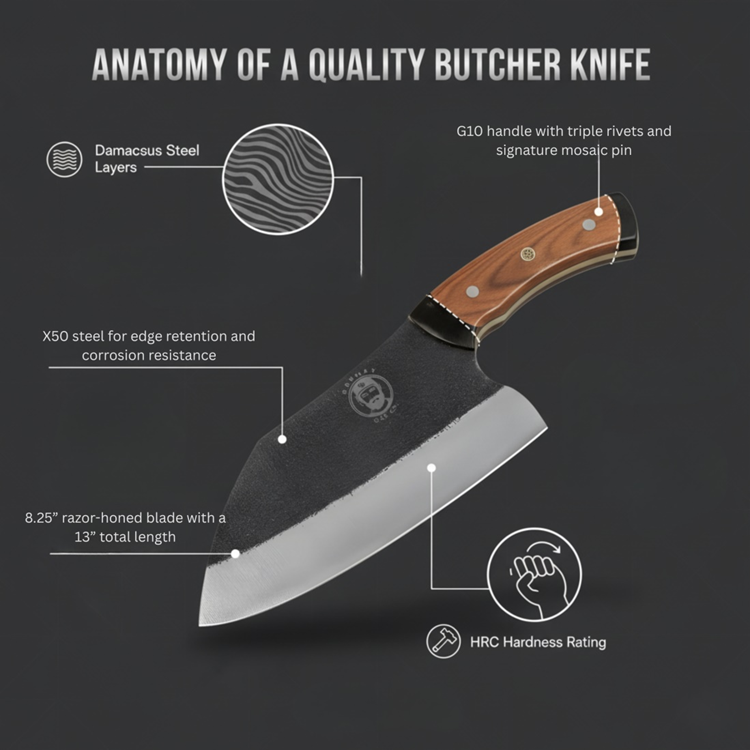
- Butcher knife / cleaver: magnetic strip if heavy-duty (most cleavers exceed wood-block slot width). If you want a deeper dive on cleaver use, see our Butcher Knife 101.
- Boning, fillet, paring: drawer organizer is ideal. Smaller blades fit awkwardly on magnetic strips.
- Steak knives: their own dedicated drawer block, or a wood case. Don’t let them live loose in the cutlery drawer.
The setup most home cooks should actually use
- Magnetic strip over the prep counter, holding 3–5 daily-use knives (chef’s, paring, bread, utility, maybe a santoku).
- In-drawer organizer in the prep drawer for occasional knives (boning, fillet, slicing) and steak knives.
- Saya for one or two prized blades you don’t use every day.
- Skip the block entirely. Or keep one decorative slot if it makes the kitchen look right.
Total cost: $40–$120 depending on materials and number of knives. Lifetime: 20+ years. For the full range of strips, blocks, and organizers in one place, browse our sharpening and storage collection.
Mistakes that quietly ruin good knives
- Putting a wet knife back into a wood block. Mold and rust love this combo.
- Sliding a knife edge-first into anything — drawer, block, magnetic strip. Always lead with the spine.
- Storing carbon steel anywhere humid (under the sink, near a steamer, on a strip directly above a stockpot).
- Hanging knives by their handles instead of magnetic-mounted blades — handles bear weight badly long-term.
- Using the knife block as a holder for kitchen shears, peelers, and birthday candles. The block is for knives. Everything else just abrades the slots.
- Letting kids “help put away” by jamming knives in any open slot. Either teach them the right slot or store knives where they can’t reach.
The travel and storage problem
Going camping? Heading to a rental cabin to cook? Hosting Thanksgiving at your in-laws who own one knife and it’s a steak knife from 1987?
You’ll want a knife roll — a fabric or leather case with sleeves for individual blades. $25–$120. Holds 4–8 knives, rolls flat for transport, doubles as workshop storage at home.
For one knife traveling solo, a saya plus a soft sleeve is plenty. Don’t toss bare knives in luggage. TSA hates this. So does whatever sweater is in there.
Marketing traps in 2026
- “Self-sharpening” blocks. They hone, badly, at angles that may not match your knife. They damage edges over time. Skip.
- “Antimicrobial” plastic blocks. The “antimicrobial” coating wears off. Plastic warps. Long-term, cheaper than wood and worse.
- Magnetic strips with “blade-protecting silicone overlays.” The silicone holds water. Knives rust. Just buy a real wood strip.
- “Universal slot” knife blocks with rubber inserts that turn black after a year. If the rubber goes black, you’re seeing oxidation and food residue. It doesn’t wash out.
- “Premium hardwood” blocks priced under $30. Real hardwood doesn’t cost $25 retail. That’s plywood with a veneer.
If you only remember five things
- Loose-in-a-drawer is the worst storage. Fix it this weekend.
- Magnetic strip + in-drawer organizer covers 95% of home cooks.
- Always dry knives fully before storing — especially in wood.
- Approach magnetic strips spine-first. Always.
- If you own one nice Japanese knife, get a saya for it.
FAQ
Are bamboo organizers as good as hardwood?
Close, but not quite. Bamboo is harder than most softwoods but more prone to splitting if it dries out. A solid bamboo organizer in a humid kitchen lasts 5–8 years. Solid oak or walnut lasts 20+. Both are vastly better than no organizer.
Can I store knives stacked on top of each other?
Only if both blades are sheathed (saya, edge guard, magnetic strip with sleeves). Bare blade against bare blade dulls both edges fast.
Do magnets damage knife steel?
No. The magnetic field on a kitchen knife strip is too weak to affect steel hardness or edge structure. The myth comes from industrial magnets, which can’t fit on your wall. Don’t worry about it.
What about edge guards (plastic blade covers)?
Cheap, useful for travel, fine for short-term storage. Long-term storage in plastic edge guards traps moisture against carbon steel — risk of rust. Pull guards off if a knife is going to sit unused for weeks.
How high should a magnetic strip be?
Eye level for the cook (60–66 inches off the floor for most adults), well above kid reach, away from the stove splatter zone. 12–18 inches above the counter is the sweet spot.
My kitchen has no wall space and a tiny drawer. Now what?
Look up. The underside of an upper cabinet can take a magnetic strip. So can the side of a wall cabinet. So can the inside of a pantry door (use shorter, lighter strips here). Vertical surfaces are always more flexible than countertops.
The Grumpy Dad Promise
Get the knives off the counter. Get them out of the drawer. Put them somewhere you can see them, dry them, and grab them without reaching past a microplane. Sharper knives, fewer cuts, longer-lasting blades, kitchen that doesn’t look like a hardware store junk drawer.
Forty bucks fixes most kitchens. Skip the fancy blocks, the “antimicrobial” lies, and the urge to keep that bread knife from 2003 just because it came in the set. Now go put your good knife somewhere it deserves.