Honing vs Sharpening: The Truth About That Steel Rod (And What You’re Doing Wrong)

That steel rod that came with your knife block? Most dads pull it out twice a year, slap it around the blade like they’re conducting a symphony, and then quietly admit the knife still won’t cut a tomato. The rod isn’t broken. The knife isn’t broken. You’re just confusing two completely different jobs.
Quick answer: Honing realigns a knife’s existing edge and removes no metal — do it every few uses in about ten seconds. Sharpening grinds away worn steel to create a brand-new edge, and you only need it a few times a year. That steel rod hones. It does not sharpen. Most “dull” knives just need honing.
- Honing straightens a microscopically bent edge — fast, frequent, zero metal removed.
- Sharpening removes metal to rebuild the edge — slow, occasional, shortens blade life if overdone.
- Frequency: hone every 2–3 cooking sessions; sharpen every 3–6 months for most home cooks.
- The paper test: tears in spots means hone; slides off without biting means sharpen.
- A ceramic rod is the one tool that safely hones both stainless and hard Japanese steel.
Here’s the boring truth: honing and sharpening are not the same thing. They feel similar, they look similar, and they get sold under names that pretend they’re interchangeable. They aren’t. One realigns an edge. The other rebuilds it. Mix them up and your knives live in a state of permanent mediocrity — never sharp, never useless, just annoying.
This is the no-nonsense breakdown. What honing does. What sharpening does. When you need each one. What to buy. And the marketing traps that keep grown men waving steel rods at perfectly good knives like they’re warding off vampires.
The 30-second version (because you have dinner to make)
Honing = realigning the edge you already have. Fast, daily, no metal removed.
Sharpening = removing metal to create a new edge. Slower, occasional, actually changes the geometry.
If your knife slides off a tomato skin, honing might fix it. If it crushes the tomato instead of cutting it, you need to sharpen.
What honing actually does (the part nobody explains)
A knife edge is not a thick wall of steel. It’s a thin metal lip — fragile by design — that bends sideways microscopically every time you cut something. Carrots, paper, chicken bones, your cutting board. Each cut nudges the edge a few microns out of true.
You don’t see the bend. You feel it. The knife “drags.” It “skips” off the skin. It doesn’t glide.
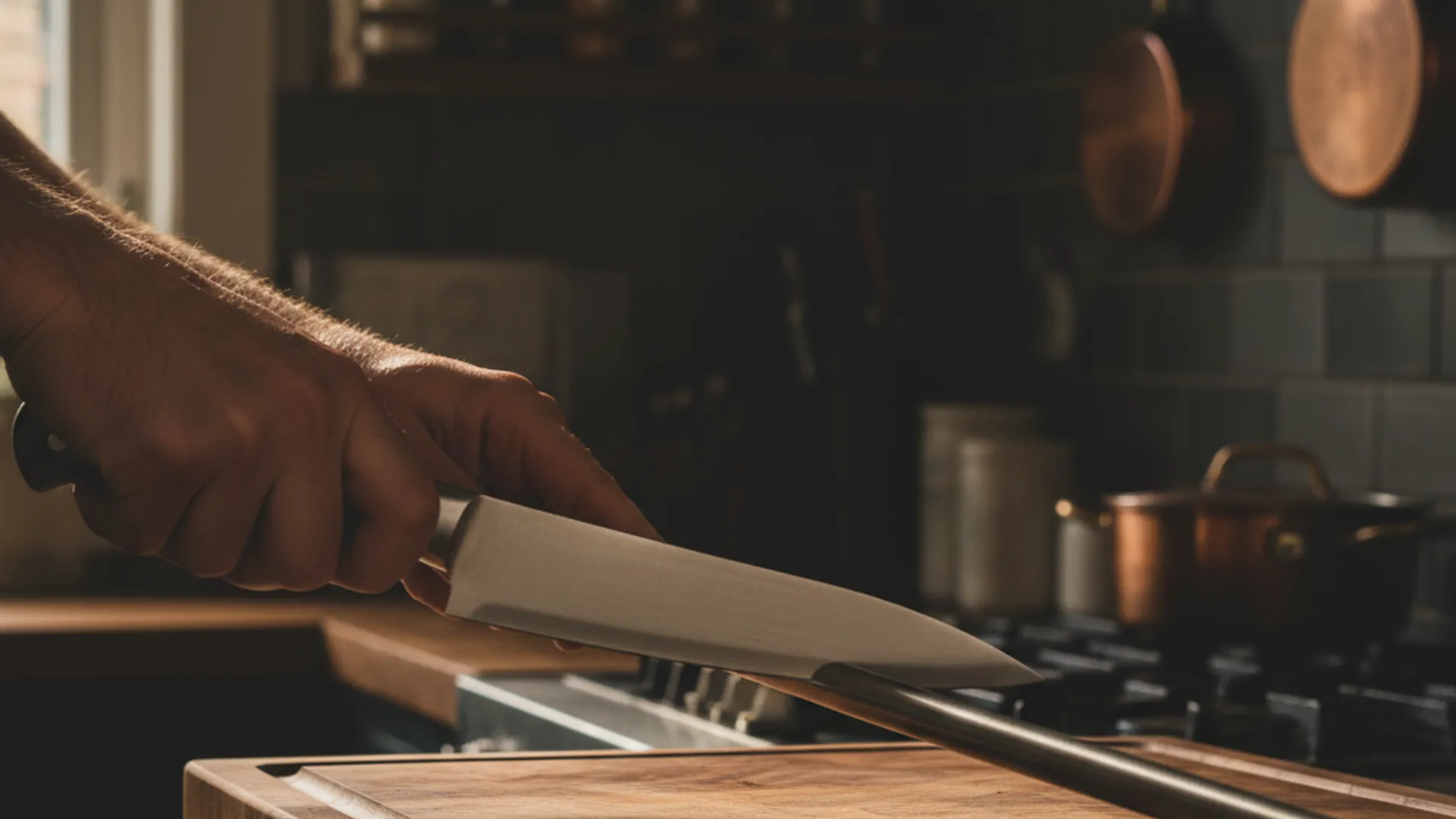
Honing pushes that bent edge back to center. The steel rod (or ceramic, or diamond — more on that in a minute) doesn’t grind the blade. It nudges metal that’s already there back into place. Done right, it takes about ten seconds and gives you maybe 80% of “fresh-out-of-the-box” sharpness.
That’s it. That’s the whole job. No scraping. No sparks. No dramatic two-handed sword-master pose.
What sharpening actually does
Sharpening removes metal. You’re using an abrasive — a whetstone, a pull-through, a belt grinder if you’re a maniac — to grind away the worn portion of the edge and reveal fresh, geometrically correct steel underneath.
This is not something you do every Tuesday. Done correctly, sharpening shortens the life of the knife. Done badly, it shortens it a lot. That’s why most home cooks should sharpen 1–4 times a year, not weekly.
If you’re shopping for a real chef’s knife, geometry and heat treat decide how often you’ll need to sharpen. (See our Best Kitchen Knife 2026 buying guide for the steel-and-geometry breakdown.)
The frequency rule (memorize this and walk away)
Honing: every few uses. Some chefs hone before each meal. For home cooks, every 2–3 cooking sessions is plenty.
Sharpening: when honing stops bringing the edge back. For most home cooks, that’s every 3–6 months. Heavy users, every 1–2 months. Casual users, once a year.
If you sharpen every week, you’re either a butcher or you’re doing it wrong.
How to tell which one your knife needs (the paper test)
Take a sheet of regular printer paper. Hold it at the top. Slice down with the knife at a slight angle.
- Clean glide, no tearing: the knife is fine. Hone it next week if it starts dragging.
- Cuts but tears in spots: hone it. The edge is misaligned, not gone.
- Snags hard, folds the paper, won’t bite: sharpen it. Honing won’t help.
- Slides over the paper without catching: the edge is rounded. Sharpen it. No amount of rod-waving will save you.
The tomato test works too. A real edge bites the skin on its own weight. A dull edge needs a saw motion and crushes the flesh.
Honing rod buyer’s guide (the part marketing won’t tell you)
Three types. They’re not interchangeable, even though they look the same.
| Rod Type | Removes Metal? | Best For | Watch Out For |
|---|---|---|---|
| Steel (smooth/grooved) | No (grooved: barely) | European/German knives, 18–22° | Useless on a dead edge; won’t fix a rounded one |
| Ceramic | Almost none (light polish) | Everything — stainless and hard Japanese (60+ HRC) | Chips if you drop it; use light pressure |
| Diamond | Yes — this is basically sharpening | Stubborn edges, fast metal removal | Over-grinds thin Japanese blades fast; skip it as a beginner |
1) Steel honing rod (smooth or slightly grooved)
The classic. The thing in your knife block. It realigns. It does not sharpen. If it has fine grooves, it removes a microscopic amount of metal — barely. Best for European-style knives at 18–22° angles.
2) Ceramic honing rod
Slightly abrasive. Realigns and very lightly polishes the edge. Better for harder Japanese steels (60+ HRC) where the edge is too brittle to bend back cleanly with a regular steel. Doesn’t shock the edge.
3) Diamond honing rod
Actually removes metal. This is closer to sharpening than honing. Useful for stubborn edges, but you can over-grind a thin Japanese blade in a hurry. Powerful tool, easy to misuse. Most home cooks should skip it.
If you have one rod for one knife block: ceramic. Works on stainless, works on Japanese, doesn’t damage anything. Quietly the most underrated item in our sharpening and storage collection.
How to actually use a honing rod (without looking like a clown)
Forget the chef-show theatrics. Here’s what works.
- Hold the rod vertical, tip on a folded towel on the counter.
- Place the heel of the blade against the rod near the top, at roughly the same angle as the bevel — about 15° for Japanese knives, 20° for German. (Not sure which style you have? The Western vs Japanese chef’s knife breakdown covers the geometry differences in detail.)
- Pull the blade down and across the rod toward you, sweeping from heel to tip in one smooth motion.
- Switch sides. Repeat. 5–6 strokes per side is enough. Not 50.
The motion is gentle. The rod doesn’t need to ring like a bell. Quiet, controlled, even. You’re realigning an edge, not sword-fighting a refrigerator.
Sharpening at home: the realistic options
You have three honest paths. Pick one and learn it.
1) Pull-through sharpener (carbide + ceramic slot)
Cheap, fast, fool-proof. Sets a fixed angle. Good enough for a $40 knife you don’t love. Not good for a knife you actually paid for, because it scrapes the edge into a one-size-fits-all geometry and shortens blade life.
2) Whetstone (the real answer)
Two stones — a 1000-grit and a 4000–6000-grit — handle 95% of home knife maintenance. A setup like the Kota Japan 1000/6000 whetstone with bamboo base and angle guide covers both grits in one purchase. Yes, there’s a learning curve. No, it’s not as hard as the internet pretends. Twenty minutes of practice on a beater knife and you’ll be passable. Three sessions and you’ll be better than your local “professional sharpener” who runs everything through a belt grinder at the wrong angle.
3) Send it out
Local knife shops, hardware stores, mail-in services. Quality varies wildly. A good service is gold. A bad one will hand you back a knife with a 35° wedge for an edge. Ask what equipment they use. If they say “we run it through the machine,” walk out.
The biggest mistakes that quietly ruin good knives
- Honing a dead edge. If the edge is rounded over, no amount of honing brings it back. You’re just polishing the rounded part.
- Wrong angle. Free-hand honing at 35° turns a Japanese knife into a butter spreader.
- Pull-through sharpeners on premium knives. Worth $40 of damage on a $200 knife.
- Sharpening too often. Every weekly session removes metal you can’t put back.
- Ignoring carbon steel patina. Patina protects carbon steel — sharpening too aggressively strips it. (More on that in our Carbon Steel Knife Care guide.)
- Storing a knife loose in a drawer. Edge contact = instant dulling. Block, magnetic strip, or in-drawer organizer. Pick one.
Stainless vs carbon: do you hone them differently?
Yes, but only a little.
Stainless takes honing well — the edge bends and snaps back into place predictably. Use a steel or ceramic rod. Done.
Carbon (especially harder Japanese carbon at 62+ HRC) is more brittle. The edge can chip instead of bend — something you’ll notice on a blade like the Aogami Bunka Keyaki knife with its hard blue steel core. Stick to ceramic. Light pressure. If you feel resistance, stop. Carbon edges hold longer between sharpenings, but they don’t tolerate aggressive honing.
Either way: clean and dry the blade after honing. Carbon will rust if you leave it wet. Stainless will pretend it doesn’t, then surprise you.
Marketing traps to spot in 2026
- “Self-sharpening” knife blocks. Most have angled ceramic strips inside the slot. They hone, badly, at random angles. They do not sharpen. The name is a lie.
- “Never needs sharpening” knives. Either ceramic (which chips and you can’t easily fix) or marketing (which is most of them).
- “Diamond steel” rods sold to beginners. Powerful, unforgiving. Wrong tool for someone learning the motion.
- “Professional 17-step sharpening systems.” Two stones cover everything you need. Anything more is a hobby, not a kitchen requirement.
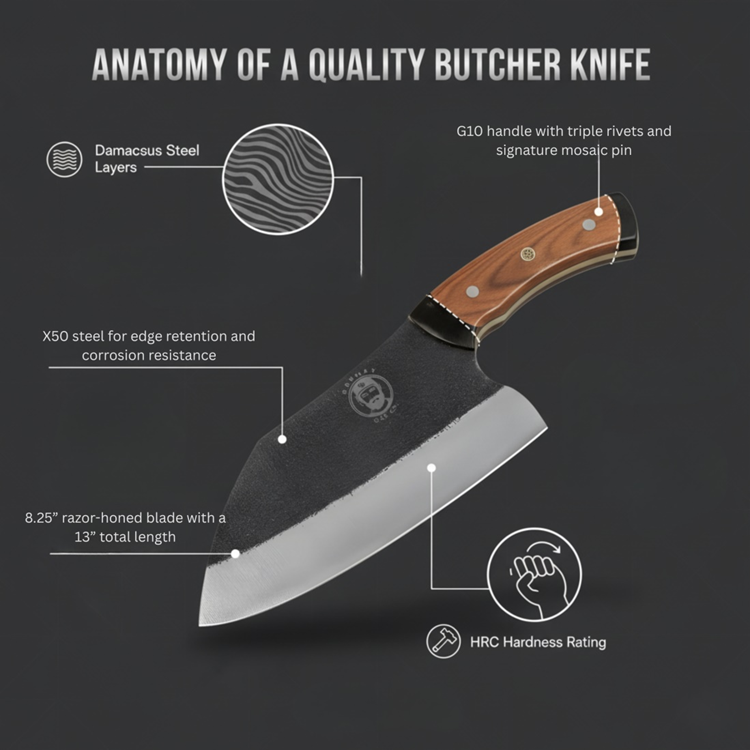
- “Damascus” patterns sold as edge performance. The pattern is decorative. The edge depends on the core steel. (Full breakdown in our Damascus vs Standard guide.)
How much should you spend?
| Tool | Honest Price | What It Does |
|---|---|---|
| Ceramic honing rod (10–12″) | $25–$45 | Daily edge maintenance, all knife types |
| Combo whetstone (1000/6000) | $30–$60 | Real sharpening, 1–4× per year |
| Cork sanding block (deburr) | $5 | Removes the burr after sharpening |
| Angle guide clip | $8 | Training wheels for whetstone angle |
| Mail-in pro service | $8–$15 per knife | Fallback when you’re behind |
Total: under $80 for a kit that handles every knife you’ll own for the next 20 years. Compare that to a single trip to a “premium sharpening service” that charges $30 a knife and ruins it on a belt grinder.
The Grumpy Dad workflow (the one I actually use)
- Hone before any serious cooking session — 5 strokes a side on the ceramic rod.
- Wash and dry the knife immediately after use. Do not put it in the dishwasher. I know you know. I’m telling you anyway.
- Test on paper monthly. If it tears, sharpen.
- Whetstone session every 3–4 months on the chef’s knife, every 6 on the paring, once a year on the bread knife (which I send out, because serrated is its own special hell).
- Block, strip, or in-drawer guard. Never loose in the drawer with the bottle opener.
That’s it. No shrine. No subscription service. No 47-piece sharpening rig.
When to send a knife to a pro
- The blade has visible chips you can feel with a fingernail.
- The tip snapped off (yes, you can break a knife — it happens to all of us).
- Serrated bread knife. Don’t try this at home.
- You inherited a knife older than you and don’t want to mess up the bevel angle.
- You hate sharpening. (Valid. Pay someone.)
For everything else: hone often, sharpen rarely, store smart.
If you only remember five things
- Honing realigns. Sharpening removes metal. They are not the same job.
- Most “dull” knives just need 10 seconds of honing.
- Ceramic rod beats steel rod for almost every modern knife.
- Whetstones are not as scary as the internet says. Two stones, one weekend, you’re fine.
- Pull-through sharpeners ruin good knives. Don’t.
FAQ
Can I hone a serrated knife?
No. The points and valleys need a tapered rod or a pro service. Don’t try to hone serrations on a flat steel — you’ll just round off the points and make it worse.
How do I know my whetstone angle is right?
Use a $6 angle guide for your first month. After that, the muscle memory kicks in. The marker trick (color the bevel with a Sharpie, take a few strokes, see where the marker disappeared) confirms whether you’re hitting the bevel or the shoulder.
Are honing rods the same as a “knife steel” or “butcher’s steel”?
Mostly yes. Different names, same job. “Butcher’s steel” usually has heavier grooves and is built for tougher European blades. Skip it for a Japanese knife.
My pull-through sharpener says it has a “honing slot.” Should I trust it?
No. Most “honing slots” on pull-throughs use ceramic discs at a fixed angle that may or may not match your knife. Either it’s grinding a different angle than your bevel (bad) or it’s barely doing anything (waste of time).
Should I oil my honing rod?
No. A clean dry rod is correct. Wipe it with a dry cloth after use to clear off micro-particles.
What if my knife is brand new — should I hone it before first use?
Usually no. A new knife has its factory edge aligned. Cook with it for a week first. Hone when it starts to drag, not before.
Can honing make a dull knife sharp again?
No. Honing only realigns an edge that’s still there but bent out of true. If the edge is actually rounded over or worn away, no amount of rod-waving brings it back — you need to sharpen and remove metal to expose fresh steel.
Does honing damage or wear out my knife?
A proper steel or ceramic rod removes essentially no metal, so honing is safe to do daily for years. Sharpening is what shortens blade life, because it grinds steel away — which is exactly why you hone often and sharpen rarely.
Steel rod or ceramic rod — which should I buy?
Ceramic, if you’re buying one. It safely realigns both soft stainless and hard Japanese steel (60+ HRC) without shocking a brittle edge, while a smooth steel rod is really only ideal for European blades. One ceramic rod covers an entire mixed knife block.
The Grumpy Dad Promise
Spend $30 on a ceramic rod. Spend ten seconds honing before serious cooking. Skip the gimmicks, the “self-sharpening” lies, and the urge to whetstone your knife every Sunday. Do that, and you’ll have sharper knives than 90% of home kitchens — including some that paid four figures for the privilege of dull blades and a fancy block.
Sharper knives mean faster prep, fewer accidents, and dinner that doesn’t feel like a wrestling match. That’s the whole point. Now put down the rod and go cook something.