Cutting Board Showdown: Wood, Plastic, Bamboo, Composite — What Won’t Wreck Your Edges (Or Your Dinner)

Most dads spend more on the knife than on the surface they cut on. Then they spend twenty minutes a week wondering why the knife dulled so fast. Plot twist: the board did it. The board has been quietly grinding your edge into mediocrity for years. It’s not the onion. It’s not the chicken. It’s the bamboo “eco-friendly” board your aunt gave you in 2019.
Cutting boards aren’t a passive accessory. They’re the second blade in the equation — every cut goes through the food and into the board surface. A soft, kind board absorbs the blade and protects the edge. A hard, abrasive board chews the edge with every chop. Same knife, two different lifespans depending entirely on what you’re cutting on.
This is the no-nonsense breakdown. Wood vs plastic vs bamboo vs composite. End-grain vs edge-grain. Why glass is a war crime. Which materials are safe for raw meat. How to retire a board before it makes your kitchen unsafe. And what to actually buy at every budget.
The 30-second answer
Best for your knife: end-grain hardwood (maple, walnut, cherry). Best for raw meat and easy cleanup: HDPE plastic. Best workflow: own both — wood for everything except raw meat, plastic for raw meat. Skip bamboo, skip glass, skip “marble cheese boards” pretending to be cutting boards. (If you’re still shopping for the knife that goes on top of all this, see our 2026 honest kitchen knife buying guide.)
Why the board affects your knife edge
Every cut transfers force through the food and into the board. The board has to absorb that force somewhere. Soft boards absorb it by deforming microscopically — fibers bend, then spring back. Hard boards refuse to deform, so the force gets transferred back into the edge of your knife.
Soft = blade glides, edge stays aligned.
Hard = blade hits a wall, edge rolls or chips.
The hardness scale (Janka rating, used for wood) gives you a rough order of edge-friendliness:
| Material | Hardness (relative) | Knife Friendliness |
|---|---|---|
| End-grain maple/walnut | Soft when struck end-on | Excellent |
| HDPE plastic | Soft and flexible | Excellent |
| Edge-grain hardwood | Medium | Good |
| Composite (Epicurean, Sani-Tuff) | Medium-firm | Good |
| Bamboo | Hard, full of silica | Bad |
| Acrylic | Very hard | Bad |
| Glass / marble / stone | Like a knife sharpener | Catastrophic |
Cut on glass once. Test the edge afterward on paper. The paper test (covered in our Honing vs Sharpening guide) will tell you immediately what just happened.
The five board categories (and the honest reality of each)
1) End-grain hardwood
End-grain boards are made by gluing the cut ends of the wood pieces together — so the cutting surface is the ends of the fibers, like the top of a butcher’s block. Knives slip between the fibers instead of cutting across them. Self-healing. Quiet. Beautiful. Heavy.
Wins: kindest surface for your knife, gorgeous, lasts decades, self-heals over time as fibers expand.
Losses: heavy (a 12×16″ board can weigh 6–10 lbs), expensive ($90–$300+), needs occasional oiling, splits if you put it through a dishwasher (which you should never do anyway).
Best species: hard maple is the workhorse. Walnut is similar performance with a darker look. Cherry is slightly softer (gentler on knives) and ages beautifully. If you want a ready-made example, our walnut end-grain board with juice groove checks every box here.
2) Edge-grain hardwood
Same wood species, but the cutting surface is the long-grain side. Cheaper to manufacture. The blade cuts across fibers instead of between them. Still very kind to knives — just not as kind as end-grain.
Wins: half the price of end-grain, lighter, still beautiful, gentle on edges.
Losses: shows knife marks faster than end-grain, won’t self-heal as well, slightly harder on your edge over years.
For 80% of home cooks, edge-grain hardwood at $40–$120 is the smart buy. You’ll never miss the difference.
3) HDPE plastic (high-density polyethylene)
The white or color-coded plastic boards used in restaurants and most home kitchens. Soft enough to be edge-friendly, dishwasher-safe, food-safe, cheap.
Wins: dishwasher-safe (kills bacteria), color-coded options (red for raw meat, green for veg, etc.), cheap ($15–$40), light, easy to replace.
Losses: shows deep knife grooves over time (which trap bacteria — see “when to retire a board” below), warps if left in direct sun or near a hot stove, looks utilitarian.
The HDPE truth most home cooks miss: for raw meat, HDPE is safer than wood. The dishwasher’s high heat sanitizes it more thoroughly than hand-washing wood. Use a dedicated HDPE board for raw chicken, beef, pork, and fish. Always.
4) Bamboo
Bamboo is sold as the “eco-friendly” choice and dominates the cheap end of the cutting board market. The truth: bamboo is the worst common material for your knife edge.
Why: bamboo is technically a grass, full of silica (microscopic glass-like fibers). The silica acts like very fine sandpaper on your knife edge. Every cut takes a tiny bite out of the edge. Multiply by hundreds of cuts. Your $200 chef’s knife dulls 2–3x faster than it would on hardwood.
Bamboo is also typically glued together with formaldehyde-based adhesives in cheaper boards (the bigger reason “eco-friendly” is misleading marketing). And it splits along the glue lines once it dries out.
Verdict: if you have a bamboo board you bought as a gift or for cheese display, fine — keep it for cheese. Don’t put a chef’s knife on it.
5) Composite (paper composite, rubber)
Two main types worth knowing:
Paper composite (Epicurean, Richlite): wood fibers fused with phenolic resin under heat and pressure. Looks like dark wood, dishwasher-safe, lighter than hardwood, harder than HDPE. Slightly more abrasive on edges than soft hardwood but gentler than bamboo.
Rubber (Sani-Tuff, Asahi rubber): Japanese-restaurant standard. Slightly soft, edge-friendly, NSF certified, stays flat, doesn’t absorb odors. Heavier than HDPE but knife-loving.
Composite is the “best of both worlds” category — wood-like aesthetic with plastic-like maintenance. The downside: paper composites are still harder than the softest wood, so they’re not the best for very fine Japanese knives with thin reactive steel. Rubber is excellent for everything but pricey ($80–$200).
End-grain vs edge-grain (the visual cheat sheet)
Stand a board on its side. Look at the side that isn’t the cutting surface.
- End-grain: the cutting surface looks like a checkerboard of small wood blocks. The grain runs vertically through the board. The side shows long horizontal lines.
- Edge-grain: the cutting surface shows long parallel wood strips. The grain runs along the length of the board.
Same wood, totally different performance. End-grain is the boutique-butcher-shop option. Edge-grain is the kitchen-store option. Both work; end-grain just lasts longer and treats your knife better.
The food safety question (the part everyone gets wrong)
For decades, the assumption was “wood = unsafe for raw meat, plastic = safe.” The science is more nuanced.
- Untreated wood has antimicrobial properties — surface bacteria die off as the wood absorbs and locks them in fibers, where they can’t reproduce. Studies (Cliver, UC Davis) have shown wood can be as safe or safer than plastic for raw meat in non-commercial settings.
- HDPE plastic is easier to sanitize (hot dishwasher, bleach). But once deeply scored with knife marks, those grooves trap bacteria below the reach of normal washing.
- Composite sits in between — easier to sanitize than wood, less knife-prone than HDPE.
The practical home rule:
- Use HDPE for raw meat, wash in dishwasher every time.
- Use wood for everything else (vegetables, cheese, bread, cooked food).
- Never use one board for both meat and ready-to-eat foods. Color-code if it helps.
When to retire a board (don’t wait)
Boards have a lifespan. Replace yours when:
- HDPE: deep grooves you can catch a fingernail in. Bacteria live in those grooves, dishwasher heat doesn’t reach them. Replace every 1–3 years for heavy users.
- Wood: deep splits along the glue lines, persistent dark stains that don’t sand out, cup or warp that makes the board rock. With proper care (oiling, no dishwasher, dry stored upright) wood boards last 10–20+ years.
- Bamboo: splits along the glue lines almost guaranteed within 2–4 years. Replace immediately when it splits — splinters in food are not a feature.
- Composite: 3–8 years. Watch for chipping at corners, warping, deep gouges.
If you’ve owned the same plastic cutting board for 8 years and it has more grooves than a vinyl record, please. It’s time. Replace it.
Care basics (the part that doubles board lifespan)
Wood boards
- Wash with hot soapy water, towel-dry, stand upright on edge to fully dry.
- Never submerge or soak. Never dishwasher.
- Oil monthly with food-grade mineral oil (or a beeswax/mineral oil paste). The oil keeps fibers from drying out and splitting. About 5 minutes of work, makes a 20-year difference. Our food-grade camellia oil for boards and blades pulls double duty here — conditions the wood and protects your knives too.
- Sand off persistent stains lightly with 220-grit sandpaper, re-oil, done.
HDPE plastic boards
- Dishwasher with the rest of the dishes. That’s it.
- If hand-washing, use hot water with bleach solution (1 tbsp bleach per gallon water) once a week, especially after raw meat.
- Keep flat or hang to dry. Don’t leave near a heat source.
Bamboo boards
- Don’t bother. If you must: hand-wash, dry immediately, oil monthly. Will still split.
Composite boards
- Most are dishwasher-safe (check manufacturer). Otherwise hot water and soap.
- No oiling needed.
Size matters more than people admit
The most common mistake: too small a board. You can’t break down a chicken on a 9×12 board. You can’t dice an onion comfortably without herbs and skins crowding off the edge.
| Board Size | Best Use |
|---|---|
| Under 12×9″ | Bread, cheese, fruit. Not real prep. |
| 12×16″ | Daily home cooking minimum. |
| 15×20″ | Comfortable for full meal prep. |
| 18×24″ | Holiday cooking, large proteins, serious home cooks. |
Bigger is also heavier. A 18×24″ end-grain walnut board can hit 14 lbs. Make sure your storage spot can handle the weight, and that you can lift it for cleaning.
Marketing traps in 2026
- “Self-healing antimicrobial bamboo.” Bamboo doesn’t self-heal. The “antimicrobial” claim is usually about a chemical coating that wears off in months.
- “Marble pastry board doubles as a cutting board.” Stop. Marble is harder than your knife steel. Use it for rolling pastry; never cut on it.
- “Glass cutting board with print pattern.” The pattern is decorative; the surface dulls knives in seconds. Use them as serving trays only.
- “Eco-friendly bamboo composite.” Bamboo glued with formaldehyde resin is not “eco-friendly.” It’s bamboo + plastic with marketing spin.
- “Reversible cutting boards” with juice grooves on one side. Useful, but the second side often becomes the “raw meat side” by default — defeating the color-coding logic. Pick one workflow.
- “Acrylic boards transparent design.” Hardness similar to glass, slightly softer but still terrible for edges.
The Grumpy Dad two-board system
Stop trying to find the one perfect board. The honest answer is two boards:
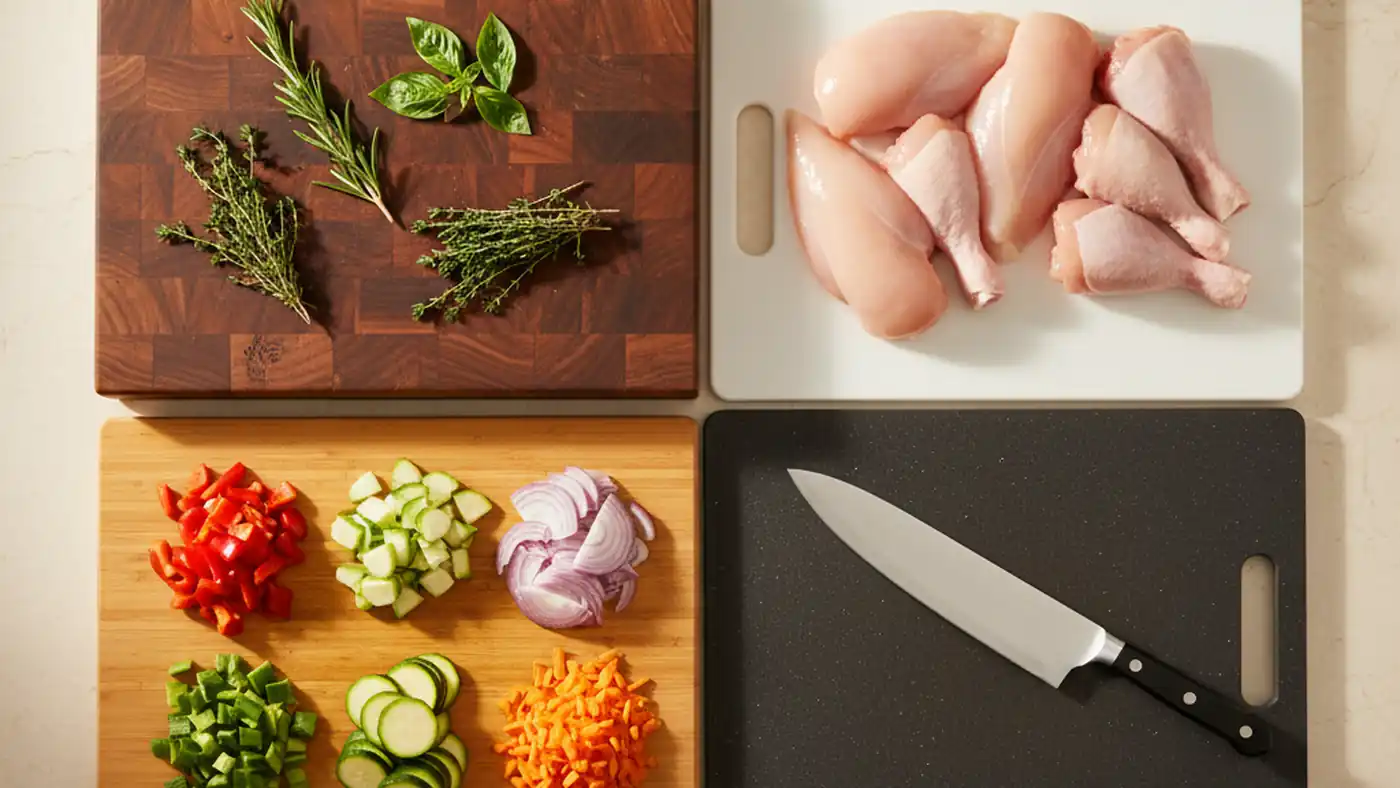
- One large edge-grain or end-grain hardwood board (15×20″, maple or walnut). Lives on the counter or hangs nearby. Every cut that isn’t raw meat goes here.
- One mid-size HDPE board (12×16″, red or another distinct color). Lives in a cabinet. Comes out for raw chicken, beef, pork, fish. Goes in the dishwasher after every use.
Total cost: $80–$180 depending on the wood. Lifespan: a decade or more for the wood, 1–3 years for the HDPE. Knife edge: protected. Food safety: handled.
This is the system most professional kitchens use, scaled down. It works.
Mistakes that ruin both knives and boards
- Cutting on a wet board (slippery, more dangerous, edge contact uneven).
- Putting a wood board in the dishwasher (it splits within 2 cycles).
- Cutting hard squash on a thin/light wood board (it’ll warp from sustained pressure on one side).
- Cleaning a wood board with a soaking-wet sponge then leaving it flat to dry. Fibers absorb water unevenly. Cup, crack, end of board.
- Storing a board flat against a wall in a humid kitchen. Mold lives there. Stand boards upright on edge.
- Using the same single board for raw chicken and salad greens. The bacteria don’t take a break between cuts.
If you only remember five things
- Wood (end-grain or edge-grain) is best for your knife. Bamboo is the silent killer.
- HDPE plastic is best for raw meat. Dishwasher every time.
- Glass, marble, and acrylic boards destroy edges. Don’t.
- Oil wood boards monthly. Adds 10+ years to their life. (The same habits that protect your board protect your blade — our carbon steel knife care guide covers the full routine.)
- Replace HDPE every 1–3 years when grooves get deep. Bacteria live there.
FAQ
Is teak as good as maple or walnut?
Teak is decent but harder than soft maple, and the natural oils in teak make oiling tricky (some products don’t absorb). Fine for occasional use; not the smart first choice. Maple, walnut, cherry, or beech are the standard recommendations.
What about acacia wood boards from big-box stores?
Acacia is hard but not as hard as maple — actually edge-friendly. Quality varies wildly. Cheap acacia boards are often softwood-glued with thin acacia veneers; real acacia hardwood boards are good. Look for solid hardwood, not “acacia veneer.”
Should I season a new wood board?
Yes. Apply 2–3 coats of food-grade mineral oil over a few days, letting each soak in fully. Then a beeswax-mineral-oil board cream once a month for the first six months, monthly thereafter.
Can I use one wooden board for raw meat if I sanitize properly?
You can — wood has natural antimicrobial properties — but it’s harder to sanitize fully than HDPE. For home cooks, the two-board system is simpler and safer. For pros with proper sanitization protocols, wood for everything works.
Is OXO Good Grips composite as good as Epicurean?
Similar category. OXO is more affordable, slightly thinner, replaces faster. Epicurean is the original and lasts longer. Both are solid composites; pick by price and aesthetic preference.
Can I sand and refinish an old wood board?
Yes — and you should, every few years for heavy users. Use 120-grit, then 220-grit sandpaper. Wipe clean. Re-oil generously. The board comes back to almost-new condition. Just don’t sand off the manufacturer’s juice groove if it has one.
Do “cutting board feet” matter?
Rubber feet keep the board from sliding (good) but trap moisture under the feet (bad over years). For wood, prefer flat boards on a damp dish towel for grip. For HDPE, feet are fine.
The Grumpy Dad Promise
Get the right board. One nice wood, one cheap plastic. Skip bamboo. Skip glass. Oil the wood once a month. Replace the plastic when it gets ravine-y. Do that, and your knife edges will last 3x longer, your raw chicken won’t cross-contaminate, and you’ll stop blaming the onions for everything.
The board is half the cutting team. Treat it like a tool, not a wedding gift you’re afraid to ruin. Now go make dinner on something that respects the knife.