The Santoku Knife: What It Is and Whether You Need One

The santoku is the most popular kitchen knife in Japan and one of the most misunderstood in the West.
In Japanese kitchen stores, the santoku is the default knife — the one most home cooks reach for, the one most commonly sold, the one that does the everyday work. In Western kitchen stores, it’s marketed as a specialty item with vague claims about its “three virtues” (the literal translation of “santoku”) and compared favorably to a chef’s knife in a way that often confuses rather than clarifies.
Here’s the clear version: what a santoku is, what it does, and whether it belongs in your kitchen.
What “Santoku” Means
San = three. Toku = virtues or uses. The three are typically described as: meat, fish, and vegetables — the three main categories of kitchen prep work. The name is a marketing description of versatility, not a technical specification.
Don’t read too much into it. It means “multi-purpose kitchen knife.” That’s it.
The Profile: What Makes It Distinct
A santoku has three immediately visible differences from a Western chef’s knife:
Shorter length: Most santoku run 165mm to 180mm (6.5″ to 7″). A standard Western chef’s knife runs 200mm to 250mm (8″ to 10″). The santoku is more compact — more maneuverable, lower leverage on harder tasks.
Flatter belly: The chef’s knife has a curved belly designed for rocking cuts. The santoku has significantly less curve — almost flat along the middle and slightly curved at the heel. It’s designed for push cuts or up-and-down chops, not the rock.
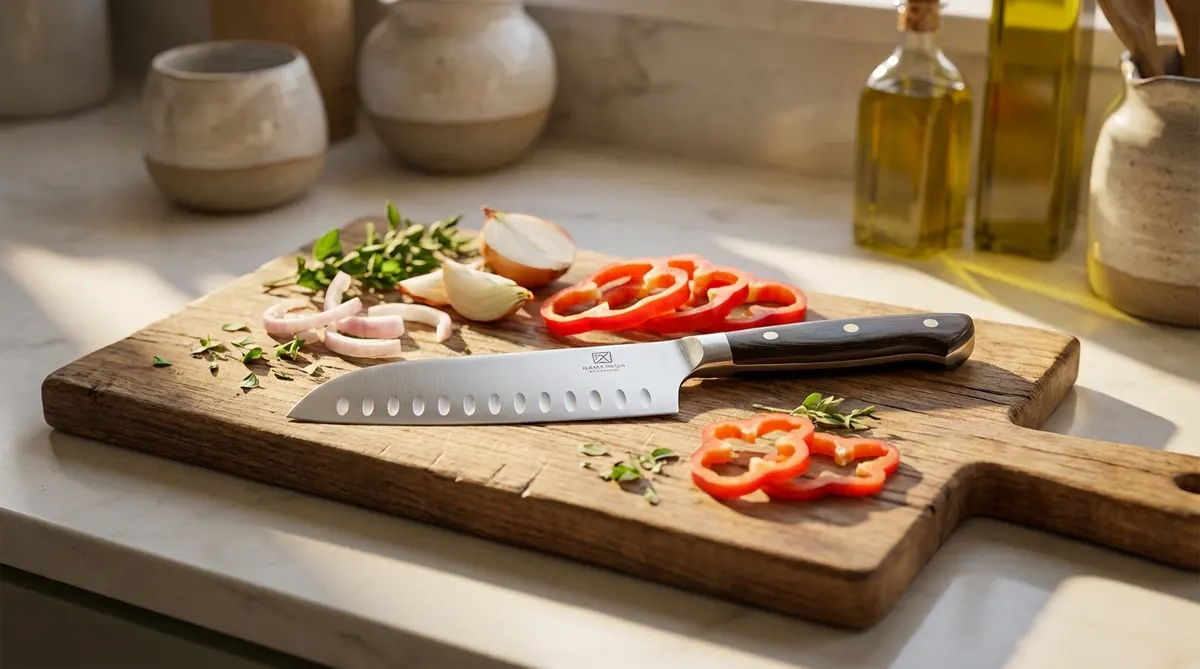
Sheep’s foot tip: The spine of a santoku drops steeply at the front end, meeting the edge at an almost straight angle. This blunted tip is safe and useful for push-cut work but limits the precise tip work that a chef’s knife’s pointed tip allows.
Dimples (hollow edge / Granton edge): Many santoku knives have oval dimples along the blade. These create small air pockets that prevent thin slices from sticking to the blade — useful for high-volume slicing of soft foods. Not all santoku have them; it’s a feature, not a defining characteristic.
What It Does Well
High-volume vegetable prep: The flat profile and compact size make the santoku efficient for push-cut work through produce. It doesn’t do what a dedicated nakiri does — it doesn’t have the nakiri’s full flat edge, tall blade, or maximum clearance for knuckle safety — but it handles most vegetable tasks well.
Slicing fish and boneless proteins: The shorter length gives more control over thin, even slices. For sashimi preparation, fish fillets, or any delicate slicing task, the compact santoku is easier to control than an 8-inch chef’s knife.
Smaller hands and smaller kitchens: The santoku is the right knife for someone who finds an 8-inch chef’s knife unwieldy — physically uncomfortable or hard to control in a small prep space. Compact, light, responsive.
Experienced Japanese home cooks: In Japan, the santoku is what most home cooks know. If you learned to cook in a Japanese kitchen, the santoku’s profile is intuitive. Push cuts, up-and-down chops, comfortable blade length.
What It Does Less Well
Heavy breakdown work: Butternut squash, large root vegetables, hard kabocha — the shorter blade and lighter weight of a santoku are at a disadvantage here compared to a longer chef’s knife with more leverage.
Tip work: The sheep’s foot tip is blunted. Scoring proteins, working around bones, fine point work — these tasks are harder on a santoku than on a chef’s knife or bunka with a defined tip.
Long slicing: Breaking down a large piece of salmon fillet or slicing a long log of sushi roll is less efficient on a short blade. The santoku needs more passes to cover the same length.
Santoku vs Chef’s Knife: The Honest Comparison
Neither is better. They’re optimized for different hands and different techniques.
If you learned to cook using a rocking cut, primarily make Western-style meals, and work with a lot of mixed tasks including protein and bread: chef’s knife.
If you push-cut rather than rock, work primarily with vegetables and fish, have smaller hands or a smaller workspace, or simply find a shorter blade more comfortable: santoku.
If you’re buying your first serious kitchen knife and aren’t sure which technique you prefer: buy the chef’s knife. It’s more versatile for a wider range of cooking contexts in a Western kitchen, and it’s easier to learn general knife skills on. A santoku as a second knife makes more sense than a santoku as the only knife.
The Quality Question
A quality santoku is built the same way a quality chef’s knife is: hard steel (60+ HRC for Japanese variants), thin behind the edge, proper balance, full tang construction.
The santoku market at the lower end is flooded with knives that look right but aren’t — thick behind the edge, soft steel that dulls quickly, handles that loosen over time. The same evaluation applies as for any knife: look for a specified steel, a disclosed HRC rating, and geometry that actually produces thin, even cuts rather than pushing through food.
The Grumpy Dad Japanese knife catalog — including the Yoshida Hamono Nakiri and the Hand-Forged Kurumi Shikaku Bunka — is built to this standard. A santoku with the same construction principles would earn its place in the lineup. A santoku built to look like one wouldn’t.
The Bottom Line
The santoku is a legitimate, versatile knife for the home cook who pushes rather than rocks, prefers a compact blade, and does a lot of vegetable and fish work.
It is not a superior alternative to a chef’s knife for everyone. It’s the right knife for the right kitchen and the right hands.
Know which one that is before buying. If you’ve read this far, you probably do.
Grumpy Dad Co. — The right knife for the right cook.
Browse the full Japanese knife collection at grumpydadco.com