Slicing vs Carving Knife: Brisket, Turkey, and the Right Edge for the Job

You spent 12 hours smoking a brisket. You let it rest properly. You set up a board, called the family in, picked up your chef’s knife to slice… and ended up with an inch-thick wedge on one end and meat shavings on the other. The slices look like they were cut by someone with a grudge against geometry. The bark falls off. The brisket looks worse than it cooked.
Welcome to the wrong-knife problem. The chef’s knife is great for prep. It’s the wrong tool for slicing finished meat. Long, even slices through brisket, prime rib, ham, turkey, or pork loin require a long, thin, smooth-edged blade — the slicing knife or carving knife. Two specific knives that 90% of American home cooks don’t own, then are confused why their dinner doesn’t look like the picture.
This is the no-nonsense breakdown. The difference between slicing and carving knives. What “Granton edge” actually does (and the marketing that misuses the term). Length, flexibility, and edge profile decisions. Why this is the most under-purchased knife in barbecue households. And how to slice meat without making it look sad.
The 30-second answer
Slicing knife: long (10–14″), thin, narrow, straight edge, often with Granton hollow-ground dimples. For brisket, prime rib, large smoked meats. Carving knife: shorter (8–12″), wider, often pointed for working around bones. For turkey, ham, roast chicken. For most home cooks who do barbecue: a 12″ Granton-edge slicing knife is the under-rated game changer — $40–$120 and it transforms how meat looks on the table.
The two knives, what each one does
Slicing knife (also called “slicer”)
Long, thin, narrow blade — typically 10–14″ long, 1–1.5″ wide at the heel. Straight or barely curved edge profile. Sharp pointed tip. Designed for one job: long, even slices through finished meat.
The length lets you slice a full brisket flat in one motion. The thin profile reduces friction so the meat doesn’t stick. The narrow blade keeps your hand and knuckle clearance manageable. The sharp tip helps with starting cuts at edges.
Best for: brisket (the iconic application), pork shoulder, beef roasts, large hams, large smoked meats, prime rib.
Carving knife
Shorter than a slicer (8–12″), wider, often with a more pronounced point. Designed for navigating around bones — turkey, chicken, bone-in roasts.
The shorter length gives more control. The wider profile gives stability. The pointed tip works around joints and along bones.
Best for: whole turkey, whole chicken (after cooking), bone-in ham, leg of lamb, anything with bones to navigate.
Side-by-side comparison
| Feature | Slicing Knife | Carving Knife |
|---|---|---|
| Typical length | 10–14″ | 8–12″ |
| Width | Narrow (1–1.5″) | Wider (1.5–2″) |
| Edge | Straight, often Granton | Slight curve, often pointed |
| Best for | Boneless large cuts | Bone-in cuts |
| Brisket | Excellent | Workable |
| Turkey | Workable | Excellent |
| Prime rib (boneless) | Excellent | Good |
| Prime rib (bone-in) | Awkward around bone | Better |
| Ham (whole) | Excellent | Good |
| Roast chicken | Too long, awkward | Better fit |
| Typical price | $40–$200 | $40–$180 |
What “Granton edge” actually does
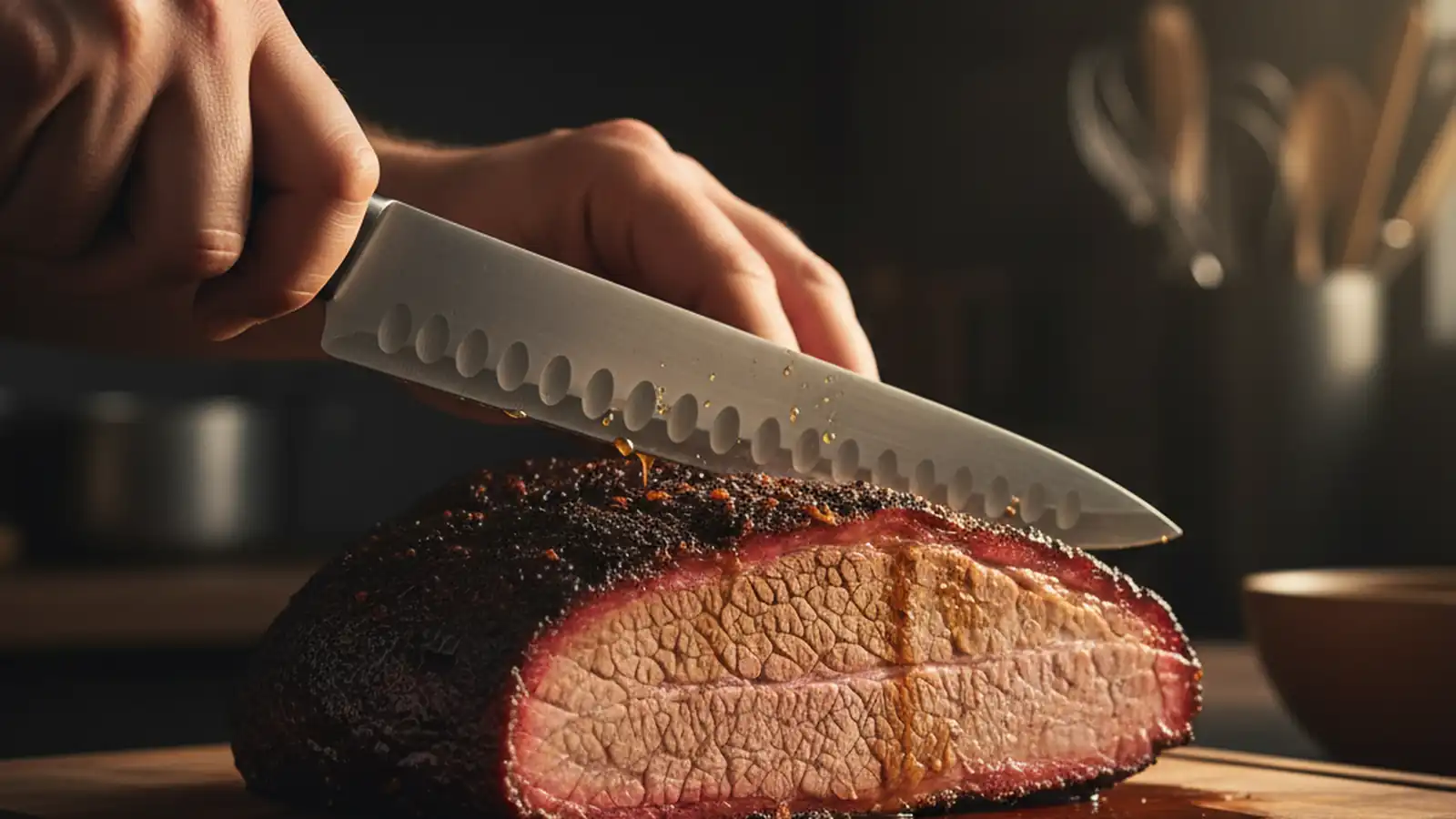
Granton edge (also called “hollow-ground” or “scalloped”) refers to oval depressions (“dimples”) ground into the side of the blade. Most slicing knives have them. Most carving knives don’t.
The purpose: as the blade slices through meat, the dimples trap small air pockets between the blade and the meat surface. The air reduces surface tension that would normally make the meat stick to the blade. Result: meat releases more cleanly, slices stay flat instead of curling onto the blade.
Granton works best on:
- Wet, sticky meats (smoked brisket, prime rib).
- Long slices where the blade is in extended contact with the meat surface.
Granton works less well on:
- Dry meats (jerky, dry-cured ham).
- Short slices where the blade is in brief contact.
- Vegetables (the dimples are designed for protein surface tension, not vegetable cellular release).
Marketing trap: some manufacturers add Granton dimples to chef’s knives, paring knives, and santoku for marketing reasons. The dimples don’t help much on those shapes. They’re real on slicing knives; mostly cosmetic on others.
Length: the most important spec
For slicing knives, length matters more than steel quality.
| Length | Best For |
|---|---|
| 9–10″ | Pork loins, smaller roasts, single-portion meats |
| 11–12″ | The “default” slicer — covers brisket flats, smaller briskets, hams, prime rib |
| 12–14″ | Full packer briskets, large hams, restaurant-style roasts |
| 14″+ | Restaurant-only, awkward in home kitchens |
The rule: blade length should equal or exceed the longest dimension of the meat plus 2 inches. A 16-inch brisket needs a 12-inch blade minimum, 14-inch ideal. A short blade means multiple back-and-forth motions per slice — which damages the meat fibers and produces uneven slices.
For most home cooks: 12-inch slicing knife is the smart default. Long enough for brisket, short enough for storage and counter manageability.
Stiff vs flexible
Stiff slicing knives
Most slicers are stiff or semi-stiff. Easier to control through dense meat, more accurate slice thickness, won’t bend in mid-cut.
Flexible slicing knives
Some slicers (often labeled “flexible” or “salmon slicer”) have noticeable flex. Useful for very thin slicing of fish (lox, gravlax) or for deboning tasks. Less common in barbecue applications.
For most home cooks: stiff is the right answer. Flexible slicers are a specialty for fish-focused cooks.
Handle and balance
Slicing motions are long, slow, and deliberate. Hand fatigue matters more than for fast prep work.
- Western riveted full-tang: standard. Comfortable for the long pulling-and-pushing motion.
- Polypropylene molded: Mercer Millennia, Victorinox. Cheaper, durable, good for high-volume use.
- Wa-handle (Japanese octagonal): often found on sujihiki (Japanese slicer). Lighter feel, less knuckle clearance for thicker meats.
Try the knife in hand if possible. The slicing motion is sustained — discomfort that’s mild in 10 seconds becomes fatiguing in 5 minutes.
The Grumpy Dad recommendation by use case
“I smoke brisket and prime rib regularly”
12″ slicing knife with Granton edge. Mercer Millennia 12″ ($40), Victorinox Fibrox 12″ ($45), or Wüsthof Classic 12″ ($150). The Mercer is restaurant-grade and the smart budget pick.
“I do Thanksgiving turkey every year”
10″ carving knife and matching fork. Wüsthof Classic Carving Set ($180) or Mercer Renaissance Carving Knife ($60). The fork matters here — stabilizes the bird while you slice.
“I want one knife to cover both”
10″ Granton slicer. Compromise on each end (slightly short for brisket, slightly long for turkey) but versatile. Mercer 10″ ($35) or Wüsthof Classic 10″ ($110).
“I’m a sushi person and want a Japanese option”
Sujihiki (Japanese slicer), 240–270mm. Tojiro DP Sujihiki ($120), Mac Pro Sujihiki ($170). Beautiful, narrow, sharp Japanese blade for elegant slicing. Not as friendly to brisket as a Western Granton slicer.
“I just want to know what to put on my Christmas list”
Mercer Millennia 12″ Granton slicer at $40. Best dollar-per-performance ratio in this category. Lasts 10+ years with care.
How to actually slice meat correctly
The technique matters as much as the knife.
For brisket
- Identify the grain. The flat runs one direction; the point usually runs perpendicular. Look at the muscle fiber lines.
- Slice against the grain. Always. Slicing with the grain produces tough chewy strips.
- Pencil-thick slices (1/4″). Thinner falls apart; thicker tastes underdone in the middle.
- Use the full length of the blade in a long pull-back motion, then a long push-forward. Don’t saw.
- Let the knife do the work. Pressing down hard squashes the meat and ruins slice geometry.
For turkey
- Remove the legs first. Cut through the skin between thigh and breast, find the joint, pop it.
- Remove the breast halves. Cut along the keel bone (top), then along the breast bone (side), peel each breast off.
- Slice the breast meat into thin slices on a board, against the grain.
- Separate thigh from drumstick at the joint. Slice the thigh meat off the bone.
For prime rib
- If bone-in: separate the bones from the rib roast first (run the knife along the bones).
- Slice across the grain into 1/2″ to 3/4″ slices.
- Use long full-blade pulls. Don’t see-saw.
For ham
- Boneless ham: slice straight through, against the grain, pencil-thick.
- Bone-in ham: cut a wedge first to access the meat, then slice parallel to the bone, working around it.
The board matters too
Slicing requires a stable, large surface. Most home cutting boards are too small for a brisket.
- Minimum board size for brisket: 18″ × 24″. A 14″ × 18″ can work but barely.
- Material: end-grain hardwood is the kindest to your knife edge (covered in our Cutting Board Showdown). HDPE plastic also works and is dishwasher-safe for clean-up.
- Juice groove: for slicing meat, the groove around the edge catches drippings instead of letting them run onto the counter. Worth having on a dedicated carving board.
- Stable. Place a damp towel under the board to prevent slipping during slicing motions.
A small board is the silent enemy of good-looking sliced meat. The brisket overhangs, the slices fall off the edge, and you end up cramming the next slice into too little space.
Care and sharpening
Slicing knives have a long thin blade with a narrow profile — both blessings and curses for maintenance.
- Hand-wash, towel dry, store properly. Same rules as any quality knife. (See Knife in the Dishwasher.)
- Storage challenges: the long blade doesn’t fit most knife blocks. Magnetic strip is the best storage. Drawer organizer with sleeves works if your drawer is deep enough. Saya for premium Japanese sujihiki.
- Sharpening: the long blade requires a long whetstone or careful work in sections. Pull-through sharpeners damage Granton edges (they grind off the dimples). Whetstone or pro service.
- Granton care: the dimples can collect water and food residue. Clean carefully with a soft brush. Don’t worry about polishing them — they’re functional, not cosmetic.
- Honing: ceramic rod for Japanese-style slicers, steel rod for Western. Hone before each major slicing session.
Marketing traps to avoid
- “Universal slicing/carving knife.” The two have different optimal designs. A “universal” version compromises both. Pick the right tool for what you cook most.
- “Granton edge for vegetables.” The dimples don’t help on vegetables — they’re designed for protein surface tension. A Granton chef’s knife is mostly marketing.
- “Damascus slicing knife” at premium prices. The pattern doesn’t help slicing performance. The cladding can break up around the dimples and look worse than plain steel after a few years.
- “Self-sharpening slicing knife.” No such thing for any knife type. Skip.
- “Slicing knife and carving knife combo set under $40.” Too cheap for two real knives. Usually two stamped plastic-handle knives that dull in months.
Common mistakes
- Using a chef’s knife to slice brisket. Too short, too curved, too wide. Result: uneven slices, torn fibers.
- Using a serrated bread knife on meat. The teeth tear meat fibers instead of slicing them. (See our Bread Knife Buyers Guide.)
- Slicing with the grain. Tough chewing texture even on perfectly cooked meat.
- Slicing without resting first. Juices run out, meat loses moisture, texture suffers.
- Slicing too thick or too thin. Too thick: dense, chewy. Too thin: falls apart, dries out fast on the plate.
- Pressing too hard. Squashes the meat. Let the long blade do the work — gravity and the edge do most of the cutting.
- Using a tiny board. Constraints lead to short choppy motions instead of long smooth ones.
The “do you actually need one?” question
If your barbecue is a Saturday burger and the occasional pork shoulder, a slicing knife is probably unnecessary. A 10″ chef’s knife will handle pork shoulder slicing well enough.
If you smoke brisket, prime rib, or large roasts more than 3–4 times a year, the slicing knife is genuinely worth it. The slice quality difference is visible, the meat looks better, and the per-cook satisfaction is real.
For Thanksgiving turkey alone — once a year — a chef’s knife handles it adequately. A dedicated carving knife is nice but not essential for once-a-year use. Buy if you host bigger holiday meals or break down birds frequently.
If you only remember five things
- Slicing knife = boneless large cuts. Carving knife = bone-in cuts. Different tools.
- Length should exceed the meat’s longest dimension by 2+ inches.
- Granton edge helps with sticky meat release. Doesn’t help on vegetables.
- Always slice against the grain. Always.
- The cutting board needs to be big enough. Small boards ruin good knives’ work.
FAQ
Can I slice brisket with a chef’s knife in a pinch?
Yes — slice carefully, take your time, accept that the slices won’t be as even. The 8″ length means each slice requires multiple passes, which damages fibers. The result is workable but not pretty.
What’s a sujihiki?
The Japanese slicing knife. Long (240–300mm), narrow, sharp tip, traditional handle (wa-handle) or Western handle. Functionally similar to a Western slicer but with thinner blade and harder steel. Beautiful for sliced fish or thinly sliced meat. Less ideal for full-brisket work — the narrow profile means less knuckle clearance.
Granton vs traditional smooth slicing edge — which is better?
For wet, smoked meats: Granton wins by a small margin. For dry meats and general slicing: smooth and Granton perform similarly. The Granton advantage is real but smaller than the marketing implies.
Is a 14″ slicer overkill for home use?
For most home cooks, yes. 14″ excels at full-packer briskets and pro-kitchen use. 12″ handles 95% of home barbecue. 10″ is the daily-driver compromise.
Should I get a slicing knife or a sujihiki?
Slicer (Western Granton) for barbecue and large hot proteins. Sujihiki for thin elegant slicing of fish, sushi, or premium proteins. Both for someone obsessed with this category.
How do I sharpen a Granton-edge slicing knife?
Same as any straight-edged knife — whetstone, matched bevel angle, alternating sides. The Granton dimples don’t change the sharpening process; you sharpen the cutting edge, not the dimples themselves. Pull-through sharpeners can damage the dimples, so avoid them.
Can I use a fillet knife as a slicing knife?
For fish, yes. For brisket, no — fillet knives are too flexible and too short for large meats.
The Grumpy Dad Promise
Spend $40 on a 12″ Mercer Millennia Granton slicing knife. Use it on the next brisket, prime rib, or large smoked meat. Watch the slices come off looking like restaurant work — even thickness, full-length pulls, clean release from the blade.
This is the most under-purchased knife in barbecue households. Real difference in result quality, modest cost, lasts a decade with care. Now go slice something properly. Your meat earned a real knife.