Why Your Knife Smells Weird (And What to Actually Do About It)

You wash the knife. You dry it. You put it away. The next time you pull it out, it smells like the fish you cut three days ago. Or there’s a faint metallic note. Or the whole kitchen has a sour funk that you traced back to the knife block. You’re not imagining it. The smell is real, and it’s quietly transferring to whatever you cut next.
Most home cooks notice the smell, accept it as “knife smell,” and move on. They probably also notice that the cucumber tastes weirdly metallic, or the apples taste faintly of last week’s onions, or the bread feels like it picked up something off the cutting board. The smell isn’t just a smell — it’s a flavor problem that travels.
Here’s what nobody at the kitchen-store tells you: knives shouldn’t smell like anything when you pull them out of storage. The smell is a signal that something specific is happening — and almost all of it is fixable in 5 minutes with stuff you already own. This is the no-nonsense breakdown.
The 30-second answer
Most knife smells come from one of five causes: trapped food residue at the bolster, mold in a wood block, oxidation on carbon steel, soap film, or contamination from where the knife is stored. The fix for 90% of cases: deep clean the knife and its storage, dry thoroughly, store smarter. Five minutes, no new purchases. The remaining 10% indicate a real problem (rust pitting, damaged handle) that needs more attention.
The five real causes of weird knife smells
1) Bolster gunk (the most common cause)
Where the blade meets the handle, there’s a tiny seam — almost invisible, but always there. Food, water, soap, and microscopic kitchen debris find their way into this seam. Over weeks and months, it accumulates. In wood handles, it gets absorbed. In riveted handles, it builds up at the rivet edges.
The result: a small reservoir of decomposing organic matter sitting on your knife. Smells fishy, sour, or musty depending on what got in there.
Quick test: hold the knife close to your nose at the bolster area specifically. If the smell is strongest there, this is the culprit.
2) Wood block mold and microbial growth
Wood knife blocks have vertical slots you can’t reach to clean. Wet knives go in. Water settles at the bottom of the slot. Without airflow, mold grows. The mold doesn’t smell strong directly, but every knife pulled from that slot picks up the smell.
This is also a hygiene issue covered in our Knife Storage 101 guide. The block is the source; the knives are messengers.
Quick test: smell the block itself. Tap it upside down over a sink. Anything beyond fresh-wood smell means cleaning is overdue.
3) Carbon steel oxidation and patina chemistry
Carbon steel knives develop a patina — a controlled blue-gray oxidation layer that protects the steel underneath. The patina itself doesn’t smell. But uncontrolled oxidation (especially around water spots or under accumulated residue) can produce a faint metallic odor.
Reactive foods (onions, garlic, citrus, tomatoes) on carbon steel produce a temporary metallic smell during cutting that transfers to the food. This is why traditional Japanese sushi chefs avoid cutting tomatoes with carbon yanagiba blades — the smell affects flavor.
Quick test: if the metallic smell only appears after cutting acidic foods, this is normal carbon steel chemistry. If it’s persistent, the patina may be uneven or developing into actual rust spots.
4) Soap film buildup
Most home cooks soap-up the knife, rinse briefly, and dry. Some soap residue stays on the blade. Over time, soap film accumulates — especially in the dimples of Granton edges and along the spine.
The smell is faint but present: chemical, slightly perfumed, sometimes “chemically clean” in a way that interferes with food flavor.
Quick test: smell the blade after rinsing but before drying. If there’s a chemical or perfumed scent, soap residue is sitting on it.
5) Storage contamination
The knife smells like its environment. If it lives in a drawer with a moldy sponge, it smells moldy. If it’s in a magnetic strip near the stove vent, it picks up cooking grease aromas. If the dishtowel it’s stored next to has been in there for weeks, it smells like that dishtowel.
Quick test: move the knife to a completely different storage location for 48 hours. If the smell goes away, the storage was the source.
The 5-minute deep clean (handles 90% of cases)
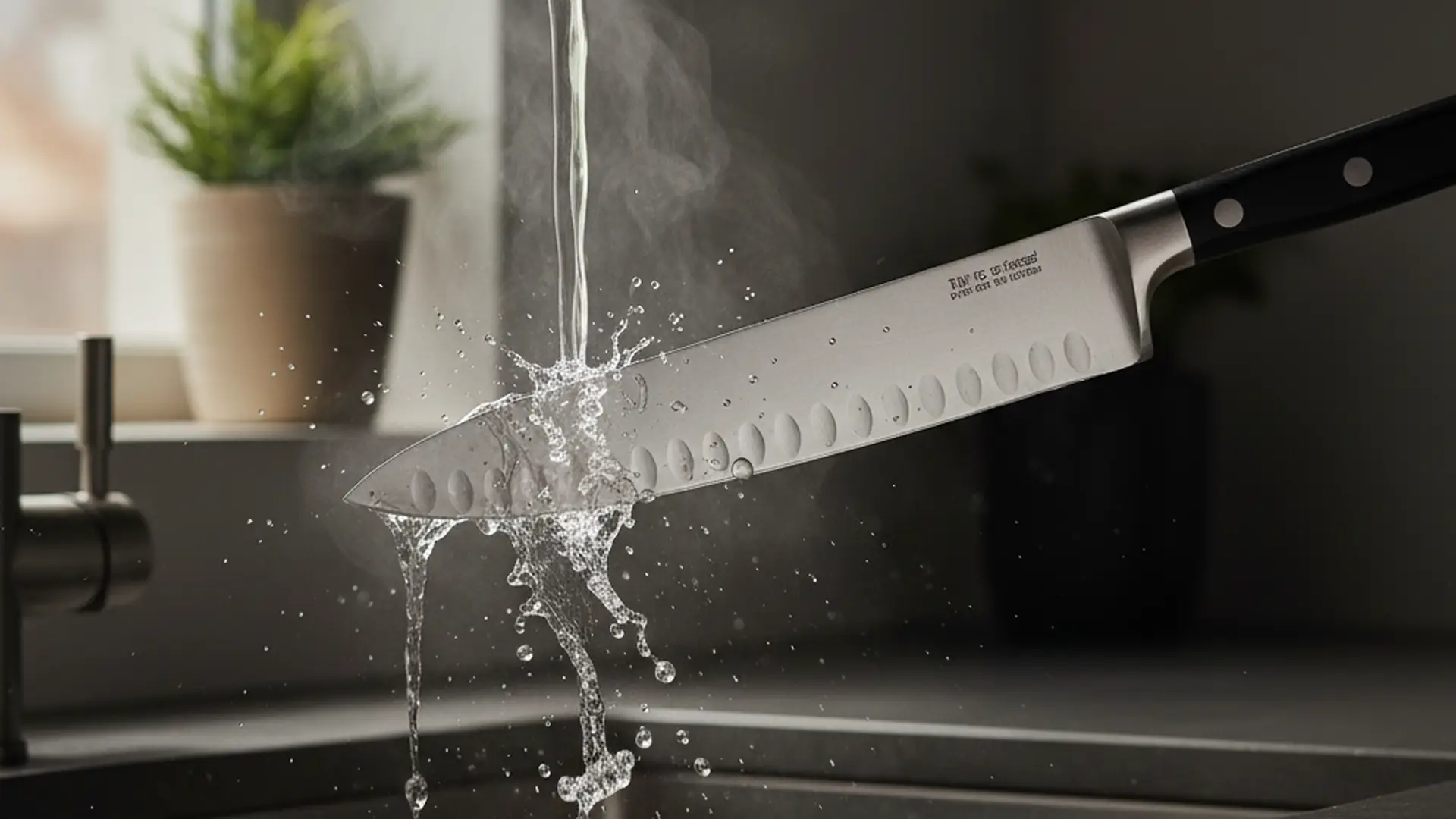
- Hot water rinse. Run very hot water over the entire knife for 30 seconds.
- Soap and soft brush. A small amount of dish soap, soft-bristle brush (an old toothbrush works). Pay specific attention to:
- The bolster seam (where blade meets handle).
- The underside of the blade where it meets the handle.
- Around any rivets.
- The base of the handle.
- Rinse very thoroughly. Make sure all soap is gone — under hot running water for at least 20 seconds.
- Dry immediately and completely. Towel dry the blade. Then stand the knife handle-down on a towel for 5 minutes to let any remaining moisture wick out of the seams.
- Smell test. If clean, you’re done. If smell persists, move to deeper cleaning.
For most home cooks, this routine done once eliminates the smell and prevents return for months. Repeat as part of your normal washing — the bolster brush takes 10 extra seconds per wash.
The deeper clean (for stubborn smells)
If the 5-minute clean doesn’t fix it, escalate.
Baking soda paste
2 tablespoons baking soda + enough water to make a thick paste. Apply to the entire knife (especially bolster). Let sit 5 minutes. Scrub with soft brush. Rinse. Dry. Baking soda neutralizes most organic smells (fish, garlic, sulfur compounds).
Vinegar wipe
White vinegar on a soft cloth. Wipe the entire blade and handle thoroughly. Let sit 30 seconds. Rinse with warm water. Dry. The acidity dissolves mineral deposits and kills surface bacteria.
Caution: don’t soak the knife in vinegar, especially carbon steel. Surface contact for short duration only.
Lemon juice and salt
Cut a lemon in half. Sprinkle salt on the cut surface. Rub the lemon along the blade and handle, including the bolster seam. The salt acts as gentle abrasive; the lemon acid breaks down residue. Rinse, dry.
Bonus: this also brightens stainless steel and removes light water spots.
Rubbing alcohol
Isopropyl alcohol on a soft cloth. Wipe the entire knife. Evaporates quickly, leaves no residue, kills surface microorganisms. Useful for handles especially — wood, polymer, riveted styles all respond well.
Cleaning the storage (the second half of the fix)
If the knife is the messenger, the storage is the source. Clean the storage too.
Wood knife blocks
- Empty all knives.
- Tap upside down over a sink — debris falls out.
- Use a long thin bottle brush or pipe cleaner to scrub the inside of each slot.
- Mix a solution of 1 tablespoon white vinegar + 1 cup hot water. Squeeze a small amount into each slot using a syringe or spray bottle.
- Tap upside down again to drain.
- Sun-dry for 4–6 hours if possible. Otherwise, position upside down with airflow for 24 hours.
- Once fully dry, knives go back in.
Magnetic strips
- Wipe with damp cloth + dish soap.
- Wipe again with vinegar solution.
- Dry with clean cloth.
- Done. Magnetic strips are the easiest storage to maintain.
In-drawer organizers
- Empty all knives.
- Remove organizer from drawer.
- Hand-wash with hot soapy water (most are not dishwasher safe — check manufacturer).
- Dry thoroughly before returning to drawer.
- Wipe the drawer interior at the same time.
Sayas (wooden knife sheaths)
- Wipe inside with a dry cloth.
- Don’t soak or wash with water — wood sayas are unfinished inside and absorb moisture.
- If actively moldy: wipe with a vinegar-dampened cloth, dry thoroughly in sun for several hours, then resume use.
Specific smell fixes
Fish smell
Lemon + salt rub on the blade. Or baking soda paste. Both neutralize amines (the chemical compounds responsible for fishy smells). Rinse and dry. The smell should be gone immediately.
Onion or garlic smell
Stainless steel against running water — yes, the knife itself can be the deodorizer. Rub the blade under cold running water. The sulfur compounds bind to the steel and rinse away. Dry, smell-check.
Sour or fermented smell
This is usually trapped food residue beginning to rot. Aggressive cleaning with baking soda paste at the bolster, then vinegar wipe, then alcohol wipe. The smell should diminish noticeably after each step.
Metallic smell that won’t go away
If on carbon steel: re-establish the patina. Cut an onion or potato (no need to eat afterward — it’s a sacrificial vegetable). The acidic juice helps reset the patina. Wipe, oil lightly, store.
If on stainless: check for hidden rust spots — pitting on the blade where moisture sat. Buff with Bar Keepers Friend or fine steel wool.
Chemical/cleaning smell
Soap residue. Multiple thorough rinses with warm water. If smell persists, switch dish soap brand — some have stronger fragrances that linger.
Mold/mildew smell
The block or storage is the source. Clean the storage as above. Replace the block if the smell persists after cleaning — old wood blocks can become permanently colonized.
The carbon steel reactivity question
Carbon steel knives react with acidic foods (onions, tomatoes, citrus, vinegar). The reaction:
- Produces a faint metallic taste in the food (especially in the first cut after washing).
- Briefly darkens the food contact area on the blade.
- Generates a slight metallic smell during cutting.
This is normal carbon steel chemistry, not a problem. The patina (the gray-blue oxidation layer that develops with use) reduces this reactivity over time. A well-developed patina knife produces almost no metallic transfer.
If you cut a fresh tomato with a brand-new carbon steel knife, the first cut will taste slightly metallic. By the 30th cut, after the patina has formed, you won’t notice. (Full breakdown in our Carbon Steel Knife Care guide.)
Mitigation:
- Don’t use brand-new carbon knives for very acidic foods until patina forms.
- Wipe the blade frequently when cutting reactive foods.
- Develop a patina deliberately by cutting onions or potatoes for the first few weeks of ownership.
The hygiene question (and what’s actually risky)
Smelly knives sit on a spectrum:
- Cosmetic issue only: faint smell that doesn’t transfer to food. Annoying but not dangerous. Most kitchen smells fall here.
- Flavor transfer: smell strong enough to affect cut foods. Annoying, sometimes ruins a meal. Time to clean.
- Hygiene concern: visible mold, dark stains, sour smells indicating active bacterial growth. Not just clean — also disinfect.
- Replace: smell that persists after thorough cleaning, especially on cheap knives where the source might be embedded in handle materials. Time to retire.
For real hygiene concerns: clean as above, then sanitize. Hot water + dish soap kills most household pathogens; alcohol or vinegar adds a layer of disinfection. For wood blocks with mold, sun exposure for several hours kills almost everything mold-related.
Prevention (the boring habit that prevents 90% of cases)
The reason knives smell is almost always the same: moisture trapped in places that don’t dry properly. Fix the moisture, fix the smell.
- Towel dry the knife completely after every wash. The handle and bolster especially.
- Stand the knife handle-down on a paper towel for 5 minutes after drying — moisture wicks out of seams.
- Don’t put a wet knife back in a wood block. Magnetic strips are forgiving; blocks are not.
- Don’t store knives near heat sources or steam (next to dishwasher, above coffee maker). Heat + moisture = aroma magnet.
- Replace dish sponges and towels regularly. They share their smell with everything they touch.
- Wash the bolster seam every 2–3 uses with a soft brush. Quick, painless, prevents most buildup.
What about the knife touching other smelly things in the dishwasher?
The dishwasher is a smell ecosystem all its own. Aside from being terrible for knives in general (covered in our Knife in the Dishwasher guide), the dishwasher cycle deposits residue and trapped scents from other items onto the knife. Plus the steam-heat cycle bakes them in.
The simplest fix: don’t dishwasher knives. The smell problem disappears as a side effect.
Marketing traps for “smell removal”
- “Stainless steel deodorizer bar” ($15–$30 for a small steel block to rub on hands or knives). The science is real (steel binds sulfur compounds) but you already have steel — the knife itself works fine. Rub the blade under running water for the same effect at zero cost.
- “Anti-bacterial knife block sprays.” Most are heavy with synthetic fragrances that mask smell rather than eliminate it. The smell comes back as soon as the spray wears off. Real cleaning solves the problem permanently.
- “Knife-safe dishwasher detergent.” Marketing language. The knife is still being subjected to a dishwasher cycle, regardless of detergent.
- “Knife block antimicrobial inserts.” Limited effect, often coated in chemicals you don’t want anywhere near food. Real airflow and dryness solves the problem.
Special case: smelly cutting boards transferring to knives
The board can be the problem. A wood cutting board that’s never been oiled or sanded properly can absorb food residue and transfer it back to anything cut on it — including the knife.
If your knife smells like garlic and you don’t cook much garlic, suspect the board. Sand the surface lightly, deep clean, oil it, and the source is gone. (See our Cutting Board Showdown for full board care.)
If you only remember five things
- Most knife smells come from the bolster seam. Brush it weekly.
- Wet knives in wood blocks grow mold. Dry fully before storing.
- Stainless steel + water = onion/garlic smell remover. Free, instant.
- The storage matters as much as the knife. Clean both.
- If smell persists after thorough cleaning, the source might be the handle material — possibly time to retire.
FAQ
Why does my knife smell only after I put it in the block?
The block has odor (mold, residue, or both) that the knife absorbs while in storage. Clean the block — the smell will stop transferring.
Is my carbon steel knife rusting if it smells slightly metallic?
Possibly. Inspect for visible rust spots or pitting. Light surface oxidation isn’t a problem; pitting is. If pitting exists, restoration with steel wool + oil. If clean: the smell is normal carbon steel reactivity, especially after cutting acidic foods.
Can I run the knife through alcohol to deodorize?
Yes — wipe with a cloth dampened with rubbing alcohol (70%+ isopropyl). Evaporates fast, kills surface microbes, leaves no residue. Don’t soak the handle, especially wood handles.
Should I worry about my kid getting sick from a slightly smelly knife?
Probably not — most kitchen smells are aesthetic, not pathogenic. But proper hygiene practices (wash and dry after each use, periodic deep clean) prevent the rare case where actual harmful bacteria are involved.
How often should I deep-clean a knife block?
Every 3–4 months for active kitchens. Yearly minimum even for low-use blocks. Sun-dry whenever possible during the cleaning.
Why does my onion-smelling knife also seem dull?
Coincidence — the smell and dullness usually have different causes. But: cutting onions a lot does dull the edge faster than other foods (onion juice slightly accelerates wear). Sharpen the knife, wash thoroughly, and both problems disappear.
Should I oil the knife to prevent smells?
Light oiling (food-grade mineral oil) on stainless: optional, slightly helps. On carbon: required as part of normal care. Doesn’t directly prevent smell but does protect against the moisture and oxidation that often cause smell.
The Grumpy Dad Promise
Spend five minutes on the next dish night. Clean the bolster seam with a soft brush. Dry thoroughly. Check your block. Replace any moldy storage. The kitchen funk you’ve been blaming on the dishwasher or the cat is probably a knife-and-block problem with a 5-minute fix.
Knives shouldn’t smell like anything. When they do, listen to the signal. Now go check yours. Then the block.