How to Spot a Fake “Damascus” Knife Online (5 Red Flags Before You Buy)

Search “Damascus chef knife” on any major online marketplace right now. Scroll through the first page of results. The top 20 listings all look identical — flowing wave patterns on shiny blades, $50–$150 prices, glowing reviews from people named “Mike R.” Most of them are not Damascus knives. They’re stamped single-piece blades with a laser-etched pattern. And the marketing language is engineered to never explicitly lie while never telling the truth either.
Real Damascus is a forge-welded sandwich of multiple steel layers, hammered together, etched to reveal the layer pattern. The pattern is the side effect of a real manufacturing process. Fake “Damascus” is a single piece of steel with a pattern lasered onto its surface. The pattern is the only resemblance. The cutting performance is whatever the underlying steel is — usually $30 worth of mid-grade stainless dressed up as a $150 knife.
This is the no-nonsense breakdown. The five red flags that out fake Damascus before you spend money. The phrasing tricks the marketing uses. How to verify on the listing photos. What real Damascus looks like vs printed pattern. And the small handful of legitimate budget Damascus brands worth knowing about.
The 30-second answer
Real Damascus knives name their core steel (VG-10, AUS-10, ZDP-189, R2/SG2). Fake “Damascus” listings hide the core steel and brag only about the pattern, layer count, or “ancient technique.” If the listing won’t tell you what’s under the pattern, the pattern is the only thing they’re selling. Real Damascus chef’s knives start around $130–$150; anything labeled “67-layer Damascus chef’s knife” at $59 is laser-etched.
What real Damascus actually is
Real Damascus (technically called “pattern-welded steel” in modern usage) is made by stacking layers of two or more different steels — typically a hard high-carbon core wrapped in softer stainless or nickel layers — and forge-welding them together under heat and pressure. The resulting billet is folded, twisted, hammered, and ground to shape. The final etching with acid reveals the contrast between the steel layers, producing the famous flowing patterns.
The cutting work is done by the core steel — a hard center sandwiched in softer cladding. The cladding adds toughness, beauty, and (in some constructions) corrosion resistance to a carbon core.
This is genuine craftsmanship. It takes hours to produce a single billet. The labor is real. That’s why authentic Damascus knives cost what they do.
What fake “Damascus” actually is
Fake “Damascus” is a single piece of steel — typically mid-grade stainless like 7Cr17MoV or 5Cr15MoV (Chinese-formulated stainless that performs adequately but is not premium) — with a Damascus-style pattern applied to the surface via:
- Laser etching: a laser burns a shallow pattern into the surface. Common on cheap knives. The pattern is visible but obviously surface-level under close inspection.
- Acid etching with a stencil: acid eats into the surface where a stencil exposes it, creating a pattern. Slightly more convincing than laser but still surface-only.
- Printed/transferred patterns: some lower-end manufacturers actually print the pattern using vinyl-like surface treatments. Wears off over time.
The cutting performance is whatever the underlying single piece of steel is — usually decent but unremarkable. The “67 layers” claim is a fiction; there’s one layer with art on top.
The 5 red flags (verify before you buy)
Red flag #1: The listing doesn’t name the core steel
Real Damascus listings always specify the core steel. They have to — the cutting performance comes from the core. You’ll see phrases like:
- “VG-10 core with 67-layer Damascus cladding”
- “SG2 core, 33-layer Damascus pattern”
- “Aogami #2 core wrapped in stainless layers”
Fake “Damascus” listings dodge the question. They mention:
- “67-layer Damascus steel” (no core mentioned)
- “Premium high-carbon stainless” (vague filler language)
- “AUS-10 Damascus” (sometimes legitimate but often used loosely)
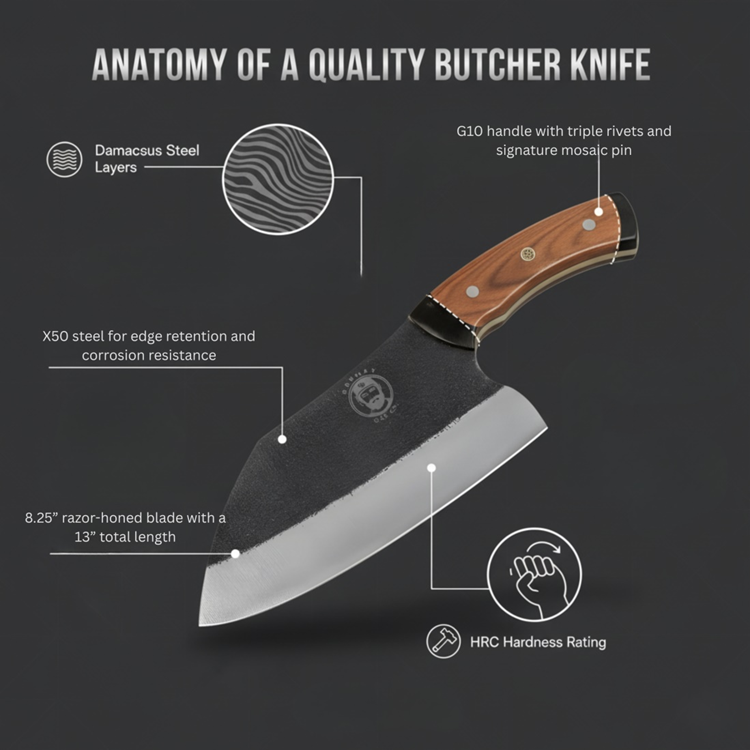
- “Forged from 9CR18MOV with Damascus pattern” (the giveaway — single steel name + pattern claim = fake)
If you can’t find the core steel after reading the entire listing, it’s not Damascus. Move on.
Red flag #2: The price is too low
Authentic Damascus chef’s knives start around $130–$150 from established makers. Hand-forged Japanese Damascus starts at $200+. Premium Damascus (SG2 core, hand-forged in Japan) runs $300–$600+.
If you see a “67-layer Damascus chef’s knife with octagonal handle” for $59, you’re looking at a laser-etched fake. The math is impossible — real Damascus production at scale doesn’t drop below $130 because the labor floor is too high.
| Damascus Type | Realistic Price Floor |
|---|---|
| Machine-pressed Damascus, mid-tier core (VG-10) | $130–$200 |
| Hand-forged Japanese Damascus (VG-10/SG2) | $200–$400 |
| Hand-forged premium Japanese (R2/ZDP-189) | $400–$800 |
| Custom/artisan Damascus | $500–$2,000+ |
Below $130 for a “Damascus” knife? It’s either an exception (rare) or fake (almost always).
Red flag #3: The pattern is too uniform
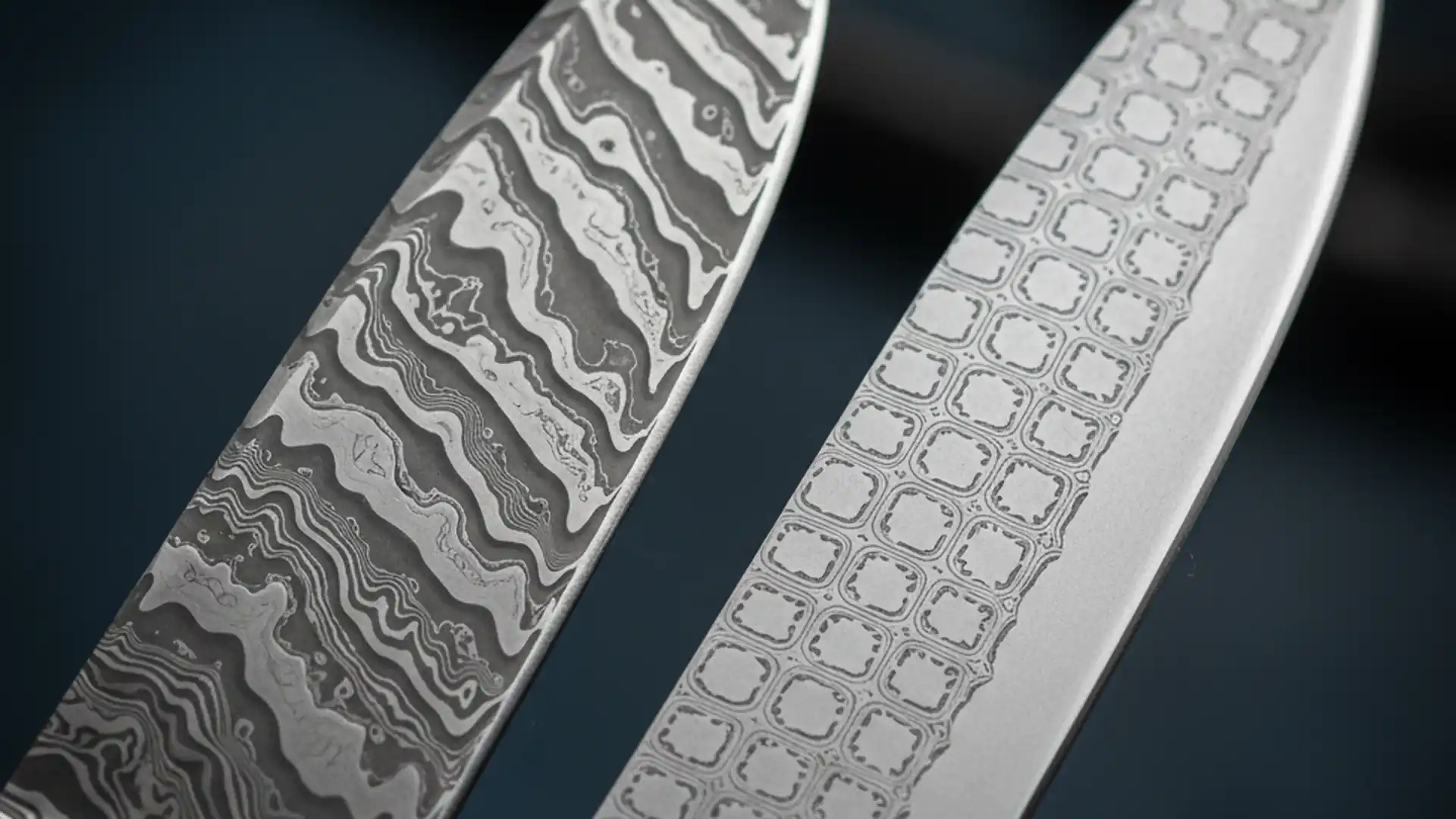
Real Damascus patterns are organic. Each blade is slightly different because the layers respond to forging unpredictably. You see swirls, drifts, irregular spacing, occasional visible “ghost” lines where the pattern is more or less prominent.
Fake “Damascus” patterns are uniform. Every blade looks identical to every other blade in the listing. The waves are evenly spaced. The “layers” are perfectly parallel. The pattern repeats predictably along the blade length — because it was generated by a CNC laser, not forged.
Look at multiple photos of “the same product” in a listing. If every blade in the photos has identical pattern placement, it’s a stamped/etched fake. If the patterns vary blade to blade, it’s likely real.
Red flag #4: “Ancient technique” / “Mountain blacksmith” vague marketing
Real Damascus brands have specific origins and verifiable histories:
- Tojiro (Niigata, Japan, 60+ years)
- Misono (Seki, Japan, 90+ years)
- Shun by Kai Cutlery (Seki, Japan, 100+ years)
- Wüsthof (Solingen, Germany, 200+ years)
- Mac (Seki, Japan, 50+ years)
Fake “Damascus” brands use vague mythology:
- “Hand-forged by traditional artisans”
- “Inspired by ancient blacksmithing techniques”
- “Made using methods passed down for generations”
- “Mountain-forged in remote workshops”
This language is engineered to imply craftsmanship without making any verifiable claim. “Inspired by” is doing a lot of work in those sentences.
Real maker information includes a city, a workshop name, a steel mill source, and decades of provenance. Romance language is the substitute when the facts aren’t there.
Red flag #5: The “review” pattern is suspicious
- Hundreds of 5-star reviews posted in clusters of dates.
- Generic reviews — “great knife, very sharp, fast shipping” — with no specific cooking detail.
- Reviews praise the pattern more than the cutting.
- The same phrasing appears across multiple reviews.
- No 1-star reviews discussing pattern wearing off, edge dulling fast, or rust spots.
Real reviews on a real Damascus knife mention specific cutting tasks (“breezed through tomatoes,” “feels great on chicken”), specific care notes (“had to oil it after first wash”), and a mix of stars including thoughtful 3-star reviews that note honest limitations.
Cheap Damascus listings often have suspicious review uniformity because the listings get review-stacked through brushing or paid review services.
How to verify in the listing photos
Some listings post enough photos to tell. Look for:
The blade spine
On real Damascus, the layered pattern continues across the spine — you can see distinct lines or a layered structure on the top edge. On fake Damascus, the spine is plain because the pattern was applied only to the side faces.
The cross-section near the bolster
Photos that show where the blade meets the handle sometimes reveal a layered cross-section on real Damascus — visible “lines” perpendicular to the cutting direction. Fake Damascus shows clean uniform metal in cross-section.
The pattern depth
Real Damascus has visual depth — when light hits the blade at angles, the pattern shifts because different layers reflect light differently. Fake Damascus is flat — the pattern is on the surface, light reflects off uniformly. Look for products filmed under angled lighting; if the pattern doesn’t shimmer or shift, it’s surface-only.
Edge geometry
Real Damascus knives are sharpened thin to take advantage of the hard core. Fake Damascus knives often have thicker edges (because the manufacturer is using mid-grade stainless that doesn’t take a thin edge well). Listings showing the edge profile from multiple angles let you compare.
The marketing language decoder
| Phrase | What It Probably Means |
|---|---|
| “67-layer Damascus pattern” | Surface pattern only; ignore layer count |
| “VG-10 core” or “SG2 core” | Probably real Damascus; verify via brand |
| “AUS-10 Damascus” | Sometimes real, sometimes fake; check brand |
| “Premium high-carbon Damascus steel” | Almost always fake — no specific steel named |
| “Hand-forged using ancient techniques” | Marketing romance — verify maker |
| “7CR17MoV Damascus” | Single steel + pattern = fake |
| “Granton edge with Damascus pattern” | Likely fake; Granton dimples + Damascus is uncommon on real knives |
| “Tungsten infused steel” | Marketing buzzword; doesn’t indicate real Damascus |
| “NSF certified Damascus” | NSF is about food safety, not authenticity |
| “Octagonal Damascus chef knife under $80” | Almost always fake |
Why fake “Damascus” exists at all
The pattern sells. People see the flowing waves and assume craftsmanship. Manufacturers figured out that they can apply the pattern to ordinary steel for almost no extra cost while charging a $50–$80 premium over plain blades.
It’s not always a scam in the criminal sense — fake Damascus knives are real knives that cut food. The problem is the marketing implies a level of construction and performance that isn’t there. You’re paying for a pattern, not a blade.
If you want a beautiful pattern on a budget knife, fake Damascus is honest about its category at the right price. A $50 stamped knife with a laser pattern is fine for $50. The same knife sold as “professional 67-layer Damascus chef knife premium quality” at $150 is the rip-off.
Legitimate budget Damascus brands worth knowing
Real Damascus exists at relatively affordable prices from a few brands:
- Tojiro DP Damascus series: VG-10 core, 37-layer Damascus cladding. Made in Niigata, Japan. $130–$180. Genuine Damascus, established maker, decades of reputation.
- Mac Damascus series: Japanese stainless core with Damascus cladding. $200–$300.
- Shun Classic: VG-MAX core (proprietary VG-10 variant) with Damascus cladding. $130–$220.
- Yaxell Damascus lines: SG2 core with stainless Damascus cladding. $150–$300.
- Miyabi by Henckels: SG2 or other premium core with Damascus cladding. $180–$400+.
These are the entry points to real Damascus from established Japanese makers. Below this price range, you’re almost certainly getting laser-etched fakes. (See our Damascus vs Standard guide for deeper context on whether Damascus is worth it at all.)
Common counter-arguments (and the honest answers)
“But the reviews are great and people seem happy”
Cheap fake Damascus knives are often perfectly fine knives — for $50. The reviews reflect “this knife cuts food and looks pretty” not “this knife is real Damascus craftsmanship.” The customers are happy because they got a usable knife. They’re not happy because they got authentic Damascus performance — they didn’t.
“What’s the actual difference in performance?”
A $50 fake Damascus knife with mid-grade stainless: dulls in 4–6 weeks, edge needs frequent sharpening, life of the knife maybe 5 years.
A $150 real Damascus knife with VG-10 core: holds an edge for 3–6 months, sharpens easily, lasts 15–25 years with care.
Per-year cost: similar ($10/year vs $7/year). Per-cooking-experience: very different.
“What if I just like the pattern?”
Then buy a fake Damascus knife with eyes open at the right price. Don’t pay $150 for a $50 knife. The pattern is fine. The marketing markup isn’t.
“Are ‘forged in Japan’ claims also fake?”
Sometimes. Some products say “forged in Japan” but the steel was milled in China and only the assembly happened in Japan. Established brands (Tojiro, Misono, Mac, Shun) source steel from named Japanese mills (Takefu, Hitachi, Aichi). Generic “forged in Japan” without brand provenance is suspect.
Where to safely shop
- Established cookware retailers: Sur La Table, Williams-Sonoma, Cutlery and More, Korin, JKnives. They vet the supply chain.
- Direct from manufacturer websites: Tojiro, Mac, Shun, Wüsthof.
- Specialty knife shops with reviewers: Knifewear, Bernal Cutlery, Cutlery Specialty.
Avoid:
- Generic Amazon brands with no website outside Amazon.
- Listings that change product photos every few weeks.
- “Limited time” pricing on perpetually limited-time deals.
- Brands you can’t find any cooking magazine review of.
Already bought a fake? It’s not the worst
If you already own a fake Damascus knife, don’t despair. The knife still cuts food. The pattern is fine. Treat it like the mid-grade stainless knife it is:
- Hand-wash, dry, store properly (see our Knife in the Dishwasher and Storage guides).
- Sharpen with a whetstone or pull-through (it’s a stamped blade, the pattern won’t suffer from pull-through use).
- Don’t expect premium performance — manage expectations to “decent everyday knife.”
- Recognize that the pattern will eventually wear off in heavily used areas, especially near the bolster.
When the pattern fades or the knife dulls beyond easy sharpening, retire it (covered in our When to Retire a Kitchen Knife guide) and upgrade to a real knife.
If you only remember five things
- Real Damascus listings name the core steel. Fake listings dodge it.
- Below $130 for a “Damascus” chef’s knife = almost certainly fake.
- Real Damascus patterns vary blade to blade. Fakes are identical.
- Vague “ancient artisan” marketing is romance, not provenance.
- If you like the pattern, buy fake at fair prices ($30–$60). Don’t pay real-Damascus money for it.
FAQ
Are all “Damascus” knives on Amazon fake?
Most are. Established brands (Shun, Tojiro, Mac, Wüsthof, Miyabi) sell on Amazon and they’re real. Generic-brand “67-layer professional Damascus” at $50–$80 is almost always fake. Check the brand reputation outside Amazon.
Can I tell on a $200 knife if it’s real Damascus?
$200 is the gray zone. Most legit Damascus chef’s knives start at $130 (Tojiro DP), so $200 is plausible for real Damascus. Verify the brand provenance and the named core steel.
How long until the pattern wears off on fake Damascus?
1–4 years of regular use, depending on how aggressive you are with the cutting board and how often you sharpen. Lighter use can preserve the pattern longer. Real Damascus patterns last decades because they’re forge-welded into the blade structure, not surface-applied.
Is “Damascus stainless” different from “Damascus carbon”?
Yes — Damascus carbon refers to high-carbon steel layers (more traditional). Damascus stainless uses chromium-bearing layers. Both can be real or fake. Both can be high quality with the right makers.
Is a real Damascus knife actually better than a non-Damascus knife of the same steel?
Performance-wise, the cladding adds toughness and corrosion resistance for carbon-core knives. For stainless-core Damascus, the practical performance difference is minor — the cladding is mostly aesthetic. The cutting comes from the core steel.
Why do some Japanese Damascus knives have rust spots near the edge?
Some Damascus cladding contains carbon-bearing layers that aren’t fully stainless. The cladding can develop rust spots while the core steel stays clean. Wipe and dry after every use; consider light oiling occasionally if the cladding is reactive.
Should I buy a Damascus knife at all?
If you want one and can afford a real one ($130+), yes — they’re beautiful and the cutting performance is real. If you can’t afford a real one, get a non-Damascus knife with the same core steel for less money — same performance, no pattern. The pattern is aesthetic.
The Grumpy Dad Promise
Spot the fake before it spots your wallet. Look for the named core steel. Verify the brand has decades of provenance. Trust no Damascus chef’s knife under $130. Recognize “ancient artisan” marketing for what it is.
If you want a real Damascus knife, buy from Tojiro, Shun, Mac, or another established Japanese maker. If you want the pattern at a budget, buy a fake honestly priced at $40–$60 and don’t pretend it’s something it’s not. Now go check your knife block. The truth might surprise you.