Father’s Day: The Knife That Keeps an Edge

He uses a knife every time he cooks.
Not occasionally. Every time. It’s the most touched tool in the kitchen — more than the pan, more than the cutting board, more than anything else on the counter. Which means if the knife isn’t good, he’s reminded of that fact every single time he cooks.
Most kitchen knives in most households aren’t good. They’re adequate. They were bought as a set, which is rarely how you’d buy a knife if you bought it deliberately. Or they were good once and haven’t been sharpened since 2019. Or they look right — heavy handle, visible branding — without the geometry or steel quality that makes a knife actually perform.
A good knife as a gift is not a novelty. It’s a correction. A tool that finally does what it’s supposed to do, used daily, felt every time it’s picked up.
Here’s how to get it right.
Why Most Kitchen Knives Disappoint
The problem isn’t usually the steel designation. It’s the geometry behind the edge.
A knife can be made from decent steel and still feel like it’s pushing through food rather than parting it — because the blade is thick behind the edge. The cross-section of the blade above the cutting edge determines how much resistance the knife creates as it enters food. A thick blade wedges. A thin blade parts. The difference is immediately felt when cutting carrots, dense onions, or anything with structural resistance.
Cheap knives are thick behind the edge because thin-grinding requires more precision manufacturing and more material removed during production. It costs more to make a blade that performs like a blade should. That cost is reflected in the price, which is why “this knife is $18 and looks like a $70 knife” always ends with disappointment.
The second variable is steel hardness. Harder steel (measured on the Rockwell C scale, or HRC) takes a finer edge and holds it longer. The trade-off is brittleness — harder steel chips rather than bends if misused. Most quality Japanese knives run 60 to 65 HRC. Most commercial Western knives run 54 to 58 HRC. The harder steel is sharper out of the box, stays sharper longer, and requires more mindful use in return.
Understanding these two variables — geometry and hardness — is enough to evaluate any knife before you buy it. Anything else is secondary.
The Grumpy Dad Knife Lineup: What Each One Is For
The 8″ Damascus Chef Knife ($55)
The starting point. The knife for the household that needs a reliable, well-balanced chef’s knife that can handle 90% of kitchen work without asking for anything unusual in return.
The Damascus pattern — 67 layers of folded steel around a harder core — is functional, not decorative. The pattern is the result of the forging process, and that forging process produces a blade with a hard cutting core (the edge that takes and holds a keen angle) surrounded by a more flexible outer steel (which absorbs impact without transmitting it to the hard core). The result is a blade that stays sharp longer than a mono-steel knife of equivalent price because the geometry and construction work together.
At $55, this knife performs significantly above its price bracket. It’s well-balanced — slightly blade-heavy, which is correct for a Western chef’s knife used with a rocking technique. The handle is full G10, which is a composite material that doesn’t absorb moisture, doesn’t crack in temperature changes, and doesn’t need conditioning.
This is the right call for: a household that doesn’t have a good knife and needs to fix that immediately. The gift that gets used the next morning.
The Hand-Forged Kurumi Shikaku Bunka Knife ($175)
The step up. For the person who already has a decent knife and is ready for what it feels like when the geometry is right.
A bunka is a Japanese multi-purpose knife — similar role to a chef’s knife, different profile. The tip is angular and comes to a k-tip point rather than a gentle curve. This matters for precision work: scoring, detail cuts near the tip, the kind of fine work that a rounded chef’s knife tip makes awkward.
The Kurumi Shikaku is hand-forged. That’s not marketing — it means the blade was shaped by hand under a hammer rather than machine-stamped from a sheet of steel. Hand forging allows the smith to control the grain structure of the steel, optimize the geometry through the blade, and produce a cross-section that machine production can’t replicate at this price point.
The walnut handle is octagonal — a Japanese handle style that seats naturally in the hand and lets the user roll the knife between fingers for different cutting positions. The weight is forward of the handle, which feels unusual for the first five minutes and then feels like the only correct balance for this kind of precise knife work.
This is the right call for: the dad who cooks seriously, already has a basic knife, and is ready to understand what the next level feels like. He will know immediately that this is different.
The Yoshida Hamono Nakiri Knife ($95)
The specialist. The knife for the household that does a significant amount of vegetable prep and has wondered why it takes more effort than it should.
A nakiri is a Japanese vegetable knife — rectangular blade, flat profile from heel to tip, tall blade height for knuckle clearance. It’s designed for push cuts: the blade goes straight down, the full edge contacts the board, the cut is complete in one stroke. No rocking. No partial cuts to go back over. No wedging in dense root vegetables.
The first time most people use a nakiri on a pile of carrots or daikon or dense sweet potato, the reaction is the same: this is what this should feel like.
The Yoshida Hamono is handmade. The steel is properly thin behind the edge, which is the property that makes a nakiri worth buying — a thick nakiri is just a rectangular chef’s knife. The balance is correct for push cuts: slightly blade-heavy, which lets gravity do part of the work.
This is the right call for: households that cook vegetables regularly and have never had a dedicated vegetable knife. Also for the cook who already has a good chef’s knife and is ready for a tool that specializes.
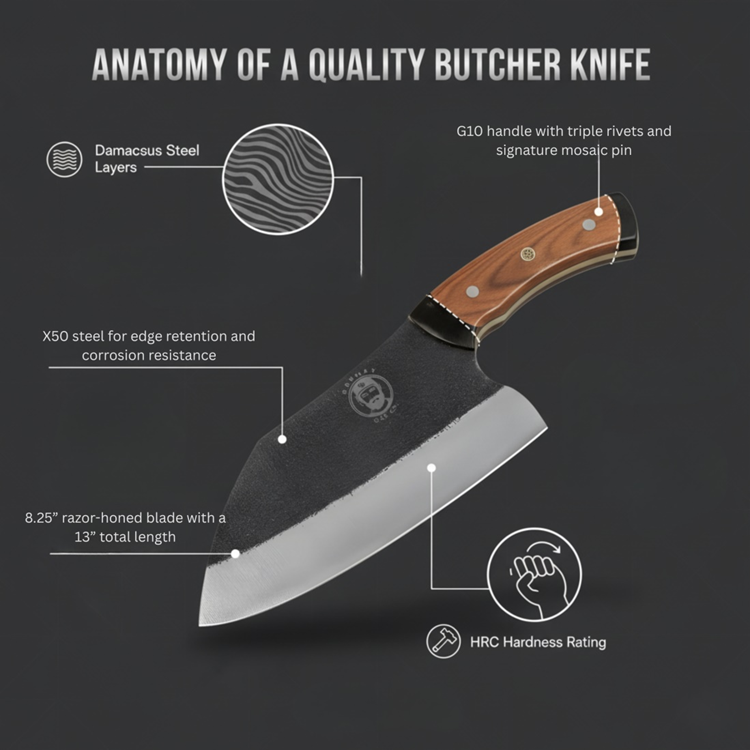
The Heavy-Duty Butcher Knife ($55, full anatomy below)
8.25 inches. 1.13 lbs. X50 stainless steel. Full tang. G10 handle with triple rivets and a signature mosaic pin. Razor-honed edge.
This knife is for the dad who grills, smokes, or breaks down larger proteins. It trims brisket without drama. It portions a rack of ribs into individual bones cleanly. It handles the heavy outdoor cutting work that a thin Japanese knife is not designed for and shouldn’t be used for.
The weight is intentional. When you’re trimming a 14-pound brisket or carving a pork shoulder, you want a blade with presence — something that moves through the work rather than requiring you to force it. The X50 steel holds an edge under heavier use without the chipping risk of harder Japanese steels in the same role.
This is the right call for: the grill dad. The guy who’s been using whatever chef’s knife happened to be in reach for outdoor carving work. He doesn’t need a delicate edge. He needs the right tool for the job.
The Steel Question People Ask
Damascus, carbon steel, stainless, X50, VG-10 — the terminology on knife listings can read like a material science syllabus. Here’s the plain-English version of what matters.
Stainless vs. carbon: Stainless steel resists rust and requires minimal maintenance. Carbon steel takes a finer, keener edge and often holds it longer, but it reacts to moisture and acidic food and requires drying and occasional oiling to prevent rust. For most home cooks: stainless or stainless-core Damascus is the right call. For cooks who want maximum performance and are willing to maintain the blade: carbon steel.
HRC (Rockwell hardness): Higher number means harder steel, sharper potential edge, better edge retention, and more brittleness. The Yoshida Hamono and Kurumi Shikaku run harder steels (60+ HRC). The Damascus Chef Knife and Butcher Knife run slightly softer, tougher steels appropriate for their use profiles. Neither is better in the abstract. The right hardness depends on the job.
Damascus: A construction method, not a single steel type. Multiple steel layers folded and welded together. The visual pattern is a byproduct of the process — etching reveals the contrast between the layers. The functional result is a blade with a hard cutting core and a tougher outer cladding. It’s not magic. It’s sound metallurgy done with skill.
The Maintenance Angle: Make It Complete
A knife is only as good as its current state of sharpness. The best knife in the world, unused for two years, performs like a mediocre knife. The most important maintenance habit for any kitchen knife is regular honing and periodic sharpening.
Honing (weekly): A honing rod — also called a sharpening steel — realigns the microscopic edge of the blade without removing metal. It’s what a professional cook reaches for before every use. A ceramic or smooth steel honing rod, used with light pressure at 15 to 20 degrees, takes 30 seconds and keeps the edge performing between sharpening sessions.
Sharpening (every 2 to 6 months): A whetstone removes a small amount of metal to restore a damaged or dull edge. Entry level: Shapton Glass 1000. The pull-through sharpeners sold in most housewares stores remove too much metal too aggressively and can ruin a quality blade. For Japanese knives especially: whetstone only.
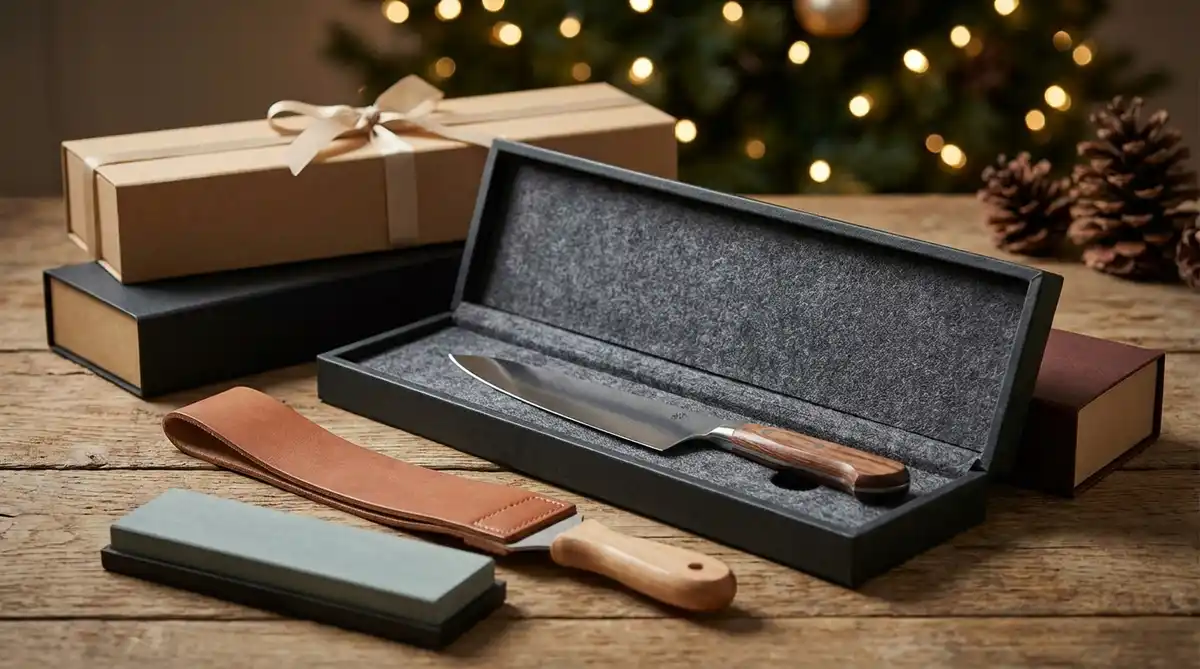
Camellia Oil: Grumpy Dad Camellia Oil is food-grade camellia oil — the traditional Japanese choice for blade and handle maintenance. A thin wipe on carbon steel after washing prevents rust. A wipe on wood handles conditions the grain and prevents cracking. A small bottle lasts a year with regular use. It’s a $10 addition to any knife gift that communicates you know what you bought.
The Gift, Simplified
One question: what does he cook most?
Mostly proteins, grilling, big cuts: Grumpy Dad Butcher Knife + Camellia Oil.
General everyday cooking: Grumpy Dad 8″ Damascus Chef Knife + Camellia Oil.
Precision cooking, Japanese technique interest: Hand-Forged Kurumi Shikaku Bunka.
Vegetable-forward cooking: Yoshida Hamono Nakiri.
Already has one good knife and wants a second: Add the Nakiri or the Bunka, depending on his style.
He’ll use whichever one you pick. Every time he cooks. For years. That’s not an exaggeration — these are tools built for daily use, not seasonal deployment.
The gift that sits in the back of the cabinet is the one that nobody needed. A knife he’ll reach for every time he stands at the cutting board is the one that was thought about.
Grumpy Dad Co. — Knives built to be used, not displayed.
Browse the full knife collection at grumpydadco.com — and add Camellia Oil while you’re there.
🎁 The knife that keeps its edge
Looking for a blade that actually holds up? That is the Grumpy Dad Co 8″ Damascus Chef Knife — and the rest of our Japanese Knives, built to be handed down, not thrown out.