Cleaver Guide for Home Cooks: When You Actually Need One (And Which Type)

Most dads have one mental picture of a cleaver: a giant rectangular blade swung two-handed at a chicken bone, possibly while grunting. That picture is one type of cleaver — and probably not the one that belongs in your kitchen.
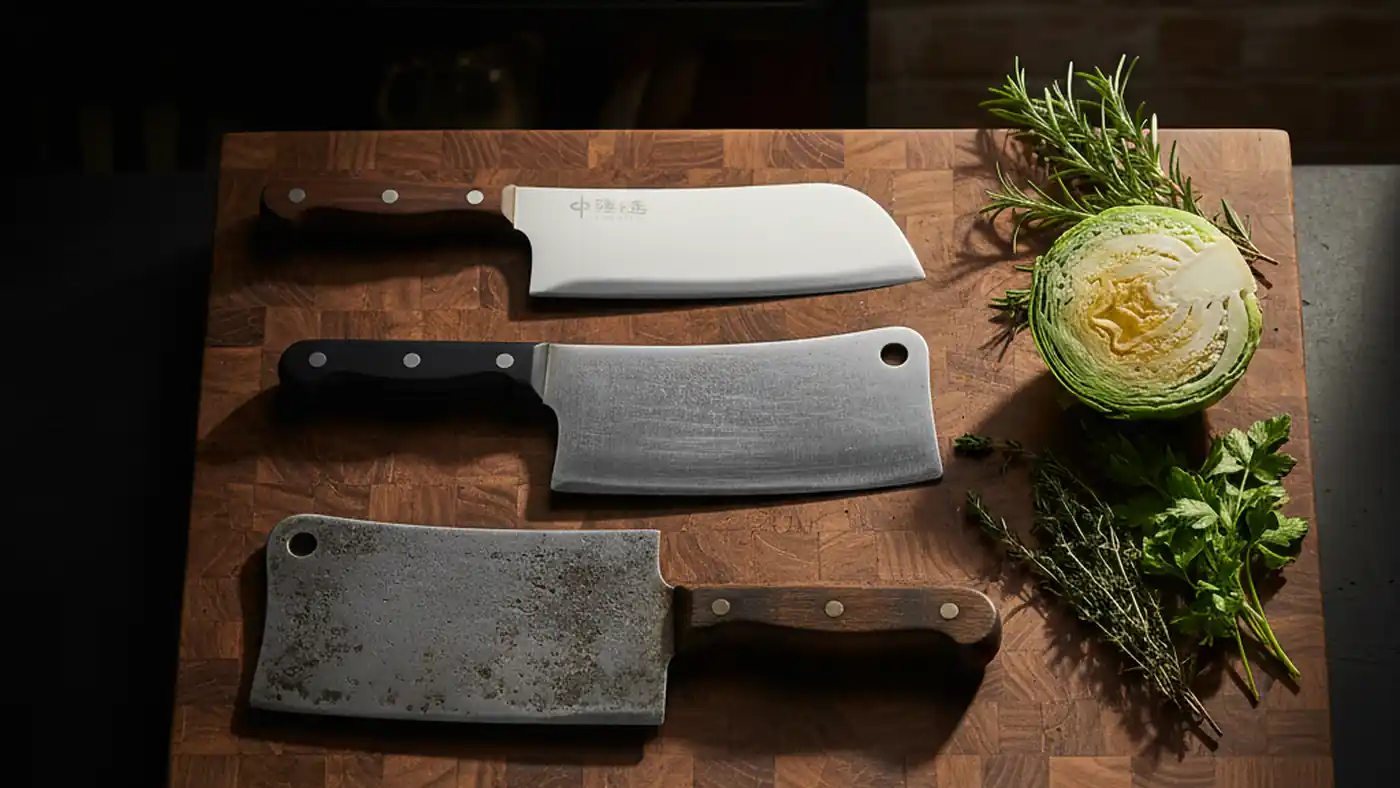
The truth nobody puts on the box: “cleaver” describes three different knives that look similar and do completely different jobs. A Chinese vegetable cleaver is a precise, lightweight slicer that’s basically a chef’s knife in costume. A Western meat cleaver is a medium-weight chopping tool. A bone cleaver is the actual bone-splitter that needs respect and ear protection. They are not interchangeable. Buying the wrong one means owning a knife that’s bad at the job you actually have.
This is the no-nonsense breakdown. The three cleaver categories. What each does well. What each is hopeless at. Which one (if any) belongs in your home kitchen. And the marketing trap that sells the wrong cleaver to dads who watched too many barbecue videos.
The 30-second answer
Cook a lot of vegetables and want one knife to replace several: Chinese vegetable cleaver (caidao) — surprisingly versatile, terrible at bones. Break down whole chickens or smaller cuts of meat: Western meat cleaver — solid all-rounder for proteins. Split lamb shoulders, pork ribs, large bones: bone cleaver (heavy) — specialty tool, rarely needed at home. Most home cooks need none of these — a sharp chef’s knife handles 95% of cleaver tasks better than a bad cleaver does.
The three categories (the part that resolves the confusion)
1) Chinese vegetable cleaver (caidao / cai dao)
Wide rectangular blade, thin spine, light weight (8–14 oz), keen edge. The blade is tall (4 inches+) but thin enough to glide through onions like a chef’s knife.
This is the cleaver that fooled everyone into thinking they needed a cleaver. It’s not for bones. It’s for everything else: vegetables, herbs, boneless meat, mincing, scooping food off the board with the broad face. In a Chinese kitchen, this is often the only knife on the counter — covers the chef’s knife, santoku, and bench scraper roles in one tool.
Wins: precision slicing, surprisingly good push-cutting, herb mincing, scoop-and-transfer with the wide face, control through the long blade-to-knuckle distance.
Losses: not built for bones. Hit a chicken thigh joint with one and you’ll chip the edge. Not built for hard rocking-chop motion either; it’s a push-cut blade.
Typical buyer: home cook who does a lot of vegetable prep, makes stir-fries weekly, wants one knife to do most cutting work.
2) Western meat cleaver
Thicker spine, heavier (1–2 lbs), shorter blade (6–8″), beefier overall. The Western meat cleaver is what most American kitchens picture: medium-heavy, beefy enough to chop through small bones, sturdy enough to split a chicken in half.
Not built for fine vegetable work — too thick behind the edge, too heavy. Built for proteins: portioning chicken, splitting whole birds, hacking through small joints, even some basic bone work on chicken and pork.
Wins: chicken portioning, smaller bones, cutting through cartilage, intimidating presence in the knife block.
Losses: clumsy on vegetables, terrible for fine slicing, overkill for boneless meat, slow for daily prep.
Typical buyer: home cook who breaks down whole chickens, deals with bone-in proteins, hosts barbecues. Not for someone who buys boneless skinless chicken breasts.
3) Bone cleaver (heavy cleaver, butcher’s cleaver)
The two-handed monster. Very thick spine (often 6–10mm), heavy (2–4 lbs), short blade (6″). Designed to split through large bones — pork shoulder, lamb leg, beef ribs — in single decisive strikes.
Not built for cutting in any normal sense. The edge is intentionally thicker and less keen than other knives because a thin edge would chip on impact with bone. The work is done by gravity and momentum, not by edge sharpness.
Wins: splitting large bones, breaking down primal cuts of meat at home, performing tasks that no other knife can handle.
Losses: useless for everything else. Can’t slice. Can’t mince. Can’t break down a chicken cleanly because it’s overkill on small bones and crushes the meat around them.
Typical buyer: someone who actually buys whole hogs, breaks down deer, processes large game, or does serious traditional butchery at home. Almost no normal home cook.
Side-by-side comparison
| Feature | Chinese Veg Cleaver | Western Meat Cleaver | Bone Cleaver |
|---|---|---|---|
| Weight | 8–14 oz | 16–32 oz | 32–64 oz |
| Spine thickness | 2–3mm | 4–5mm | 6–10mm |
| Edge angle | 15–18° | 22–30° | 30–40° |
| Best on vegetables | Excellent | Poor | Useless |
| Best on boneless meat | Good | Good | Poor |
| Best on small bones | No (will chip) | Yes | Overkill |
| Best on large bones | No | Limited | Yes |
| Daily prep tool | Excellent | Limited | No |
| Typical price | $40–$200 | $30–$150 | $50–$300 |
The Chinese vegetable cleaver deep-dive (because it’s the most surprising)
Most American cooks see a Chinese cleaver and assume it’s for bones. It’s not. Pick one up — it weighs less than your 8-inch chef’s knife. The blade is tall, but the spine is thin. The geometry is closer to a chef’s knife than to a bone cleaver.
What it actually replaces in a home kitchen:
- Chef’s knife for most cutting (better blade height = more knuckle clearance, faster mincing).
- Santoku for vegetable prep (similar push-cut motion, longer cutting edge).
- Bench scraper for transferring chopped food (the broad face scoops perfectly).
- Pestle/mash for garlic, ginger, herbs (lay the blade flat, press down with the heel of your hand).
What it does not replace:
- Boning knife for working around joints.
- Bread knife for serrated work.
- Paring knife for in-hand work.
- Anything that touches bones.
For a single-knife household, a Chinese cleaver plus a paring knife genuinely covers 90% of cooking tasks. Faster than most home cooks expect, with a learning curve of about two weeks.
Recommended models: CCK Small Slicer (KF1303) at $90 (legendary, hand-forged, the one most pros recommend), Shibazi F208 at $40 (excellent budget option), Sugimoto No. 6 at $180 (Japanese-made, premium).
The Western meat cleaver: who it’s actually for
If you regularly buy whole chickens, fryers, smaller cuts of bone-in meat, the Western meat cleaver earns its drawer space. The motion is a controlled chop — not a wild swing — and the weight does most of the work for you.
Tasks where it excels:
- Splitting a whole chicken down the back (spatchcocking) for the grill.
- Sectioning a rack of pork ribs.
- Breaking down a chicken into 8 pieces.
- Trimming hard fat caps that resist a chef’s knife.
- Crushing garlic with the broad face (the only soft-task it does well).
Tasks where it’s the wrong tool:
- Vegetable prep (heavy, clumsy, thick edge wedges in firm vegetables).
- Fine boning (the boning knife is faster, more controlled).
- Splitting large bones (use a bone cleaver or bone saw).
- Slicing cooked meat (carving knife is way better).
Recommended models: Wüsthof Classic 6″ Cleaver at $130 (workhorse, balanced), Mercer Culinary 8″ Cleaver at $40 (cheap, durable, restaurant-grade), Dexter-Russell Sani-Safe 7″ Cleaver at $35 (NSF-certified, indestructible).
The bone cleaver question (probably skip)
Unless you actively process whole hogs, deer, or do traditional butchery at home, you don’t need a bone cleaver. The few tasks that genuinely require one (splitting a pork shoulder, sectioning a leg of lamb at the joint, breaking down primal cuts) are also tasks most home cooks just don’t do.
If you do, expect a real heavy cleaver to cost $100–$300, weigh 2–4 lbs, and require a heavy butcher block (not a thin cutting board) for safe use. The motion is two-handed, the surface needs to be solid, and the workspace needs to be clear of fragile dishes.
For occasional bone work that doesn’t justify a dedicated tool, a sturdy mallet on the back of a Western meat cleaver handles most home tasks. (Or call your butcher and ask them to portion before you take it home.)
Why most home cooks don’t need any cleaver
Honest truth: a sharp chef’s knife handles 95% of “cleaver tasks” better than a poorly-chosen cleaver does.
- Vegetables? Chef’s knife (or our recent Western vs Japanese Chef’s Knife guide) is faster and more precise.
- Mincing herbs? Chef’s knife rocks more efficiently.
- Boneless protein? Chef’s knife slices cleaner.
- Garlic crushing? Side of the chef’s knife works fine.
The cleaver fills three specific niches:
- You cook a lot of vegetables and want one tall blade to do everything (Chinese cleaver).
- You break down whole birds or bone-in meat regularly (Western cleaver).
- You do home butchery on large primals (bone cleaver).
If none of those describes you, save the drawer space and the $50–$200. Spend it on a better chef’s knife instead.
How to actually use a cleaver (without losing a finger)
Chinese vegetable cleaver technique
- Pinch grip — thumb and forefinger on the blade itself, not the handle. Just like a chef’s knife.
- Push-cut motion: blade angled forward, slide forward and down through the food in one motion. No rocking.
- Use the broad face to scoop food into a bowl after chopping.
- For garlic and ginger: lay the blade flat over the clove, press down with the heel of your hand, smash. Then chop normally.
Western meat cleaver technique
- Full grip on the handle. The cleaver is heavier; you need leverage from the wrist and forearm.
- Stable cutting board (avoid bamboo for cleaver work — it’s too hard and chips edges).
- For chicken portioning: locate the joint, place the edge there, single firm chop. Don’t saw.
- For ribs: identify the cartilage between bones (lighter color), chop through that — not the bones themselves.
Bone cleaver technique
- Heavy butcher block, never a thin cutting board.
- Two-handed grip on the handle. Eye protection optional but recommended.
- Single decisive strike. Sawing or hesitating = injury risk.
- Aim for joints when possible; cleavers split cartilage easier than they split solid bone.
- Clear bystanders (kids, pets) — the strike force is real, the recoil less so but unpredictable on bone.
Cleaver care (different from chef’s knives)
- Hand-wash, towel-dry, store properly. Same rules as our Knife in the Dishwasher guide.
- Storage: magnetic strip preferred. Cleavers are too tall for most knife blocks. Drawer organizer with a sleeve works.
- Sharpening: Chinese vegetable cleavers sharpen like chef’s knives — 1000-grit then 4000+ on a whetstone. Western meat cleavers can use the same plus a less aggressive angle (more durable edge). Bone cleavers are intentionally less sharp; sharpen rarely, accept the duller edge as a feature.
- Cutting board choice matters more for cleavers — the impact force is higher than a chef’s knife. End-grain hardwood or thick HDPE only. Bamboo and acrylic destroy cleaver edges fast.
- Carbon steel cleavers (CCK, traditional Chinese cleavers): wipe dry after every use, oil monthly, develop patina. Same care as any carbon steel knife (see our Carbon Steel Knife Care guide).
Marketing traps to avoid
- “Heavy-duty meat cleaver” at under $30. Stamped low-carbon steel with a plastic handle. Chips on first chicken bone. Cheap meat cleavers are wasted money.
- “Chinese-style chef knife with cleaver design.” Sometimes legit (CCK, Sugimoto, Shibazi). Sometimes a thick-spined Western blade with a square shape — looks like a Chinese cleaver, performs like a thick clumsy chef’s knife.
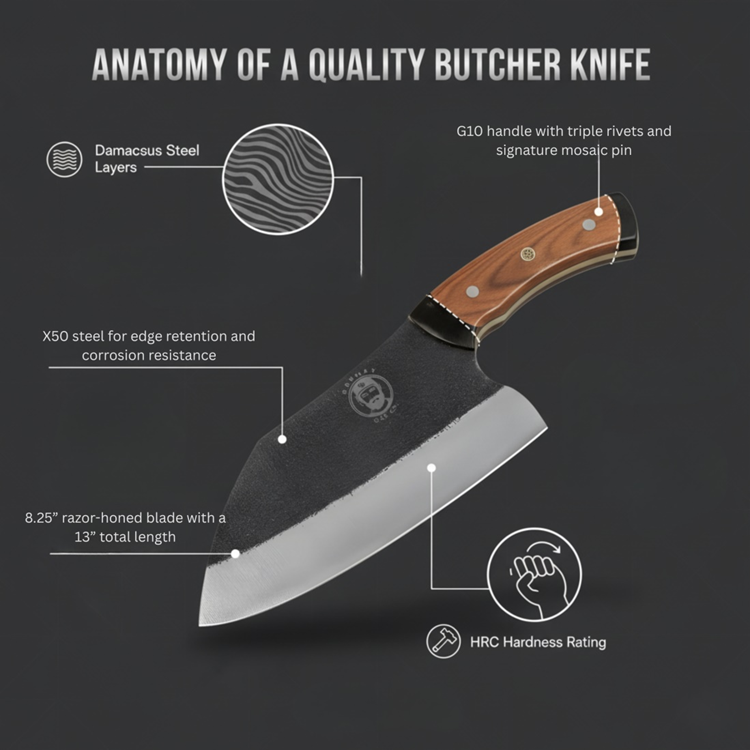
- “Damascus cleaver” under $80. Almost always laser-etched pattern over single-piece steel. The pattern doesn’t help bones at all.
- “All-purpose cleaver — bones, vegetables, fish.” The geometry that works for bones doesn’t work for vegetables. The marketing wants you to skip buying multiple knives. The reality is one mediocre tool that does nothing well.
- “Cleaver and steak knife combo set.” Steak knives have nothing in common with cleavers. The set is a marketing bundle, not a curated kit.
- Hand-forged “ancient design” cleavers from no-name brands. Real hand-forged cleavers (CCK, traditional Japanese deba-style) come from established workshops. Random “ancient design” branding on a $50 Amazon cleaver is decoration on mediocre steel.
The Grumpy Dad recommendation by household
“I cook a lot of vegetables, stir-fries, herbs, and want versatility”
Chinese vegetable cleaver — CCK Small Slicer ($90) or Shibazi F208 ($40). Genuinely worth replacing your chef’s knife with one of these.
“I break down whole chickens for the grill regularly”
Western meat cleaver — Mercer 8″ ($40) or Wüsthof Classic 6″ ($130). Solid daily-driver for proteins, accepts abuse, lasts a decade.
“I bought a half-hog from a farm and need to break it down”
Bone cleaver — heavy commercial-grade, plus a bone saw. Or pay your butcher to do the breakdown for you. Often cheaper than buying the right tools.
“I just want one cleaver because they look cool”
Skip. The cleaver-as-aesthetic is the most common reason home cooks own a knife they never use. Spend the money on a better chef’s knife or sharpening lessons instead.
“I have a small kitchen and storage is tight”
Skip the cleaver. A 10-inch chef’s knife or 240mm gyuto handles 95% of cleaver tasks in less drawer space.
Sizes and weight: matching the cleaver to the cook
| Blade Height | Weight Range | Best For |
|---|---|---|
| 3.5–4″ | 8–10 oz | Light Chinese cleaver, small hands, daily prep |
| 4–4.5″ | 10–14 oz | Standard Chinese vegetable cleaver, the workhorse |
| 4.5–5″ | 14–20 oz | Heavy Chinese cleaver or light Western, dual-purpose |
| 5–6″ | 20–32 oz | Western meat cleaver, chicken/protein work |
| 6″+ thick spine | 32+ oz | Bone cleaver territory only |
The “looks impressive on the wall” cleaver is usually the wrong size for actual cooking. Smaller and lighter than expected is usually correct for daily use.
Mistakes that ruin cleavers
- Using a Chinese vegetable cleaver on chicken bones (chips edge, ruins the knife).
- Using a Western meat cleaver to slice tomatoes (clumsy, wastes the tool).
- Putting any cleaver in a dishwasher (covered in detail in our dishwasher guide).
- Storing a cleaver loose in a drawer with chef’s knives (heavy + cleaver edge contact = damaged everything).
- Using a thin or bamboo cutting board for cleaver work (impact damage to both knife and board).
- Letting a cleaver dry on a damp dish rack (heavy knives drip into the rack and rust at contact points).
- Sharpening a Chinese cleaver to a 12° edge (it’s not a Japanese gyuto — keep 15–18°).
If you only remember five things
- “Cleaver” describes three different knives. Don’t mix them up.
- The Chinese vegetable cleaver is shockingly versatile — and not for bones.
- Western meat cleavers are for chicken portioning, not vegetable prep.
- Bone cleavers are specialty tools 95% of home cooks don’t need.
- A sharp chef’s knife replaces most cleaver tasks for most kitchens.
FAQ
Can I split a chicken with a Chinese vegetable cleaver?
Don’t. The thin edge will chip on the breast bone. Use a Western meat cleaver, kitchen shears, or a chef’s knife for joint work.
What’s the difference between a Chinese cleaver and a santoku?
A Chinese cleaver is much taller (4″+ blade height vs 1.5–2″), wider, and slightly heavier. The motion is similar (push-cut) but the cleaver gives more knuckle clearance and a broader face for scooping. Santoku is more compact; Chinese cleaver is more versatile.
Are carbon steel Chinese cleavers worth the maintenance?
For enthusiasts: yes. CCK and traditional Japanese-style carbon steel cleavers reach edge sharpness that stainless can’t quite match. For everyone else, stainless Chinese cleavers (Shibazi, modern CCK Stainless) are 95% of the performance with no rust paranoia.
Can I use a meat cleaver instead of a chef’s knife daily?
Possible but inefficient. Most Western meat cleavers are too heavy and too thick-edged for fine prep. The Chinese vegetable cleaver replaces a chef’s knife much better than a Western meat cleaver does.
What’s a good “first cleaver”?
For most home cooks: the Shibazi F208 ($40) or CCK Small Slicer ($90) Chinese vegetable cleavers. Versatile, affordable enough to experiment with, and you’ll learn whether you like the cleaver-style cooking before upgrading.
How do I know if a cleaver is good quality?
Look for: solid steel construction (not stamped sheet), a real edge (not a beveled chunk), a comfortable weighted handle, and a manufacturer with a track record. Avoid the $25 “professional chef cleaver” with the marketing of a $200 knife — they don’t exist at that price.
Is the back of a cleaver useful for anything?
Yes — pounding meat tender (use the spine, not the edge), crushing whole spices on a board, breaking small bones in a controlled way. Don’t use the edge as a hammer; that’s how chips happen.
The Grumpy Dad Promise
Pick the cleaver that matches what you actually cook. Skip the cleaver entirely if you’re not breaking down whole birds or doing serious vegetable prep. The cleaver in the showroom is rarely the cleaver you need; the right cleaver is one of three specific tools, picked deliberately, used for its intended job.
Get the Chinese vegetable cleaver if you’re a daily home cook curious about a versatile tall blade. Get the Western meat cleaver if you’re breaking down chickens for grilling weekends. Get the bone cleaver if you’re processing animals at home — and if you are, you already know.
Now go cleave something. Or don’t. The chef’s knife was probably enough.