The Tool Drawer Every Dad Should Have (And the 30 Things to Skip)

Open the kitchen drawer right now. The one with the spatulas. Count the items. Most American homes are sitting on 40+ kitchen tools in that one drawer alone. There’s a melon baller. There’s an avocado slicer. There’s a “strawberry huller” you used twice in 2019. There’s a thing nobody can identify, possibly an aerator for a wine you don’t drink. The drawer doesn’t close all the way.
Then you cook a real meal and reach for the same six tools you always reach for. The other 34 are decoration with handles.
Here’s the truth nobody at the housewares store will tell you: twelve tools cover 95% of home cooking. The rest are single-use gadgets the marketing team invented to fill another shelf. Your drawer doesn’t need more tools. It needs fewer, better ones, organized so you can actually find them.
This is the no-nonsense breakdown. The 12 tools that earn their drawer space. The 30 popular gadgets that don’t. The handful of “nice to have” extras for specific cooking styles. And the audit that turns chaos into a working tool drawer in 20 minutes.
The 30-second answer
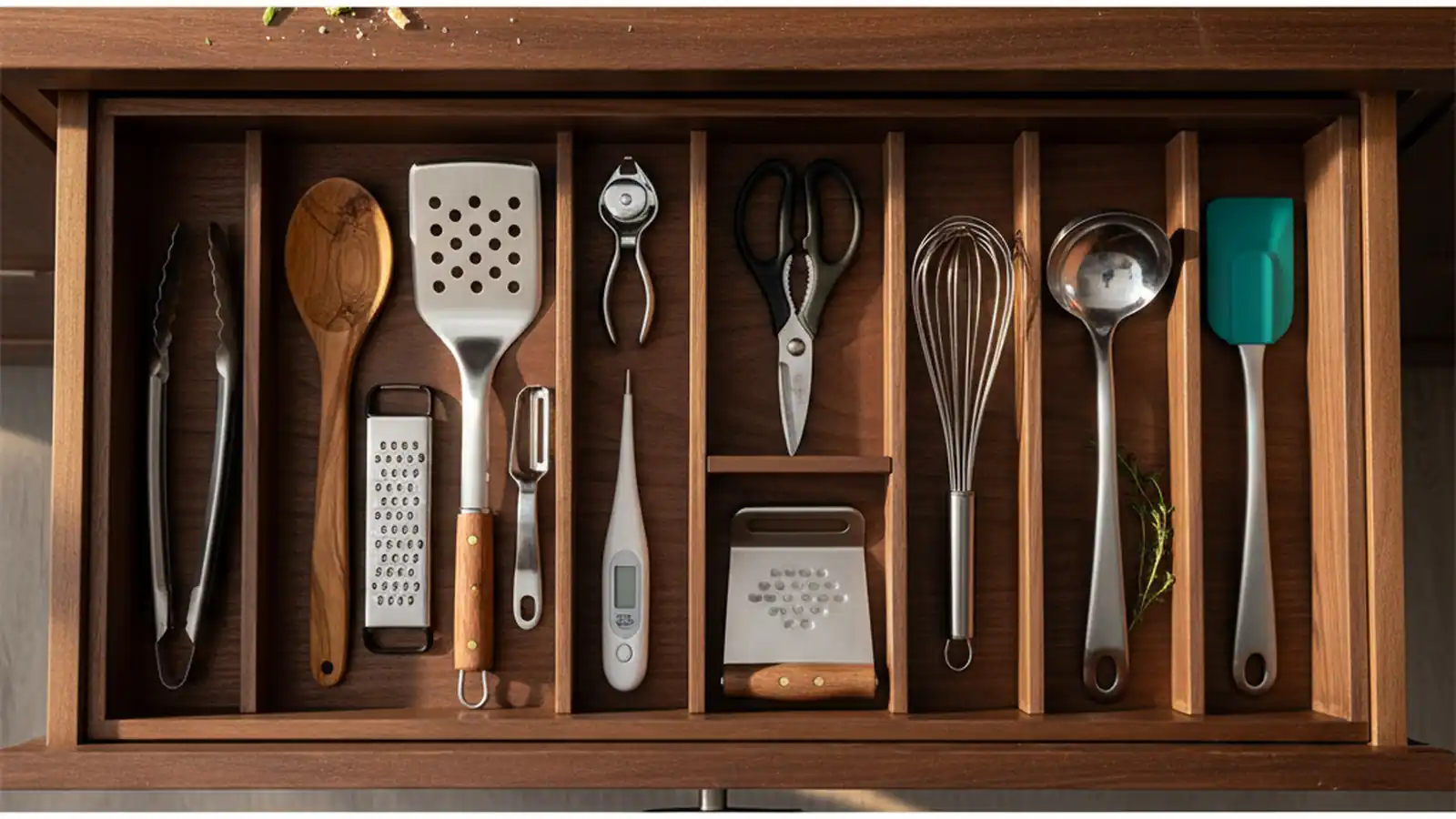
The 12 essentials: tongs, wooden spoon, fish spatula, rubber spatula, microplane, Y-peeler, can opener, kitchen shears, instant-read thermometer, bench scraper, whisk, ladle. Spend $120–$180 total on quality versions. Throw out everything else. Lifetime kit, no gadget regret, drawer closes properly.
The 12 essentials (and why each one earns its space)
1) Tongs (12-inch stainless with silicone tips)
The most-used tool in any working kitchen. Flips meat, tosses pasta, grabs vegetables out of boiling water, retrieves things from the back of the oven, plates food. Spring-loaded with a locking mechanism for storage.
Skip the silicone-only “soft-grip” tongs — too floppy. Skip the giant 18-inch grilling tongs in the kitchen — too long for indoor work. The 12-inch stainless with silicone tips covers both stovetop and oven.
Recommended: OXO Good Grips Locking Tongs ($15) or Cuisipro 12″ Silicone Tongs ($22). Lifetime tools.
2) Wooden spoon
Stirs, scrapes, doesn’t scratch nonstick pans, doesn’t conduct heat. The boring tool that does more cooking than any single gadget.
One large flat-edge wooden spoon (12-inch) is enough. Add a slotted version if you cook a lot of soups and stews.
Recommended: Olive wood, beechwood, or maple. Avoid bamboo (splinters faster). $10–$25 from any cookware store.
3) Fish spatula (offset metal spatula)
Despite the name, this is the universal flipping tool. Thin, flexible, slips under delicate items (fish, eggs, pancakes), strong enough for burgers and steaks. Better than any “burger flipper” you’ve used.
The thin metal edge is the secret — it slides under food without breaking it. Plastic spatulas can’t do this.
Recommended: Wüsthof Gourmet Fish Spatula ($20), Lamson Pro 8″ Slotted Fish Turner ($25), or Mercer Renaissance ($14). Lifetime tool.
4) Rubber/silicone spatula (high-heat)
For folding batters, scraping bowls, finishing sauces, getting the last of the peanut butter out of the jar. The silicone heat-resistant version (up to 600°F) doubles as a pan-stirrer for delicate sauces.
Skip the $5 Walmart version (handle pops off). Skip the cheap rubber kind (deteriorates within a year). The silicone-on-stainless-handle version lasts decades.
Recommended: GIR Ultimate Spatula ($14), OXO Good Grips Silicone Spatula ($12), or Le Creuset Revolution ($25).
5) Microplane (fine grater)
Zest citrus, grate hard cheese, pulverize garlic into paste, finely shred ginger, chocolate, nutmeg, anything that needs to be very fine. The original Microplane brand is genuinely better than competitors — sharp, durable, doesn’t scratch food into mush like cheaper graters.
One zester/fine-grater Microplane is enough. The “set of 4” Microplane variety pack is rarely worth it for most home cooks.
Recommended: Microplane Premium Classic Zester/Grater ($15). The actual Microplane brand, accept no imitations.
6) Y-peeler
The Y-shaped peeler beats the straight-handle peeler for almost every task — apples, potatoes, carrots, vegetables you’d shred (use it like a vegetable razor for ribbons), squash. The Y-shape gives better leverage and the user holds the peel differently.
Recommended: Kuhn Rikon Original Swiss Peeler ($4). Yes, four dollars. Sharp Swiss steel, the cheapest essential tool in the kitchen, lasts 10+ years.
7) Can opener (manual, side-cutting)
Skip the electric can openers. The manual side-cutting can opener (cuts the side, not the top, leaving no sharp edge on the lid) is faster, smaller, lasts decades.
Recommended: OXO Good Grips Smooth Edge Can Opener ($24). A few dollars more than the cheaper “around-the-top” version, vastly better.
8) Kitchen shears
Cuts herbs, opens packaging, butchers chicken (cuts through small bones easily), trims off chicken fat, cuts pizza, cuts dried fruit, snips bacon. The kitchen scissors that actually live in the kitchen, not the junk drawer.
Recommended: Joyce Chen Original Kitchen Scissors ($16) or Wüsthof Come-Apart Kitchen Shears ($45). Both spring-loaded, both genuinely useful daily.
9) Instant-read thermometer
The single most-underrated cooking tool. Tells you if the chicken is done at 165°F, the steak hit medium at 130°F, the bread is baked through at 200°F. Cooking by visual cues alone is folklore; cooking with a thermometer is consistency.
Recommended: ThermoPop ($35) for budget, ThermoPro TP-19 ($30) for budget-budget, Thermapen ONE ($109) for the lifetime tool. The Thermapen is the gold standard — 1-second readings, accurate, lasts forever.
10) Bench scraper (dough scraper)
Originally a baker’s tool, but home cooks who learn it use it constantly: scrapes chopped vegetables off the cutting board into a bowl, scrapes dough, divides dough, scrapes the cutting board clean between tasks. Replaces the awkward “swipe everything off with a knife” move.
Stainless steel with a wood or comfort grip handle. Sharp metal edge for scraping, flat surface for measuring (some have ruler markings).
Recommended: OXO Good Grips Stainless Steel Bench Scraper ($16) or Dexter-Russell Bench Scraper ($25).
11) Whisk (10-inch French/balloon)
For sauces, vinaigrettes, eggs, batters, gravies. One quality whisk handles 99% of home cooking. The “balloon” or “French” whisk shape (rounded ball of wires) is the all-rounder.
Recommended: OXO Good Grips Whisk ($15) or Tovolo Stainless Steel Whisk ($12). Skip the silicone-coated whisks — heat tolerance is fine but cleaning between the wires is harder.
12) Ladle
For soups, stews, sauces, transferring liquids. One 4–6 oz stainless ladle is enough. Optional: a smaller 2 oz ladle for portioning sauces.
Recommended: Mercer Renaissance Ladle ($12) or OXO Good Grips Ladle ($14).
The “almost essential” tier (5 more if you cook a lot)
If you cook 4+ times a week, these earn their space:
- Slotted spoon: for retrieving solids from liquids. $10–$15.
- Mortar and pestle: for grinding spices, smashing garlic, making pesto. $20–$60.
- Mandoline: for ultra-thin uniform slices (potato gratin, cucumber salad). $30–$80. The OXO has good safety features.
- Kitchen scale: for baking, portioning meats, getting recipes right. $25 OXO digital. Lifetime tool for serious cooks.
- Pasta server: the slotted spoon for spaghetti specifically. The “fork-shape” with grooves works better than alternatives. $10.
The 30 gadgets that don’t earn their space
Specific gadgets that 80% of home cooks would be better off without:
- Avocado slicer (a knife works fine).
- Strawberry huller (a paring knife is faster).
- Apple corer (a paring knife is faster).
- Garlic press (a knife with the side-smash technique is better).
- Garlic peeler (skin slips off after a smash with a knife).
- Egg slicer (a knife is fine).
- Pineapple corer (saves time once a year).
- Banana slicer (this is a real product. It exists. Don’t buy it.).
- Onion goggles (chill the onion in fridge 10 minutes; tear-free for free).
- Cherry pitter (only useful if you cherry pit weekly).
- Olive pitter (same).
- Egg yolk separator (a clean hand is the best yolk separator).
- Watermelon slicer (a chef’s knife is faster).
- Egg cracker tool (literally a tool to crack eggs).
- Avocado peeler (overlap with the slicer).
- Citrus juicer with built-in container (a regular reamer + bowl is fine).
- Mango pitter (a knife and a glass works).
- Quesadilla maker (a pan and a stovetop works).
- Specialized egg cookers (“perfect” hard-boiled appliances).
- Dedicated panini press (a heavy pan on top of a sandwich works).
- Hot dog cookers.
- Specialized french fry cutters (a knife is faster than the cleanup).
- Pasta measurer (your eye is fine).
- Spaghetti tongs with built-in measurer.
- Dedicated bagel cutter.
- Decorative cookie cutters in shapes you’ll use once.
- “Chefs torch” for crème brûlée 3 times a year (rent a propane torch from the hardware store if you commit).
- Fancy cocktail muddler (a wooden spoon end works).
- Ice cream scoop heater (run hot water over a regular scoop).
- “Genius hack” gadgets seen in Instagram ads that solve nonexistent problems.
This isn’t snobbery — it’s space economics. Every gadget you don’t have is a gadget you’re not searching for, fishing out of a drawer, washing, putting away, replacing batteries on, or replacing when it breaks.
The “specific cuisine” extras
If you cook in a particular style regularly, these earn their drawer space:
For Asian cooking:
- Wok ladle and spider strainer.
- Bamboo steamer (or stainless equivalent).
- Rice paddle.
- Microplane fine grater for ginger.
For Mexican cooking:
- Cast iron tortilla press (if you make from scratch).
- Mortar and pestle (molcajete style for guac).
- Citrus reamer for limes.
For Italian cooking:
- Microplane for parmesan (already in essentials).
- Pasta server.
- Manual pasta machine (only if you make fresh pasta regularly).
For baking:
- Bench scraper (already in essentials).
- Kitchen scale (in “almost essential”).
- Stand mixer (counter, not drawer).
- Rolling pin.
- Pastry brush.
Drawer organization (the part most people skip)
Twelve tools in a chaotic drawer is still a chaotic drawer. The organization saves more time than the tool selection.
Bamboo or wood drawer dividers
Adjustable wooden dividers fit any drawer. Group tools by function: stirring tools (spoons, spatulas, whisks) on one side, cutting/peeling tools (microplane, peeler, shears) on another, measuring tools (thermometer, scale spatula) in a small section.
Recommended: Joseph Joseph DrawerStore or Bambüsi expandable bamboo dividers. $25–$40.
Vertical organization for handles
Some dividers stand tools handle-up so you grab them without rummaging. Faster than laying everything flat.
Don’t over-stack
If you have to lift one layer to get to another, the bottom layer is essentially in storage. One layer per drawer.
The Saturday audit
- Empty the drawer completely. All of it.
- Wash the drawer interior. It’s worse than you think.
- Sort items into three piles:
- Used 3+ times a month.
- Used occasionally (1–3 times a year).
- Haven’t used in 12+ months.
- Pile 3 is donated, sold, or trashed. No “but maybe someday” exceptions. If you haven’t used it in a year, you won’t.
- Pile 2 goes in deep storage (basement, top shelf of pantry, holiday box). If you forget about it in a year, donate.
- Pile 1 returns to the drawer with dividers. Group by function.
- Notice what’s missing from the 12 essentials. Buy what you don’t have.
- Cook a meal. Notice the workflow improvement.
Total time: 30–45 minutes. Total cost (if all 12 essentials need replacing): $130–$180. Drawer that closes, tools you can find, lifetime improvement.
What to spend on each tool
| Tool | Budget Pick | Lifetime Pick |
|---|---|---|
| Tongs | OXO ($15) | Cuisipro ($22) |
| Wooden spoon | Generic beechwood ($10) | Olive wood ($25) |
| Fish spatula | Mercer ($14) | Wüsthof ($25) |
| Rubber spatula | OXO ($12) | GIR or Le Creuset ($25) |
| Microplane | Microplane ($15) | Microplane Premium Classic ($20) |
| Y-peeler | Kuhn Rikon ($4) | Kuhn Rikon (still $4) |
| Can opener | OXO ($24) | OXO (same) |
| Kitchen shears | Joyce Chen ($16) | Wüsthof Come-Apart ($45) |
| Thermometer | ThermoPop ($35) | Thermapen ONE ($109) |
| Bench scraper | OXO ($16) | Dexter-Russell ($25) |
| Whisk | Tovolo ($12) | OXO ($15) |
| Ladle | Mercer ($12) | OXO ($14) |
| Total | $185 | $354 |
Budget tier covers a lifetime for most home cooks. Lifetime tier is the “buy once, cry once” version where the Thermapen alone is half the difference.
The “second drawer” trap
Once you’ve organized the main drawer, resist the urge to fill a second drawer with overflow. The discipline is “the drawer fills, that’s the limit.”
If a new tool comes in, an old one goes out. One in, one out. Otherwise the second drawer becomes the third drawer becomes the chaos again.
What about the “Made in [country]” question?
For most kitchen tools, manufacturing origin matters less than the design and materials.
- Made in Japan/Germany/Italy: often premium pricing, sometimes premium quality. Check the actual specs.
- Made in USA: sometimes premium, sometimes “made here” branding without quality justification.
- Made in China: ranges from terrible to excellent. The brand matters more than the country.
- Made in Vietnam, Thailand, India: increasingly common, quality matches the brand’s QC standards.
OXO tools are usually made in China and are excellent. Wüsthof is German and excellent. Cheap Amazon brands from China are sometimes terrible. Country origin is one signal among several, not the deciding factor.
Marketing traps to avoid
- “All-in-one kitchen tool sets” with 25 pieces. Usually 5 useful tools and 20 single-use gadgets. Buy individual tools that match the essentials list.
- “Smart” kitchen gadgets with apps. A wifi-connected meat thermometer is mostly cool the first month. Then the app stops being maintained, the firmware breaks, and you’re back to the analog.
- “Multi-functional” gadgets that do 5 things badly. The corkscrew with a built-in bottle opener and waiter’s knife: fine. The grater that’s also a peeler that’s also a slicer: usually bad at all three.
- “As seen on TV” kitchen gadgets. The category exists because the products don’t sell themselves on quality.
- Subscription gadget boxes. Receive a new gadget every month. The drawer fills with single-use marketing.
The minimalism payoff
A well-curated 12-tool drawer changes how you cook in subtle ways:
- You find tools instantly. No rummaging.
- You know each tool well. The microplane becomes second nature instead of “where’s that grater thing.”
- You stop buying gadgets. The “I need a new tool” impulse fades because the tools you have do the jobs.
- The kitchen feels calmer. Less visual chaos = less mental friction.
- Cooking gets faster. Real time savings, not just psychological.
This is the under-told secret of professional kitchens — pros own fewer tools than amateurs, organized better. The chaos drawer is a home phenomenon born of marketing.
Common mistakes
- Buying tools individually as you “need” them, never auditing the drawer.
- Keeping tools “in case I ever need them again” — the test of “in 12 months” usually proves you won’t.
- Buying matching sets to look organized. The set is rarely the right tools.
- Storing knives in the tool drawer (covered in our Knife Storage 101 guide).
- Buying gadgets to solve a kitchen problem that’s actually a knife skill problem (avocado slicer vs. learning to use a paring knife).
- Filling the drawer because empty space “feels wrong.” Empty space is the goal, not the failure.
If you only remember five things
- 12 tools cover 95% of home cooking. Skip the 30+ gadgets.
- Buy quality versions of essentials. They last decades.
- Y-peeler, fish spatula, instant-read thermometer — the underrated trio.
- Drawer dividers transform organization more than tool selection.
- One in, one out. Don’t let the drawer expand again.
FAQ
Should I get a digital or analog kitchen scale?
Digital. Faster, more accurate, often dual-function (grams and ounces). Analog scales drift over time and are slower to read. Get one with a tare button. $25 OXO digital is plenty.
Is a Microplane really worth $15?
Yes. Cheaper “zester” alternatives don’t have the same blade sharpness or design. The Microplane shaves zest in seconds; the cheap version requires force and tears the zest into mush. The original brand has held up against competitors for 25 years.
Why no cooking apron in the essentials?
Aprons are personal. Some cooks love them; others find them in the way. Not in the drawer either way — they hang on a hook. So they’re outside this analysis.
What about a meat fork?
Optional. Useful for carving roast turkey or large meat where a fork stabilizes while the slicing knife works. A long fork with two tines, $10–$25. Buy if you carve large bone-in meats often; skip if you don’t.
Do I need a colander or strainer?
Yes — but it lives in a cabinet, not the drawer. Same category as bowls and pots. One large stainless colander covers most needs.
Why no measuring cups in the essentials?
Measuring cups and spoons live in their own drawer or cup, separate from the cooking tools. They’re essential but not in the “active cooking tool” category.
What’s the most underrated tool people don’t think of?
The bench scraper. Most home cooks haven’t used one. After two weeks, it’s indispensable for clearing the cutting board, dividing dough, scraping sticky messes off counters.
The Grumpy Dad Promise
Empty the tool drawer. Sort honestly. Donate the gadgets. Buy the missing essentials. Add wood dividers. Group by function. Total cost: under $200 if you’re starting from scratch, under $50 if you just need to fill in gaps.
The drawer will close. The tools will be findable. The cooking will be faster. The avocado slicer will haunt no one. Now go cook with twelve tools and stop feeling guilty about the thirty you haven’t used in years.