Knife Steel Cheat Sheet: VG-10, AUS-10, S35VN, and the Names That Actually Matter

Walk down any knife aisle in 2026 and the marketing copy reads like a chemistry textbook had a fight with a marketing intern. VG-10. AUS-10. SG2. R2. ZDP-189. S35VN. M390. Plus terms like “powder steel,” “tungsten infused,” and “premium German engineering.” If you’ve ever stood there squinting at a label trying to figure out whether AUS-10 is better or worse than VG-10 — you’re not alone. The internet doesn’t agree either.
Here’s what nobody at the kiosk explains: most steel names matter less than how the steel was treated. The same steel from two different makers can perform completely differently because the heat treat — the secret recipe of heating, quenching, and tempering — does most of the work. The name on the label is one variable. The maker behind it is the bigger one.
This is the no-nonsense breakdown. The actual differences between common kitchen steel families. Which letter-and-number codes mean something. Which ones are marketing. How heat treat changes everything. And the dad-friendly cheat sheet for what’s worth your money at each price tier.
The 30-second answer
Don’t shop by steel name alone — shop by reputable brand first. For most home cooks: VG-10, AUS-10, X50CrMoV15, or 1.4116 stainless from a known maker is everything you need. Hard-core enthusiasts: SG2/R2 powder steel. Carbon steel folks: White #2, Blue #2, or 1095. Skip exotic-sounding brands without a track record.
Why steel matters (and why the maker matters more)
Steel is iron mixed with carbon and alloying elements (chromium, vanadium, molybdenum, tungsten, cobalt). Each element does something specific:
- Carbon: hardness and edge holding. More carbon = harder steel.
- Chromium: rust resistance. 13%+ makes steel “stainless.”
- Vanadium: wear resistance. Helps the edge stay sharp longer.
- Molybdenum: toughness, helps with heat treatment.
- Tungsten: hardness retention at high temperatures (matters less in kitchens).
- Cobalt: hardness and corrosion resistance.
The same recipe (same elements, same percentages) gets a different name in different countries. That’s part of why the alphabet soup is confusing. AUS-10 is roughly equivalent to VG-10 — Japanese vs Japanese — but they’re branded by different mills (Aichi vs Takefu). Same chemistry, different signature.
Here’s the bigger truth: two knives made from the exact same steel can perform totally differently because the heat treat — temperatures, hold times, quench medium, tempering cycles — varies by maker. A skilled Japanese workshop heat-treating VG-10 produces a knife that holds an edge for months. A budget factory using the same VG-10 with poorly controlled heat treat produces a knife that dulls in two weeks.
This is why the brand matters more than the steel name.
The big steel families (the part that simplifies everything)
1) Soft-stainless workhorse steel (Western style)
Names: X50CrMoV15, 1.4116, 420HC, AUS-8.
Hardness: 54–57 HRC.
What it’s like: tough, easy to sharpen, doesn’t hold an edge as long, very forgiving. The default steel in Wüsthof, Henckels, Mercer, Victorinox, and most German/American knife brands.
Best for: daily kitchen use, families with multiple cooks, dads who don’t sharpen often, anyone who values “easy” over “ultimate sharpness.”
2) Mid-hard stainless (Japanese style)
Names: VG-10, AUS-10, AUS-8 (in Japanese knives), Ginsanko (Silver 3).
Hardness: 58–61 HRC.
What it’s like: noticeably sharper out of the box than soft stainless, holds the edge longer, sharpens easily, fairly tough. The sweet spot for home Japanese-style knives.
Best for: home cooks ready to graduate from German workhorses, anyone who wants Japanese performance without exotic prices, the most popular tier in $80–$300 Japanese knives.
3) Hard premium stainless (high-end)
Names: SG2 (also called R2), ZDP-189, HAP40, M390.
Hardness: 62–66 HRC.
What it’s like: exceptional edge retention, can take and hold a glass-like edge, but more brittle (chips on bones), harder to sharpen, requires care.
Best for: enthusiasts who sharpen properly, vegetable-focused cooking, those who want the absolute longest-lasting edge between sharpenings.
4) Powder/super steels (the high-end alphabet soup)
Names: S35VN, S30V, S45VN, M390 (also in this category), Vanadis 4.
Hardness: 60–62 HRC typically.
What it’s like: made via “powder metallurgy” — fine particles fused under heat and pressure for ultra-uniform structure. Holds edges extremely long, more chip-resistant than ZDP-189, expensive to make and sharpen.
Best for: outdoor knives, EDC, occasional kitchen use. Less common in pure kitchen knives but appears in higher-end multi-purpose blades. Overkill for most home cooks.
5) Carbon steel (the traditional choice)
Names: 1095, 52100, White #1/#2 (Shirogami), Blue #1/#2 (Aogami), Sandvik 19C27.
Hardness: 60–65 HRC typical.
What it’s like: can take a sharper edge than any stainless, sharpens easier (no chromium hardening the steel against your stone), develops a patina, rusts if neglected, won’t survive a careless dishwasher dad. (See our Carbon Steel Knife Care guide.)
Best for: committed cooks who’ll dry the knife and oil it occasionally. Loved by Japanese sushi chefs, Western butchers, and anyone who likes the ritual.
Steel cheat sheet (memorize this section)
| Steel Name | Type | Typical HRC | Edge Hold | Sharpening | Common In |
|---|---|---|---|---|---|
| X50CrMoV15 | Soft stainless | 56 | Short | Easy | Wüsthof, Mercer |
| 1.4116 | Soft stainless | 54–56 | Short | Easy | Henckels, Mercer |
| 420HC | Soft stainless | 54 | Short | Easy | Buck, entry knives |
| AUS-8 | Mid stainless | 57–58 | Medium | Easy | Mid-Japanese |
| VG-10 | Mid-hard stainless | 59–61 | Long | Medium | Tojiro DP, Shun, Mac Pro |
| AUS-10 | Mid-hard stainless | 59–61 | Long | Medium | Mid-Japanese |
| Ginsanko (Silver 3) | Mid-hard stainless | 59–61 | Long | Medium | Premium Japanese |
| SG2 / R2 | Powder stainless | 62–64 | Very long | Hard | Shun Premier, Tojiro Pro |
| ZDP-189 | Hard powder | 64–67 | Extreme | Very hard | High-end Japanese |
| HAP40 | Hard powder | 64–66 | Extreme | Hard | Specialty Japanese |
| M390 | Powder super | 60–62 | Very long | Hard | Kitchen + EDC crossover |
| S35VN | Powder super | 60–61 | Very long | Hard | Premium kitchen + outdoor |
| White #2 (Shirogami) | Pure carbon | 62–64 | Long | Easy | Traditional Japanese |
| Blue #2 (Aogami) | Alloyed carbon | 62–64 | Very long | Easy | Premium Japanese carbon |
| 1095 | Carbon | 56–58 | Medium | Easy | Western carbon |
The “premium German” trap
Most German knives from major brands (Wüsthof, Henckels, Mercer, F. Dick) use the same X50CrMoV15 or 1.4116 steel. The difference between a $80 Henckels Pro and a $200 Wüsthof Classic Ikon isn’t usually steel — it’s the heat treat, finish, handle, and bolster design.
“Premium German engineering” branding implies steel superiority that often isn’t there. The Mercer Renaissance ($60) and the Wüsthof Classic ($120) use almost identical steel. The Wüsthof has nicer fit-and-finish; the Mercer cuts essentially the same.
If you’re buying German for steel, you’re paying for branding. If you’re buying German for ergonomics and balance, the upgrade is real.
The Japanese steel ranking (simplified)
For Japanese-style knives, here’s the rough sharpness/longevity hierarchy:
- Entry: AUS-8, VG-1.
- Mid: VG-10, AUS-10, Ginsanko.
- Premium: SG2/R2, HAP40, ZDP-189.
- Carbon equivalents: White #2 (sharper), Blue #2 (sharper + tougher).
Most home cooks should aim for the “mid” tier — VG-10 or AUS-10 from a reputable Japanese maker. The “premium” tier is for committed enthusiasts who’ll baby the knife. The carbon tier is for ritualists.
What HRC actually means
HRC = Rockwell C scale hardness. It’s a number that measures how hard the steel resists indentation by a diamond cone. Higher HRC = harder = holds an edge longer but more brittle.
Practical translations:
- 54–57 HRC: European style, very forgiving, moderate edge retention.
- 58–60 HRC: good middle ground, most premium Western knives, lower-end Japanese.
- 60–62 HRC: typical Japanese mid-tier, noticeable edge longevity.
- 62–64 HRC: hard Japanese, premium territory, requires more care.
- 64+ HRC: specialty enthusiast steels, brittle, perform amazingly when treated right.
Be wary of HRC numbers without a maker name attached. “65 HRC chef’s knife $40” online is almost always lying about either the HRC or the steel itself.
Marketing traps in steel labeling
- “Surgical-grade stainless steel.” Means nothing. There’s no industry-standard “surgical grade.” Could be 420 (cheap) or 440C (decent) or anything in between.
- “7Cr17MoV German steel.” Chinese stainless, despite the European-sounding name. Decent budget steel, not “German” in any meaningful sense.
- “AUS-10 Pro” or “VG-10 Plus.” The “Pro” or “Plus” suffix often means nothing — same steel rebranded.
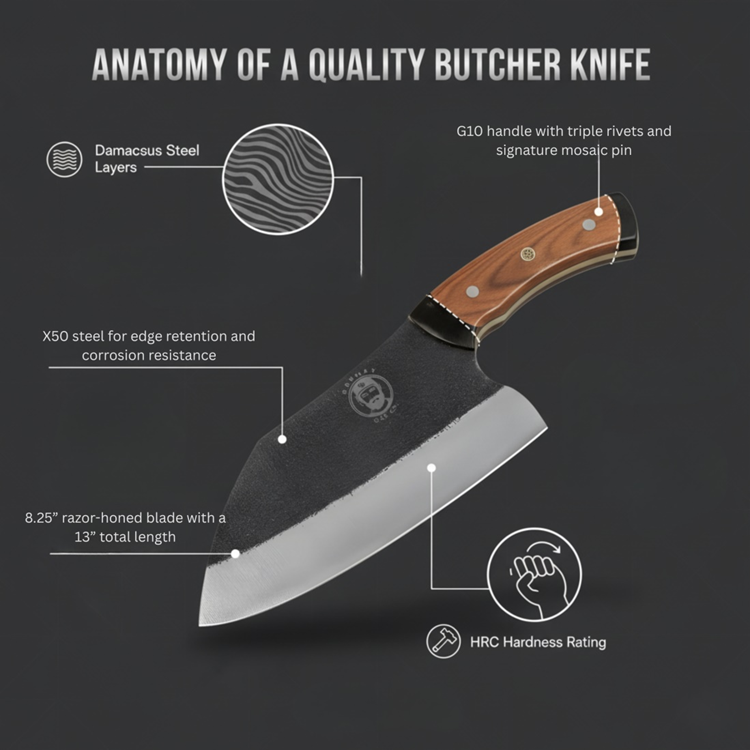
- “Tungsten Damascus 67-layer steel.” Layer count is mostly cosmetic. The cutting performance comes from the core steel, not the cladding layers. (See our Damascus vs Standard guide.)
- “Cryogenic-treated steel” without specifics. Cryo treatment can improve some steels by transforming retained austenite. But “cryo treated” with no other context is often a marketing badge, not an actual process step.
- Vague “high-carbon stainless steel.” True for almost every kitchen knife on earth. Tells you nothing.
- “Better than VG-10” claims with no specifics. Better in what way? Edge retention? Toughness? Corrosion? “Better” without a metric is marketing.
Heat treat: the invisible variable
Same steel, two heat treats, two completely different knives. Heat treat involves:
- Heating the steel to its critical temperature (varies by steel — VG-10 is ~1850°F).
- Quenching at a controlled rate (oil, brine, air).
- Tempering at a lower temperature to balance hardness and toughness.
- Sometimes: cryogenic treatment to lock in the hardened structure.
A famous example: VG-10 from Shun (well-known American brand) consistently performs as expected. VG-10 from a no-name AliExpress knife often performs worse — same steel, worse heat treat.
This is why brand reputation matters. The recipe (steel) is public; the cooking method (heat treat) is the secret sauce.
Stainless vs carbon: the practical decision
| Factor | Stainless | Carbon |
|---|---|---|
| Maintenance | Low | Medium-high |
| Sharpness ceiling | Very sharp | Sharper |
| Sharpening ease | Medium | Easy |
| Patina | None | Develops over time |
| Rust risk | Low | High if neglected |
| Reactivity to acid food | Inert | Can darken food briefly |
| Best for | Daily use, multiple users | Solo home cooks who care |
The carbon vs stainless choice is more about lifestyle than performance. A carbon knife rewards attention; a stainless knife forgives inattention. Pick the one that matches your kitchen rhythm.
What about clad blades?
Many premium Japanese knives are san-mai or damascus-clad — a hard core steel sandwiched between softer outer layers. The core does the cutting; the cladding adds toughness, beauty, and sometimes corrosion resistance to a carbon core.
Common combinations:
- VG-10 core with 16-67 layer Damascus cladding: the classic premium home knife.
- SG2 core with stainless cladding: high-end Japanese.
- Aogami (Blue) core with iron cladding: traditional Japanese carbon, sushi chef territory.
The performance is dictated by the core. The cladding is mostly aesthetic and structural support.
The Grumpy Dad recommendation by tier
Under $50
Steel target: X50CrMoV15 or 1.4116 from Mercer or Victorinox. Honest workhorse steel from honest brands.
$50–$150
Steel target: VG-10 from Tojiro DP, Mac Pro, or Wüsthof Classic in stainless. Real upgrade in edge retention and feel.
What we stock in this band: the Satake VG10 Damascus Santoku ($125) — the same VG-10 core as the names above, Damascus-clad, made in Seki, Japan, without the brand premium. Starting cheaper? The Grumpy Dad 8″ Damascus Chef Knife ($55) is the honest entry point.
$150–$300
Steel target: SG2/R2 from Shun Premier, Tojiro Pro Damascus, Misono UX10. Premium edge longevity, beautiful finishes.
Ours in this band: the Satake 69-Layer Damascus Gyuto ($164.98) if you want stainless, or the Yoshida Hamono Deba 6.5″ in Aogami #2 ($154.98) if you have read the carbon section above and still want in.
$300+
Steel target: ZDP-189, hand-forged Japanese carbon (White or Blue), or one-off custom makers. Real differences for committed enthusiasts.
Mistakes that don’t have to do with steel
Plenty of “the steel is bad” complaints aren’t actually about steel:
- Cutting on glass or marble (covered in Cutting Board Showdown) — destroys any steel.
- Dishwasher abuse (covered in Knife in the Dishwasher) — corrodes steel from the outside in.
- Improper sharpening — pull-through sharpeners damage all steel types.
- Wrong angle — sharpening a Japanese knife at a German angle destroys edge geometry.
- Storing edge-down on hard surfaces — physical damage independent of steel.
If your knife is dulling fast and you blame the steel, audit the rest of your habits first.
If you only remember five things
- Brand reputation matters more than steel name. Heat treat is invisible but decisive.
- VG-10 or AUS-10 from a known maker covers most home cooks.
- Higher HRC means harder steel — better edge holding, more brittle.
- Damascus pattern = decoration. The core steel does the cutting.
- Carbon steel rewards care. Stainless steel forgives neglect.
FAQ
Is VG-10 actually different from AUS-10?
Slightly. VG-10 is from Takefu Special Steel; AUS-10 is from Aichi Steel. Chemistry is similar but not identical. Real-world performance overlap is large. Both are excellent mid-tier Japanese stainless. Don’t lose sleep over which.
Is M390 worth the premium for a kitchen knife?
Probably not. M390 is excellent steel but optimized for outdoor and EDC use (corrosion resistance, edge retention against rope and cardboard). For kitchen use, VG-10 or SG2 give similar real-world performance with easier sharpening.
What’s “powder steel”?
Made by atomizing molten steel into fine powder, then fusing under heat and pressure. Result: very uniform internal structure, fewer impurities, generally tougher and more wear-resistant. Examples: SG2, S35VN, M390. More expensive to manufacture, often shows in $200+ knives.
Do “Damascus layers” affect cutting performance?
Mostly no. The cutting edge comes from the core steel. The Damascus layers (the visible pattern) are cladding — they affect aesthetics, slightly affect blade rigidity, and traditionally protected the carbon core from corrosion. Layer count is marketing decoration once you’re past 30 or so.
What’s the best steel for someone who hates sharpening?
Soft stainless (X50CrMoV15, 1.4116). It dulls faster but takes a new edge in 30 seconds on a pull-through (acceptable for cheap knives) or 5 minutes on a whetstone. The “easy come, easy go” steel.
Is Chinese-made VG-10 the same as Japanese-made VG-10?
The steel might be (the recipe is public), but the heat treat usually isn’t. Chinese-made VG-10 from no-name brands often performs worse than Japanese-made VG-10 because of inferior heat treatment. Buy from established brands regardless of where the steel originated.
What steel do “celebrity chef” knife brands use?
Almost always X50CrMoV15 or similar soft stainless under a celebrity-branded handle. The endorsement adds zero to the steel quality. You’re paying for the name, not the cutting.
The Grumpy Dad Promise
Buy by brand reputation first, then look at the steel name as a secondary check. VG-10 or AUS-10 from a real Japanese maker, or X50CrMoV15 from a real German maker, gives you 95% of the kitchen experience anyone needs. The exotic alphabet soup beyond that is for hobbyists, collectors, and people who genuinely sharpen at 12° on $80 whetstones.
Skip the “premium tungsten Damascus” Amazon deals. Skip the steel-name marketing on cheap brands. Spend $50–$200 on a knife from a maker who’s been making knives for 50+ years, and you’ll be ahead of 95% of home kitchens. Now go grind something — preferably onions, not your edge.