Can You Put a Knife in the Dishwasher? (Short Answer: No. Long Answer: Hell No.)

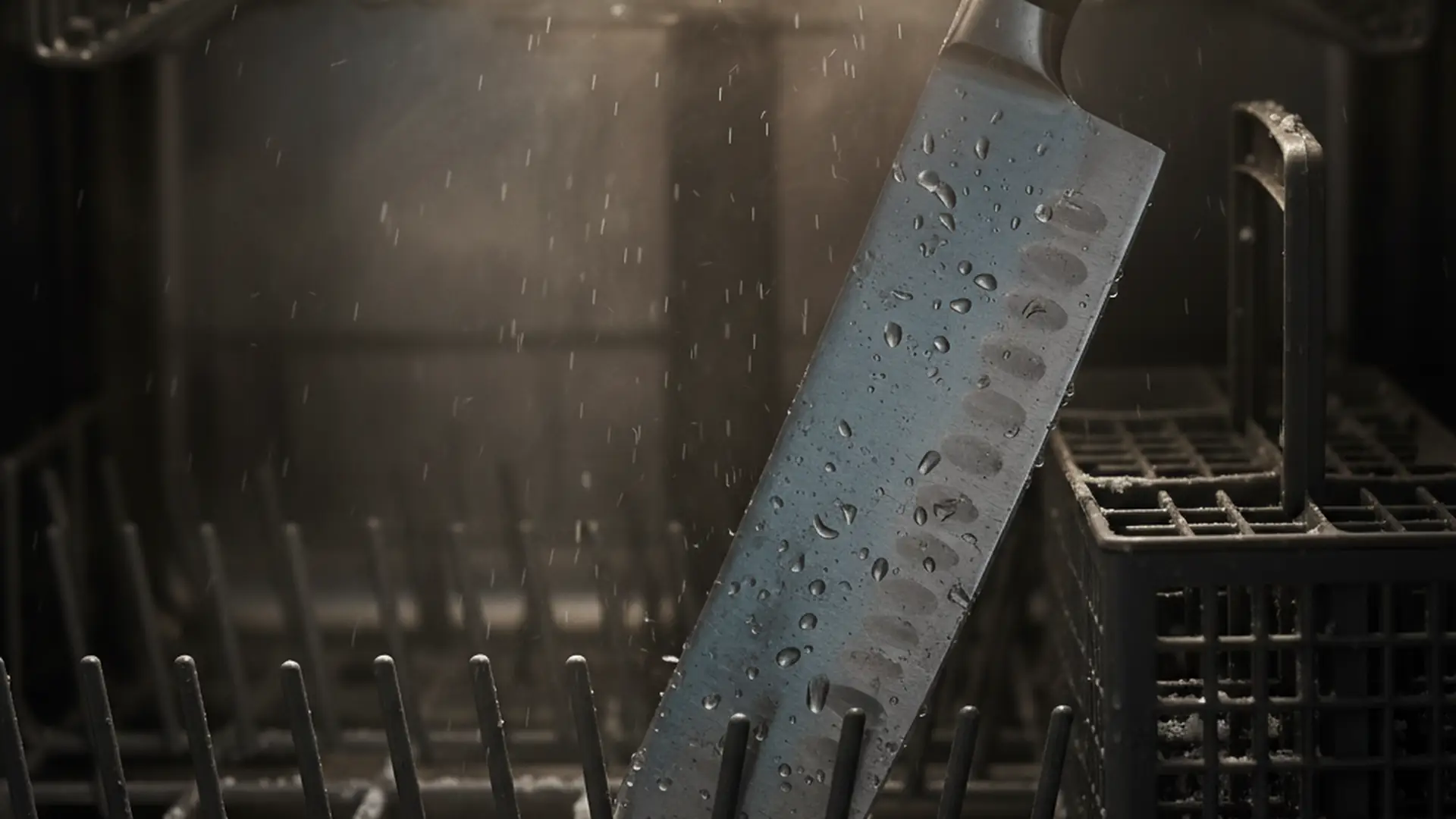
Look, you know you’re not supposed to. The instruction card that came with the knife said so. Your wife said so. The internet said so. But it’s late, the rack still has room, and what’s the worst that can happen — really? It’s a knife. Steel. Tough. It’ll be fine.
It will not be fine.
Putting a kitchen knife in a dishwasher is not a “small mistake” or a “controversy.” It’s a slow-motion act of vandalism on something you spent real money on. The damage is rarely catastrophic in one cycle — it’s cumulative across dozens of cycles. The knife comes out looking mostly normal. It cuts mostly the same. Mostly. And that’s the trap.
This is the no-nonsense breakdown. Exactly what happens to a knife in there — chemically, thermally, mechanically. The myths people use to justify it. The 30-second hand-wash routine that takes less effort than loading the rack. And the rare exceptions where dishwasher tolerance is real (spoiler: almost never).
The 30-second answer
No. Hand-wash with hot water and dish soap. Towel-dry immediately. Put away. Total time: under 30 seconds. The knife you save is one you’ve already paid for. The dishwasher cycle “saves” 10 seconds and costs you steel, edge, and handle integrity. The math is not close.
What actually happens to a knife in a dishwasher
Five problems, all happening simultaneously. Each one is small. Stacked across hundreds of cycles, they retire knives years before their natural lifespan.
1) High heat warps the blade
A typical dishwasher cycle hits 130–160°F during wash and over 170°F during the heated dry. Hardened knife steel was heat-treated at very specific temperatures (often 1900°F+ for hardening, then tempered at 300–600°F). The dishwasher’s repeated heating-and-cooling cycles don’t reach tempering temperature, but they do create thermal cycling that can cause:
- Micro-warping in thin Japanese blades.
- Residual stress in heavier Western blades that shows up as bent edges over time.
- Loss of the perfectly flat profile that lets a blade slice tomatoes without sawing.
You don’t see the warp after one cycle. You see it after fifty. The blade lays flat-ish on the counter but the edge no longer touches uniformly across the length.
2) Dishwasher detergent eats the steel
Standard dishwasher detergents are highly alkaline (pH 10–12) and contain enzymes, surfactants, and bleaching agents engineered to dissolve food residue at high heat. They are also corrosive to:
- Carbon steel (no protection — it pits and rusts within a single cycle).
- Lower-grade stainless steel (the “stainless” coating depends on a thin layer of chromium oxide that detergent strips).
- Hardened high-end stainless (better, but not immune — repeated exposure causes pitting along the edge over months).
- Damascus pattern layers (cladding can show black streaks where detergent etched the softer outer steel).
Pitting is irreversible. Once the steel surface has microscopic crater marks, the cutting edge can no longer be sharpened to a clean line — the abrasive grinds across hollows and ridges instead of flat steel.
3) The dishwasher rack chips tips and edges
Every dishwasher rack has metal-coated wires and plastic-tipped pegs. Every cycle, water pressure jostles the load. Every rinse, the load shifts. A knife in there is bumping into:
- Other metal utensils.
- The plastic-coated wires (which contain steel underneath).
- Glasses and ceramics that occasionally cycle into adjacent positions.
- The walls of the basket itself.
Tip damage is the most common dishwasher injury to knives. The very narrow point of a chef’s knife or paring knife is the most fragile part of the blade — and it’s exactly the part most exposed to rack collisions.
4) Heated dry destroys handles
Wood handles split. Polymer composite handles crack at the rivets. Plastic handles soften, deform, and develop hairline fractures that grow over time. Even pakkawood (the polymer-impregnated wood often used on mid-range knives) loses its bond between layers in a heated drying cycle.
The handle damage is rarely noticed in the first 6–12 months. Then one day the handle wobbles. Then a rivet pops. Then the knife is unsafe to use because the blade can torque inside the handle during a hard cut.
5) Water spots and loss of finish
Hard water plus high heat plus alkaline detergent leaves mineral deposits on the blade. On a polished Japanese knife, those deposits etch permanent water marks. On a satin-finished Western knife, they cloud the finish. Aesthetically — and these things are bought partly for aesthetics — the knife looks tired, used, dull, even when sharpness is intact.
You can buff some of this out with metal polish. You can’t undo the etched layer underneath.
The five myths that justify dishwasher use
Myth 1: “It’s stainless steel — it can’t rust.”
“Stainless” doesn’t mean “rust-proof.” It means “rust-resistant.” The stainless quality depends on a passive chromium oxide layer that high-pH detergent strips. Once stripped, the underlying steel is just steel and rusts like any other steel — usually first as small brown freckles along the edge.
Myth 2: “The label says dishwasher-safe.”
Some manufacturers label knives “dishwasher-safe” because the label sells more knives. The label means “the warranty won’t be voided” — not “the knife will be unaffected.” Read the actual care card; nearly every quality knife brand recommends hand-wash even on “dishwasher-safe” lines.
Myth 3: “I put it in handle-up so the blade doesn’t bang.”
Handle-up exposes the most fragile parts (tip, edge) to the basket bottom and direct water blast. Handle-down is safer but sticks the handle into the bottom water, where heat and detergent concentrate. Neither orientation actually solves the chemistry, the heat, or the contact problem.
Myth 4: “It’s a cheap knife — who cares.”
The damage rate is the same regardless of price. A $30 knife dies faster from dishwasher abuse than a $300 knife dies from being neglected. The economics of replacement aren’t great either: replacing a dishwasher-damaged $30 knife every 18 months costs $20+/year vs. zero for hand-washing.
Myth 5: “I rinse it before bed and put it in the dishwasher in the morning.”
The damage isn’t from food residue. It’s from the cycle itself. Rinsing first and then running it through the cycle is exactly the same damage profile.
The 30-second hand-wash routine
Faster than loading it into the rack. Genuinely.
- Right after use: rinse food off the blade under warm running water (5 seconds).
- Soap: drop of dish soap on a sponge, wipe spine-to-edge along both sides (10 seconds).
- Rinse: warm water, both sides (5 seconds).
- Dry: towel from spine to edge, both sides, then handle (8 seconds).
- Put away: magnetic strip, in-drawer organizer, or saya. Not loose in a drawer. (See our Knife Storage 101 guide.)
Total: under 30 seconds. The dishwasher rack-loading routine for that single knife — opening the door, sliding out the rack, fitting the knife in without bumping the wineglass — is similar time, plus the cumulative damage.
If you’re hand-washing other dishes in the same session anyway, the marginal time for one knife is essentially zero.
What if I already put it in the dishwasher last night?
One cycle isn’t catastrophic for most modern stainless knives. Don’t panic.
- Inspect the blade for any new spots, pitting, or discoloration. Buff out water spots with Bar Keepers Friend or a metal polish.
- Run the paper test (or tomato test). If the edge is still cutting cleanly, you’re fine.
- Check the handle for any new looseness, cracking, or moisture penetration.
- Don’t do it again.
For carbon steel knives, treat one dishwasher cycle as a serious incident — strip any developed rust, oil the blade fully, restore the patina. (Our Carbon Steel Knife Care guide covers the recovery process.)
The very rare exceptions (where dishwasher tolerance is real)
Some specific knives are designed to survive dishwasher cycles. They’re worth knowing because they exist — and so does the marketing that pretends every knife belongs in this category.
- Victorinox Fibrox line. Stainless steel, fully molded polypropylene handle, designed for restaurant kitchens that run everything through industrial dishwashers. Will survive consumer dishwasher cycles. Still recommended hand-wash by Victorinox itself, but tolerates abuse better than most.
- Mercer Millennia, Dexter-Russell Sani-Safe. Restaurant workhorses with similar build philosophies.
- NSF-certified molded plastic-handle knives. Often labeled “commercial” or “food-service grade.” Designed for industrial sanitization.
What these all share: cheap stainless steel that’s tolerant of detergent (because it never had a fancy passive layer to strip), molded plastic handles with no rivets or wood, and edges that are designed to be sharpened often anyway. They are not premium knives. They are tools that survive the dishwasher because nothing premium about them needs protection.
If you own a $40 Victorinox chef’s knife as a backup or your only knife, putting it in the dishwasher is a tradeoff with relatively low cost. You’ll dull the edge a little faster; the steel is forgiving; the handle won’t fail. It’s not great, but it’s defensible.
If you own anything else — Wüsthof, Henckels, Shun, Mac, Misono, Tojiro, Global, hand-forged Japanese, anything from a knife shop, anything with wood or pakkawood — the dishwasher is sabotage.
What about expensive knives marketed as “dishwasher-safe”?
Some premium brands now market certain lines as “dishwasher-safe.” The marketing is technically accurate (the warranty covers it) and practically misleading (the knife will still degrade faster than hand-washed). The brand doesn’t lose money — they sell you another knife in 5 years instead of 15. The math works out for them. It does not work out for you.
Read the warranty fine print. Most “dishwasher-safe” labels specifically exclude:
- Cosmetic damage (water spots, discoloration).
- Edge wear from chemical exposure.
- Handle damage from heat cycles.
So what is covered? Manufacturing defects in the steel — which would be covered whether you washed it in a dishwasher or not. The “dishwasher-safe” label provides almost zero practical protection.
The knife block / drying rack mistake
Even hand-washed, a knife can still get dishwasher-adjacent damage:
- Damp drying rack: a hand-washed knife laid in a wet rack with other dishes for hours absorbs moisture, especially through wood handles. Dry it with a towel immediately, then store properly.
- Going back into a wood block while wet: traps moisture in slots, grows mold, rusts the blade. Always fully dry the knife before putting it in any wood storage.
- Sitting in soapy water in the sink: “soaking” a knife is identical to a brief dishwasher cycle. Detergent + heat + time. Don’t soak knives. Wash, rinse, dry, store.
Mistakes that compound the dishwasher problem
- Putting the knife in the dishwasher and also using a glass cutting board (covered in our Cutting Board Showdown). Two assaults on the edge in the same dinner.
- Pulling the knife out at the end of the cycle while it’s still wet and putting it directly in a block. Rust starts within hours.
- Letting the knife sit in standing water at the bottom of the rack between cycles. Water spots become permanent.
- Running detergent-heavy cycles (“pots and pans” mode) with the knife included. Higher heat, harsher chemistry.
What to do with the dishwasher-damaged knife you already have
Most knives that have been through dozens of dishwasher cycles can be partially saved.
- Inspect. Run the paper test, check the tip, look for handle wobble, scan the blade for pitting.
- Restore the edge. Send to a professional sharpening service or use a whetstone (1000-grit start, then 4000+). Removes most surface damage and creates a fresh cutting edge.
- Polish the blade. Bar Keepers Friend on a damp cloth, rub spine-to-edge, rinse, dry. Removes surface oxidation, water spots, and minor stains.
- Address the handle. If wobble exists, decide whether to retire (cheap knife) or have it rehandled by a pro (premium knife).
- Commit to hand-washing going forward. The damage is largely cumulative. Stopping the cycle stops new damage.
If the knife is past saving, see our When to Retire a Kitchen Knife guide for the honest exit strategy.
If you only remember five things
- “Dishwasher-safe” on a knife label is marketing, not protection.
- Hand-washing takes 30 seconds. Less than loading the rack.
- The damage is cumulative — one cycle won’t kill it, fifty will.
- Dry the blade fully and immediately. Damp storage is its own slow disaster.
- The only knives that genuinely tolerate the dishwasher are cheap commercial-grade workhorses. Everything else suffers.
FAQ
What about putting the knife in the upper rack instead of the bottom?
The upper rack avoids direct heat from the bottom heating element but doesn’t avoid detergent, water pressure, or rack contact. Marginally better. Still bad.
Can I use eco-friendly low-temperature dishwasher detergent for knives?
Better than standard detergent, but still alkaline. Reduces some pitting risk. Doesn’t fix heat or rack contact. Hand-wash is still the right answer.
Are NSF-certified knives meant to go in the dishwasher?
NSF certification is about food safety and sanitization tolerance, not edge preservation. NSF knives can survive industrial sanitization but the edge still dulls faster than hand-washed. Restaurants accept this tradeoff because they sharpen daily. Home cooks shouldn’t.
What about ceramic knives?
Ceramic blades are inert to most dishwasher chemistry and tolerate heat better than steel. The handles, however, suffer the same heat-cycling damage. Also, ceramic chips on rack contact more easily than steel. Hand-wash anyway.
Can I dry a hand-washed knife in the dishwasher’s heated dry cycle?
That’s still subjecting the knife to dishwasher heat. Just towel-dry it. Done.
How do I get my dad/spouse/teenager to stop putting the knives in the dishwasher?
Move the knives to a magnetic strip or in-drawer organizer where they’re visibly not part of the “dish loading routine.” Out of the rack’s logical pathway. Visual cue replaces the conversation.
What’s the realistic lifespan difference?
A mid-range chef’s knife hand-washed: 15–25 years. The same knife dishwashed weekly: 5–8 years. The same knife dishwashed daily: 2–4 years. The math is real.
The Grumpy Dad Promise
Take the knife out of the rack. Wash it by hand for 30 seconds. Towel-dry. Put it on the magnetic strip. That’s the entire commitment. In return, you get a knife that lives 3–5x longer, holds its edge between sharpenings, doesn’t develop pitting along the bevel, and doesn’t randomly torque in your hand when the handle finally fails after 800 dishwasher cycles.
The dishwasher is brilliant at most things. Knives aren’t one of them. Now go take that knife out of the rack you just loaded.
🧼 Keep that edge alive
The dishwasher is where good knives go to die. Protect yours the easy way: a wipe of camellia oil, a rust eraser for emergencies, and the full Care Guide. New to blade care? Read How to Stop Your Knife From Rusting.