Western vs Japanese Chef’s Knife: Which Style Belongs in Your Hand (Honest Breakdown)

You’ve held a German chef’s knife. It feels like a tool. Heavy, balanced toward the bolster, ready to bash through a chicken thigh and apologize to no one. Then you pick up a Japanese gyuto for the first time and it feels like someone handed you a scalpel that took the liberty of also being a knife. Lighter. Sharper. Suspiciously precise.
Quick answer: Pick Western (German/French) if you cook a lot of meat, bones, and hard veg and don’t want to baby a knife — softer 56–58 HRC steel forgives abuse. Pick Japanese (gyuto, santoku, bunka) for veg, fish, and surgical precision — harder 60–66 HRC steel stays sharper but chips. Best move for most: a hybrid.
- Western steel runs 56–58 HRC — softer, tougher, easier to sharpen, forgives the occasional bone or frozen mistake.
- Japanese steel runs 60–66 HRC — holds a finer edge far longer but chips if you twist it through bone.
- Edge angles differ: Western 18–22° per side (sturdy); Japanese 12–16° per side (glassy-sharp, less forgiving).
- A hybrid (Western shape, Japanese steel) like a Misono UX10 or Tojiro DP is the lowest-regret first upgrade.
- Neither belongs in a dishwasher. Ever. Edge geometry and care habits matter more than the country stamped on the blade.
Two different schools. Two different ways to cook. Both correct. Both wrong for the wrong cook. The internet wants you to believe Japanese is “better” because it’s expensive and the marketing is breathless. The reality is more boring: the right chef’s knife is the one that matches how you actually use it. Picking the wrong style isn’t a moral failing — it’s just a knife that won’t get used.
This is the no-nonsense breakdown. What each style is. Where they came from. The actual differences in steel, edge angle, weight, and grip. Which one fits which cooking style. And the marketing traps that get dads buying $400 Japanese knives they’re scared to use.
The 30-second answer
Cook a lot of meat, bones, hard vegetables, and don’t want to baby a knife: Western (German or French). Cook mostly vegetables, fish, want surgical glide and don’t mind drying the blade after use: Japanese (gyuto, santoku, bunka). Hate the idea of choosing: a hybrid (Western shape, Japanese steel) like a Wüsthof Classic Ikon or a Misono UX10.
That’s the whole map. Everything below is the why.
Where they each came from (and why it matters)
Western chef’s knives evolved from European butcher tools. Tradition: large animal breakdown, big proteins, robust handling. The knife had to bone, slice, cleave through small cartilage, all without chipping. Steel: tougher, softer, more forgiving. Geometry: wider belly, more rocking motion.
Japanese chef’s knives evolved from sushi and vegetable preparation traditions, plus later adaptations of Western shapes for Japanese cooks. Tradition: precision, single-portion clean cuts, fish, vegetables. Steel: harder, sharper edges that hold longer but chip if abused. Geometry: thinner spine, flatter profile, push-cutting motion. If you want to explore what that looks like in practice, our Japanese Knives collection covers the full range of styles and steel types.
Different jobs, different solutions. Both extremely good at what they were built for.
The five real differences (everything else is fluff)
1) Steel hardness (HRC)
HRC is the Rockwell hardness rating. It’s a useful comparison number, not an absolute quality measure.
- Western chef’s knives: 56–58 HRC. Softer steel. Easier to sharpen, harder to chip, takes a less aggressive edge angle.
- Japanese chef’s knives: 60–66 HRC. Harder steel. Holds a finer edge longer, but chips if you twist it through a chicken bone.
Practical translation: a Japanese knife stays scary-sharp longer between sharpenings. A Western knife forgives the occasional dad mistake of cutting frozen butter.
2) Edge angle
- Western: 18–22° per side. Wider, sturdier, more forgiving.
- Japanese: 12–16° per side. Narrower, glassy-sharp, less forgiving.
Onions don’t care about wide angles. Brisket trim doesn’t either. Frozen things do — a 14° edge is happy slicing room-temperature meat and unhappy meeting an ice crystal at full speed.
If you don’t know what edge angle yours is at, our Honing vs Sharpening guide covers how to tell and what to do about it.
3) Weight and balance
- Western (8″ chef’s): 7–10 oz. Forward-balanced toward the bolster. Designed for rock-chopping and downward force from the wrist.
- Japanese (240mm gyuto): 5–7 oz. Mid-balanced or slightly handle-heavy. Designed for push-cutting and pull-cutting motion driven by the arm and shoulder, not the wrist.
Western knives let gravity do half the work. Japanese knives ask you to provide the motion — but require less force per cut because the geometry is doing more of the work.
4) Profile (the curve of the edge)
- Western: noticeable belly curve. Excellent for rock-chopping (heel pinned to the board, tip rocks up and down).
- Japanese: flatter profile, especially near the heel. Excellent for push-cutting (full edge meets the board in one motion) and the slap-chop technique professional cooks use for speed.
If you’ve spent 20 years rock-chopping onions on a German knife, a flat-profile gyuto will feel weird for a week. After that week, you’ll be faster.
5) Handle
- Western: riveted, full-tang, contoured grip. Often heavier polymer composite or stabilized wood. Sits low in your palm, feels like a tool.
- Japanese (traditional wa-handle): octagonal or D-shaped wood handle, often a friction-fit tang inside the handle. Lighter, neutral feel, less ergonomic but more nimble.
- Japanese (yo-handle): Western-style riveted handle on a Japanese blade. Best of both worlds for someone transitioning.
Wa-handle knives are not “worse” because they aren’t molded — they’re built for a different grip style (pinch grip with thumb and forefinger on the blade itself, not wrapped around the handle).
Side-by-side comparison
| Feature | Western (German/French) | Japanese (Gyuto/Santoku) |
|---|---|---|
| Hardness (HRC) | 56–58 | 60–66 |
| Edge angle | 18–22°/side | 12–16°/side |
| Weight (8″/240mm) | 7–10 oz | 5–7 oz |
| Profile | Curved belly | Flatter heel |
| Best motion | Rock-chop | Push-cut, pull-cut |
| Forgives abuse | Yes | No (chips) |
| Edge longevity | 2–4 weeks at sharp | 4–8 weeks at sharp |
| Ease of sharpening | Easy | Harder, less margin |
| Typical price (decent) | $80–$200 | $120–$400+ |
| Dishwasher tolerance | None — never | None — really never |
What each one is great at
Western chef’s knife wins at:
- Whole chickens (joints, small bones).
- Squash, pumpkins, hard winter vegetables.
- Frozen items (with care).
- One-knife-for-everything households.
- Cooks who don’t sharpen often.
- Rock-chopping technique (the most common home cook motion).
- Surviving years of mild abuse.
Japanese chef’s knife wins at:
- Vegetables, especially fine julienne and brunoise.
- Fish and seafood breakdown.
- Tomatoes (the test of a sharp knife).
- Cooks who already sharpen and care for blades.
- Push-cutting and the slap-chop technique.
- Anyone who cooks a lot of stir-fries, pho, or Asian-influenced dishes.
- Looking like you know what you’re doing.
Which style fits how you actually cook
“I cook 4–5 times a week, mostly proteins with some veg”
Western. The forgiving steel, the rock-chop profile, and the ability to mishandle a chicken thigh without chipping are worth more than the marginal sharpness gain of a Japanese knife you’ll be too nervous to use.
“I do a lot of vegetable prep — stir fries, salads, daily veg sides”
Japanese. The thinner edge glides through onions, peppers, and herbs. You’ll cook faster and your hand will be less tired at the end.
“I want one knife for the next 30 years and I’ll baby it”
Either, but a Japanese hand-forged gyuto with great steel will reward the patience. The Hand-Forged Kurumi Shikaku Bunka Knife is one example of the kind of craftsmanship worth committing to. Get the saya. Hone with ceramic. Sharpen properly. (See our Best Kitchen Knife buying guide for the broader steel-and-geometry rules.)
“I’m scared of expensive knives”
Western. Specifically a Wüsthof Classic, Henckels Pro, or Mac Professional. Workhorse, mid-priced, takes punishment, sharpens easily.
“I love the rock-chop, hate flat profiles”
Western. Or a Western-style Japanese hybrid (Misono UX10 — Japanese steel, Western shape, mid-balance).
“I cut a lot of soft, ripe tomatoes and the current knife squishes them”
Japanese. Or sharpen your Western knife properly. Either fix works.
The hybrid category (the smartest move for most dads)
You don’t have to choose between schools. Hybrid knives apply Japanese steel and edge geometry to Western blade shapes and handle styles. Best of both worlds, fewer compromises.
- Misono UX10 (8.2″ gyuto): Swedish stainless at 59 HRC, Western shape, riveted Western handle. Around $270.
- Mac Professional Series: Japanese-made, Western shape, harder steel at moderate price. $130–$180.
- Wüsthof Classic Ikon (modern bolster): German workhorse with a refined edge profile. Forgiving but better-cutting than the entry Wüsthof Classic. $200.
- Tojiro DP F-808: Japanese VG-10 core with Western handle. Famous “first nice knife” recommendation. $90–$110.
If you’re new to higher-end knives and don’t know which philosophy fits you yet, a hybrid is a low-regret first move. After 18 months of using one, you’ll know which way you lean.
Care differences (the part where Japanese knives demand more)
Western knives are tough. You can:
- Cut on a wood or plastic board.
- Wash with soap and water, towel-dry, put away.
- Hone weekly, sharpen every 3–6 months.
- Survive accidental contact with bone or a stray olive pit.
Japanese knives ask for more:
- Wood or soft plastic boards only — never glass, marble, or stoneware.
- Wash and dry immediately, never sit in the sink. Especially carbon steel.
- Hone with ceramic, not steel rod.
- Sharpen properly — pull-through sharpeners are a felony here. A quality whetstone and proper storage are the minimum commitment.
- Protect tip and edge — magnetic strip approach spine-first, drawer organizer with sleeves.
None of this is hard. It’s just deliberate. If “deliberate” sounds like a chore, Western is your answer.
The “Damascus” problem
Most Japanese-style knives sold in the West today have a layered “Damascus” pattern on the cladding. Real or fake?
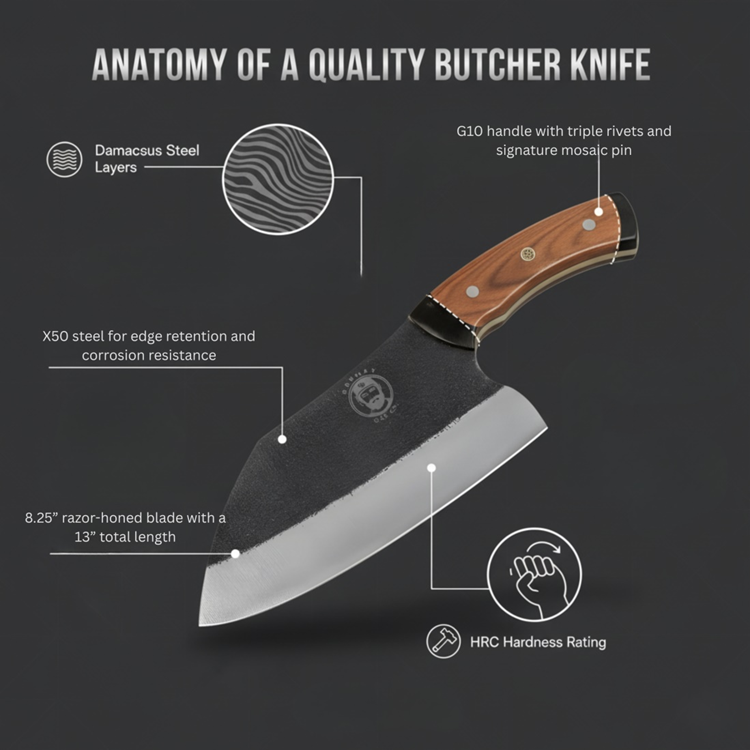
- Real Damascus cladding: a hardened core steel (VG-10, AUS-10, ZDP-189, R2/SG2) sandwiched between forge-welded layers of softer steel that produce a visible pattern when etched. The core does the cutting; the layers protect the core and look beautiful. The SATAKE 69-Layer Aichi Stainless Damascus Chef Knife is a good example of how this is done right.
- Fake “Damascus”: laser-etched or printed pattern on a single steel blade. The pattern is decorative only. The cutting performance is whatever the underlying steel is — usually disappointing.
If you’re paying for Damascus, verify the core steel and the layer count. Real Damascus claims should specify both. (Full breakdown in our Damascus vs Standard guide.)
Here’s how the steels you’ll actually see named on a spec sheet stack up — because the name on the box is only half the story:
| Steel | Origin / school | Typical HRC | What it’s good at |
|---|---|---|---|
| X50CrMoV15 | Western (German) | 56–58 | The Wüsthof/Henckels workhorse. Tough, forgiving, easy to sharpen. |
| VG-10 | Japanese | 60–61 | The classic “first nice knife” core. Sharp, stain-resistant, widely available. |
| AUS-10 | Japanese-formulated | 59–61 | Solid budget core — but made worldwide, so heat treat decides everything. |
| SG2 / R2 | Japanese (powder) | 62–64 | Premium edge retention, fine grain. Sharp for ages, less forgiving. |
| ZDP-189 | Japanese (powder) | 64–66 | Extreme hardness and edge life. Chips if you look at it wrong. |
Marketing traps to spot
- “Hand-forged in Japan” with a Japanese-sounding brand and a $39 price tag. You’re getting a stamped blade with a kanji sticker. Real Japanese hand-forged knives start around $200.
- “Damascus chef knife” as the entire description. Real Damascus knives name the core steel. If they don’t, the pattern is decorative.
- “German steel, Japanese craftsmanship” Amazon brands. One of those statements is probably true. The other is paint.
- “Razor sharp out of the box” claims. Most real Japanese knives are sharp. Most marketing claims of sharpness are not. The factory edge on a $400 Misono UX10 is real. The factory edge on a $59 “professional chef knife” is “sharper than your grandma’s drawer knife” at best.
- “AUS-10 Pro Japanese super steel.” AUS-10 is a real Japanese-formulated stainless. It’s also widely manufactured outside Japan, including in China. The steel name doesn’t tell you who made it or how well it was heat-treated.
Knife size: what 8″ Western and 240mm Japanese mean
Sizes do not translate one-for-one because measurement conventions differ.
| Western Length | ≈ Japanese Length | Best For |
|---|---|---|
| 6″ | 165–180mm | Small kitchens, smaller hands, paring-adjacent |
| 7″ | 180–210mm | Most home cooks, especially smaller hands |
| 8″ | 210–240mm | The default — covers 95% of home cooking |
| 9″ | 240–270mm | Larger preps, full-time cooks, those who like reach |
| 10″+ | 270mm+ | Restaurant and serious enthusiast territory |
For a first or only chef’s knife, 8″ Western or 210–240mm Japanese is the sane default.
If you only remember five things
- Western forgives. Japanese performs. Pick by your tolerance for care.
- Hybrid (Western shape, Japanese steel) is the low-regret move for most home cooks.
- The first 30 days with a Japanese knife feel weird. Push through.
- Never put either one in a dishwasher. Ever. We covered why in our Knife Storage 101 guide.
- Edge geometry matters more than the country. A great Western knife outperforms a mediocre Japanese knife.
FAQ
Can I use a Japanese chef’s knife on chicken bones?
No. Use a heavy Western chef’s knife or a dedicated cleaver. Japanese steel chips on bone. The chip won’t kill you; it’ll just ruin a $300 edge.
Are German knives “worse” because they’re softer?
No. Softer means tougher and more forgiving. The “harder is better” narrative is online enthusiast culture, not real-world cooking truth. Both have their place.
What’s the difference between a gyuto and a santoku?
A gyuto is a Japanese chef’s knife — same general shape as a Western 8″ chef’s, similar uses. A santoku is shorter (165–180mm), flatter, with a sheepsfoot tip. Santoku is great for vegetables and small proteins, less great for full chicken breakdown. Many home cooks own both. If you’re trying to decide which to buy first, our guide on the best Japanese knife set for home cooks breaks down the combinations worth considering.
Does a $400 Japanese knife really cut meaningfully better than a $150 hybrid?
Sometimes. Better steel, better heat treat, more refined geometry — yes, the difference is real. But the gap from $150 to $400 is smaller than the gap from $50 to $150. If your current knife is the $50, the bigger upgrade is to $150, not from $150 to $400.
How long should a chef’s knife last?
A well-maintained chef’s knife — Western or Japanese — should last decades. The blade gets noticeably narrower over many years of sharpening, but the knife itself outlives most kitchen appliances.
Is single-bevel ever the right answer for a home cook?
No. Single-bevel knives (yanagiba, deba, usuba) are specialty tools for sushi prep, fish breakdown, and traditional Japanese vegetable cuts. Beautiful, expensive, and useless for a Tuesday-night chicken stir-fry. Stick with double-bevel for general cooking.
What’s a “western-handled gyuto”?
A gyuto blade (Japanese steel and shape) with a Western-style riveted handle. Combines Japanese cutting performance with the familiar grip Western cooks already know. Genuinely the best entry point for someone curious about Japanese steel.
Is a Japanese knife better than a German knife?
Neither is “better” — they’re tuned for different jobs. Japanese knives cut finer and hold an edge longer; German knives are tougher and shrug off abuse. The better knife is the one that matches how you cook and how much care you’ll actually give it.
Which is sharper, Western or Japanese?
Japanese, out of the box and over time. Harder steel (60–66 HRC) and a narrower 12–16° edge angle make it glassy-sharp. A Western knife can get just as sharp temporarily, but it won’t hold that edge as long.
Should a beginner buy a Western or Japanese chef’s knife?
Start Western or buy a hybrid like a Tojiro DP or Mac Professional. They forgive rookie mistakes, sharpen easily, and won’t make you nervous to actually cook. Go full Japanese once you’ve got knife habits and a sharpening routine down.
Can you sharpen a Japanese knife on a regular pull-through sharpener?
No — that’s the fast way to ruin it. Pull-through sharpeners tear at hard, thin Japanese edges. Use a whetstone, and hone with a ceramic rod rather than a steel one.
The Grumpy Dad Promise
Pick the school that matches the cook, not the cook who lives in your imagination. The dad who cooks weekly with a sharp Western knife eats more home-cooked food than the dad who owns a $500 gyuto and is too nervous to use it. Either school will outperform what’s in 90% of American kitchens — assuming you keep it sharp, dry, and out of the dishwasher.
Buy the knife. Cook with it. Sharpen it. Don’t put it in a drawer with the bottle opener. That’s the whole job.