How to Stop Your Knife From Rusting: A Dad-Proof Carbon-Steel Care Guide


You spent real money on a good knife. You used it twice. You left it in the sink “just for a minute.” And now there’s a constellation of little brown freckles on the blade and a quiet sense of betrayal. Welcome to rust — the most preventable problem in your entire kitchen.
Good news: rust is not a death sentence, it’s not your knife’s fault, and stopping it forever takes about thirty seconds a day. Here’s exactly how.
Why your knife rusts (it’s not bad luck)
Rust is just iron meeting water and oxygen and deciding to throw a party. The better your knife, the more likely it is to be high-carbon steel — and high-carbon steel is more reactive precisely because it’s harder and sharper. So that rust is, annoyingly, a side effect of the thing that makes the knife great.
Cheap stainless butter-knives don’t rust because there’s barely any real steel doing any real work. Your good knife rusts because it’s actually trying.
Three things accelerate it: sitting wet, contact with acidic foods (lemon, tomato, onion), and being stored somewhere damp. Remove those and rust has nothing to feed on.
The 30-second routine that prevents 99% of rust
This is the whole secret. There is no advanced version. Do this and you’ll basically never see rust:
- Wash by hand, right after use. Warm water, a drop of dish soap, your fingers or a soft sponge. Never the dishwasher — the heat, the harsh detergent, and the long wet cycle are a rust factory.
- Dry it immediately. A towel, ten seconds, both sides. Do not leave it on the rack to “air dry.” Air drying is just slow rusting with extra steps.
- Don’t let it soak. A knife sitting in a sink of dishwater is a knife actively rusting. Wash it first, set it aside dry.
That’s it. Ninety percent of all kitchen knife rust would vanish from the earth if everyone simply dried their blade. The other ten percent is what the next section is for.
The one upgrade: a thin wipe of oil
If you own carbon steel, or you store knives in a humid kitchen, add one more step: a light coat of food-safe oil before the knife goes away for the night.
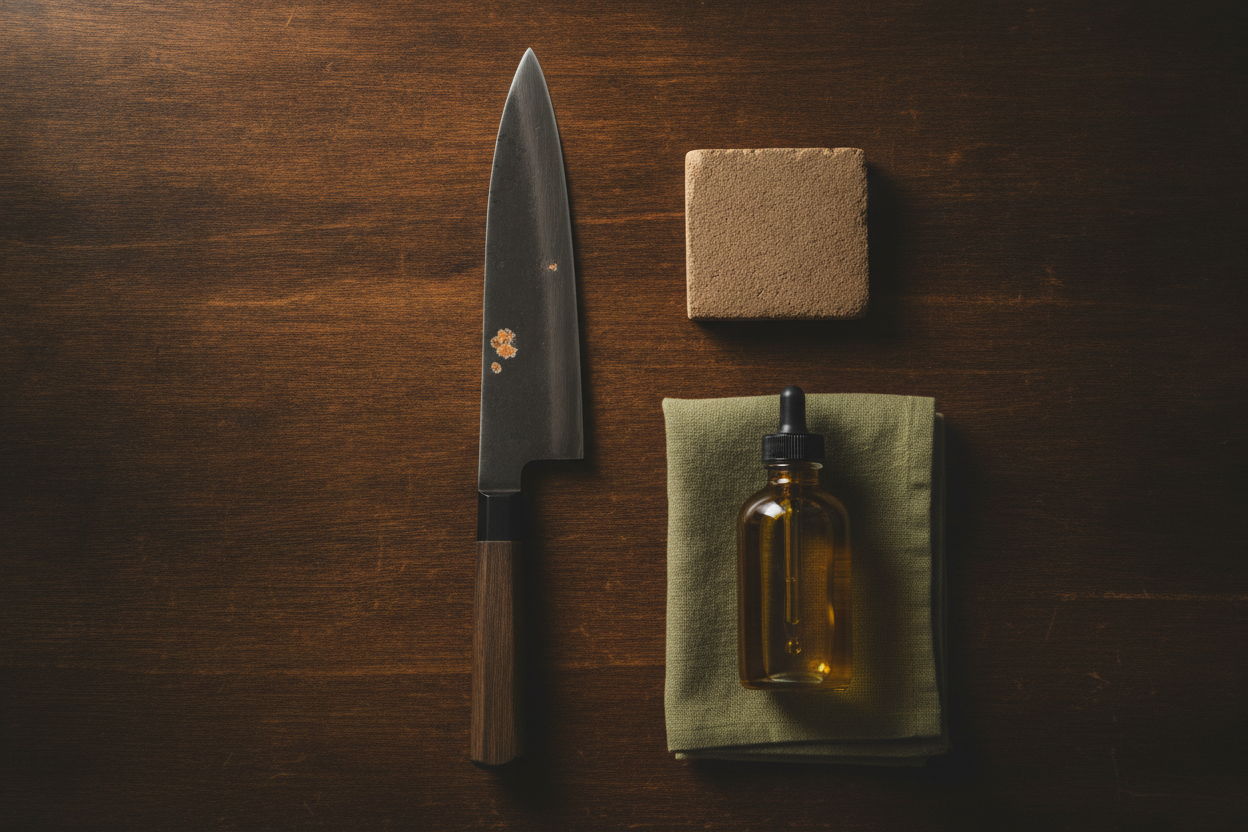
You want a food-grade, non-rancid oil — which is why the traditional choice is camellia oil (tsubaki). It’s odorless, tasteless, doesn’t go sticky or rancid like cooking oils can, and forms an invisible barrier between your steel and the air. A few drops on a paper towel, wipe the blade, done. Our Grumpy Dad Co Camellia Oil is the same stuff Japanese craftsmen have used for centuries, and the bottle lasts a very long time because you use so little. Bonus: it conditions wooden handles and cutting boards too.
Already have rust? Here’s how to fix it
Don’t panic and don’t attack it with steel wool — you’ll scratch the finish. Match the fix to the severity:
Light spotting
Make a paste of baking soda and a little water, rub gently along the blade (in the direction of the edge, not across it) with a cloth or cork, rinse, dry. Most fresh spots lift right off.
Stubborn or established rust
This is what a rust eraser block is for. It works like a pencil eraser for metal — a few passes lifts rust and light staining without gouging the steel. It’s the fastest, most satisfying two minutes in knife maintenance, and it’s the tool we reach for before anything more aggressive.
Wooden handle looking dry or grey?
Same camellia oil, rubbed into the wood, brings it back and stops it cracking. One product, two jobs.
Storage: where good knives quietly die
How you store a knife matters as much as how you wash it:
- Best: a magnetic strip or a knife block, somewhere dry and away from the steam of the sink and stove.
- Fine: a blade guard or saya if knives share a drawer.
- Worst: loose in a damp drawer, banging edges with other metal, collecting moisture. That’s how you get a dull, rusty, chipped blade all at once.
You’ll find strips, blocks, guards and the rust-fighting kit together in our Sharpening & Storage collection.
Make it a kit so you never think about it again
The whole anti-rust system is three cheap things: a way to dry, a bottle of camellia oil, and a rust eraser for emergencies. Set them next to where you store your knives and the routine becomes automatic. For the full edge-to-handle maintenance walkthrough, see our Care Guide.
The grumpy bottom line
Rust isn’t a defect — it’s a message that says “you left me wet.” Hand-wash, dry immediately, wipe carbon steel with a little oil, and store it somewhere dry. Do that and your knife will outlive your patience for everyone else’s dull knives. Treat a good blade like it matters, and it’ll return the favor for twenty years.
Stock the rust-prevention basics in Sharpening & Storage, or start fresh with a blade worth protecting in Japanese Knives.