Bread Knife Buyers Guide: Why Cheap Ones Lose Their Bite Fast (And What to Buy Instead)

Slicing bread should be one of the easier things a knife does. The blade is long. The bread is sitting there. The motion is sawing. Nothing is fighting back. And yet — most home cooks own a bread knife that crushes the loaf, tears the crumb, and produces uneven slices that look like a toddler made them with safety scissors. Then everyone blames the bread.
Here’s the thing nobody tells you in the cookware aisle: most bread knives are quietly terrible, and the ones that are great are the ones nobody buys. The 8-inch one in your knife block is probably too short. The cheap “20-piece set” version is probably already dull beyond saving. The $200 designer one with the molded silicone handle is probably still wrong for what you actually slice.
This is the no-nonsense breakdown. How serrations actually cut. Why blade length matters more than steel quality. The two main serration types and which one wins. Why bread knives can’t be sharpened at home. The price tiers that genuinely matter. And how to know when to replace one.
The 30-second answer
For a daily-use bread knife: 10-inch blade minimum, scalloped (not pointed) serrations, comfortable handle. Spend $40–$120 from a real knife brand. Skip the $20 “comes with the set” version. Skip the $250 “artisan” with marketing copy that mentions blacksmiths. The middle is where every actually-good bread knife lives.
How serrations actually cut (the part nobody explains)
A regular knife edge cuts by pressure — a thin metal lip pressing through soft material. That works on tomatoes and chicken breast. It fails on bread.
The problem with bread is that the crust is harder than the crumb. A flat smooth edge tries to cut through both at the same time. The crust resists; the blade pivots; pressure transfers to the crumb; the soft interior crushes before the crust splits.
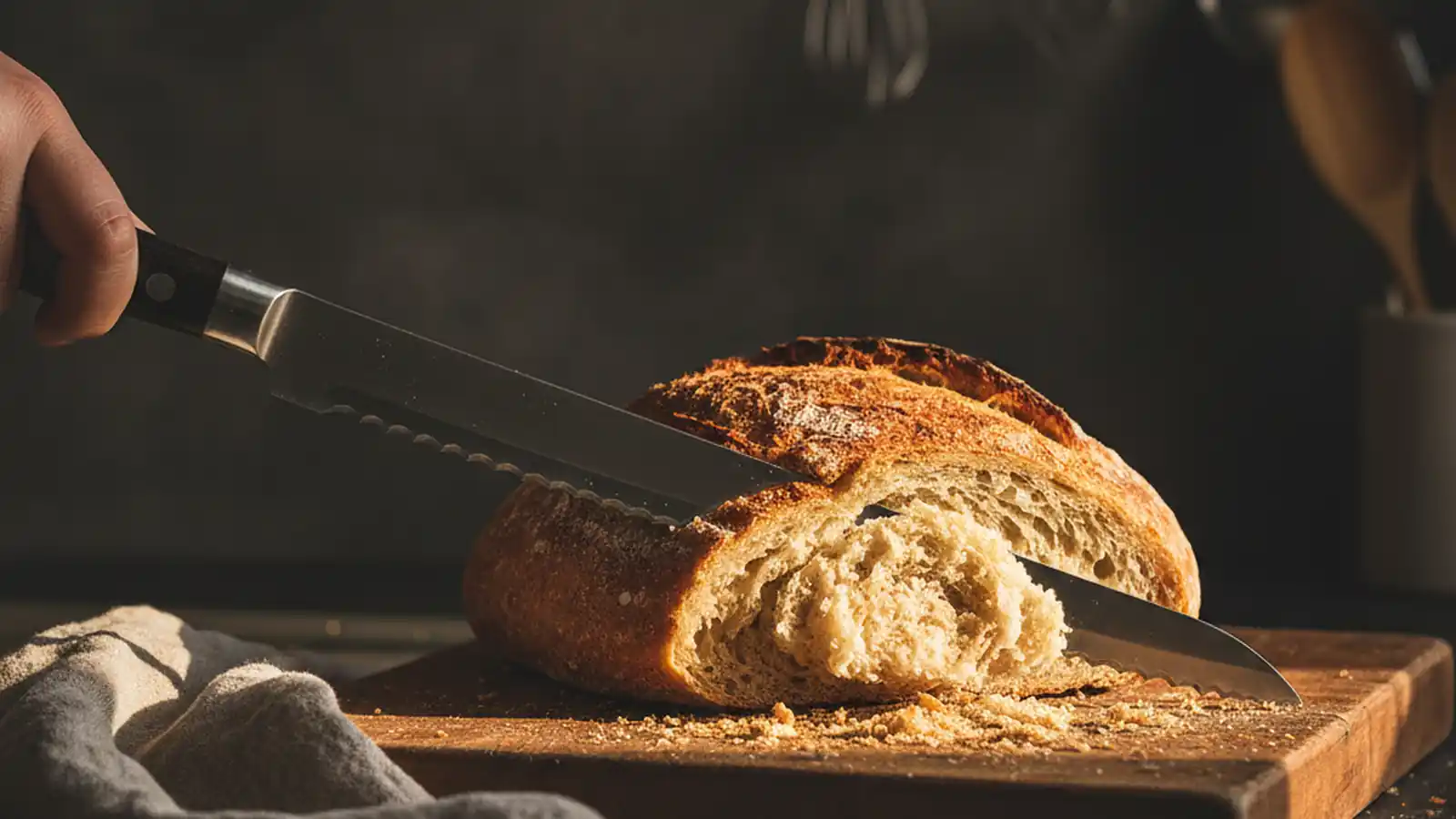
Serrations solve this by spreading the work. Each tooth is a tiny knife with its own angle. As you saw, each tooth bites a small section, accumulates pressure at multiple points along the cut, and pierces the crust without forcing the blade to move sideways. The crumb stays open. The slice stays even.
Cutting bread is not “sawing” in the wood sense — it’s a controlled slide where dozens of small bites happen simultaneously. A long blade with sharp teeth makes one motion through the loaf instead of three.
The blade length problem (the most common mistake)
Most home cooks own an 8-inch bread knife. That’s because the 20-piece block they bought in 2014 came with one. Eight inches is not enough.
To slice a sourdough boule, a country loaf, a French batard, or any modern artisan bread, you need blade length greater than the loaf’s widest dimension plus 2 inches. A typical 9-inch boule needs a 10–11 inch blade minimum. A 10-inch country loaf needs 12 inches. Anything less means you’re sawing back and forth, wrecking the crumb structure with each pass.
| Bread Type | Recommended Blade Length |
|---|---|
| Pre-sliced sandwich bread (cutting in half) | 8″ works |
| Baguette | 9–10″ |
| Country loaf, batard | 10–12″ |
| Sourdough boule (8–10″ diameter) | 11–13″ |
| Whole pullman loaf | 10″ |
| Bagels (cutting horizontally) | 8″ |
| Layer cakes | 10–12″ |
If you bake or buy artisan bread regularly, get a 10-inch as your default and add a 12-inch when you commit to the lifestyle.
The two main serration types
1) Scalloped (rounded teeth)
Wave-shaped curves along the edge, each “tooth” a smooth rounded scallop. The cutting surfaces are the inside of each curve.
- Wins: cleaner cuts on soft crumb, less crumb-tearing, smoother glide on hard crusts.
- Losses: harder to manufacture, more expensive, marginally trickier to sharpen.
The standard for premium bread knives. Wüsthof, Mercer, Mac, Tojiro, Misono all use scalloped serrations on their best bread blades.
2) Pointed (saw-tooth) serrations
Triangular teeth like a saw. Each point is a small spear that pierces, then the inside angle of the tooth slices.
- Wins: aggressive on hard crusts, cheap to manufacture, common on entry-level knives.
- Losses: tears soft crumb, leaves a rougher cut surface, points dull faster than scallops because each point is a stress concentrator.
Common on cheap bread knives. Acceptable for hard crusts and tough loaves. Not ideal for soft sandwich bread or fluffy interiors.
Side-by-side comparison
| Feature | Scalloped Serrations | Pointed Serrations |
|---|---|---|
| Cut quality on crumb | Clean, even slices | Tears, rough edges |
| Cut quality on crust | Smooth glide | Aggressive bite |
| Edge longevity | Slower to dull | Points dull first |
| Sharpening | Pro-only, $15–$25 | Pro-only, $15–$25 |
| Typical price | $40–$200 | $15–$80 |
| Typical lifespan | 10–15 years | 3–7 years |
If you’re buying once and keeping it for a decade, scalloped is the right answer. If you’re outfitting a rental kitchen or you’re hard on knives, pointed is acceptable.
The “you can’t sharpen this at home” reality
This is the part most cookware ads don’t mention: bread knives are essentially un-sharpenable in a typical home setup.
Here’s why:
- Each scallop or tooth has its own internal angle.
- Sharpening requires a tapered rod or specialized abrasive that fits inside each individual scallop.
- You’re sharpening one tiny edge at a time, dozens of times, at consistent angles.
- The edges of the scallops (which do the actual cutting) are tucked inside curves where standard sharpening tools can’t reach.
What this means in practice: when a bread knife goes dull, you have two options:
- Send it to a pro who has tapered ceramic rods, specific bread-knife sharpening jigs, or a dedicated bread knife sharpening service. Cost: $15–$25. Frequency: every 2–4 years for most home cooks.
- Replace it. Sometimes it’s the right call for cheaper knives.
Anyone who sells you a “bread knife sharpener” pull-through gadget is selling you something that grinds the points off your serrations. Don’t.
(For the broader sharpening picture, see our Honing vs Sharpening guide.)
Steel quality: less critical than you’d think
For a chef’s knife, the steel formula matters enormously — edge retention, hardness, sharpening ease. For a bread knife, the differences shrink. Why?
- Bread knives don’t push-cut. They saw. Less stress on the apex of the edge.
- The serrations distribute force across many micro-edges. No single point bears all the cutting load.
- Most of what’s marketed as “premium steel” gives little practical benefit on a serrated edge.
What matters more on a bread knife:
- Geometry: the angle and spacing of the serrations.
- Length: covered above.
- Stiffness: a flexy bread knife wobbles mid-slice and produces uneven thickness.
- Handle ergonomics: long sawing motions amplify any handle discomfort.
That said, don’t go entirely cheap on steel. Stamped low-carbon stainless on a $15 bread knife will lose its bite in months. Mid-range stainless (X50CrMoV15 on Wüsthof, similar on Henckels) gives 5–10 years easily. Higher-end stainless (Wüsthof’s modern proprietary, Mac’s Japanese stainless, Misono’s UX10) gives 10–15+ years.
Handle considerations (more important than people think)
Bread cutting is a slow, deliberate motion. You’re applying force across a long lever (the blade) at a sustained pace. Handle ergonomics matter more than they do for fast-action knives.
- Riveted full-tang Western handle: the standard. Comfortable, durable, dishwasher-vulnerable (but you’re hand-washing anyway, right?).
- Polypropylene molded handle: Mercer Millennia, Victorinox. Lightweight, indestructible, ugly. Good for daily users.
- Wood handle: some Japanese and European bread knives. Beautiful, heavy, requires care (oil occasionally).
- Pakkawood or stabilized wood: the sweet spot for many premium knives. Wood-look with composite durability.
Whatever you choose, hold the knife in the store (or order with a free returns policy). Your hand and the handle have to agree about what “comfortable” means.
The price tiers that genuinely matter
Under $20: skip
Stamped low-carbon steel, plastic handles, pointed serrations. Will last 18 months at best. The bread will not slice well from day one.
$20–$40: workhorse tier
Mercer Millennia 10″, Victorinox Fibrox 10″, Dexter Russell. Mid-grade stainless, polypropylene handles, scalloped serrations on the better ones. Restaurant standard. Will last 5–10 years. The honest “good enough for most home cooks” option.
$50–$120: real upgrade
Wüsthof Classic 10″, Mac SBK-105, Tojiro Pro Bread. Better steel, better serration geometry, better handles. Will last 10–15 years. Cuts cleaner crumb, glides through thick crusts. The smart buy if bread is a regular part of your kitchen.
$130–$220: premium
Misono UX10 Bread, Shun Classic Bread, Wüsthof Ikon. Real differences in steel and finish. Often hand-finished serrations. Pretty. Worth it if you actively bake or eat artisan bread weekly.
$250+: enthusiast / collector
Hand-forged from named makers. Beautiful. Rarely meaningfully better-cutting than the $150 tier. Buy if you love it; don’t buy because you “need” the cut quality.
The Grumpy Dad recommendation by household
“I eat a sandwich a week and toast for breakfast”
$25 Mercer Millennia or Victorinox 10″. You don’t need more.
“I buy a bakery boule on Saturdays and slice it through the week”
$60–$90 Wüsthof Classic 10″ or Mac SBK-105. Real cut quality difference for the price.
“I bake sourdough every weekend”
$120–$180 Misono Bread, Tojiro F-687, or Shun Classic 9-10″. Long blade, clean serrations, made for thick crusts.
“I host dinner parties and slice cake”
10″ or 12″ scalloped. Cake-friendly long blades like Wüsthof Super Slicer or Tojiro Pro double up for both bread and dessert. $80–$140.
“I have college kids moving out”
$25 Mercer or Victorinox bread knife in their starter kit. They’ll thank you in two years when their roommates’ bread knife is already useless.
Marketing traps to avoid
- “Self-sharpening serrated edge.” Not a thing. Period. The marketing exists; the technology does not.
- “Damascus serrated bread knife.” Often laser-etched pattern over single-steel construction. The cutting performance is the underlying steel — usually mid-grade. Real Damascus on a serrated bread knife is rare and very expensive.
- “Surgical-grade stainless steel” on a $20 knife. Marketing language with no defined meaning. There’s no cutlery-industry “surgical grade” specification.
- “German engineered, stamped in China.” The fine print matters. Stamped construction means thinner, lighter, less durable. Not always bad — Mercer is stamped and excellent — but the “German engineered” claim is meaningless if the actual making is elsewhere.
- “Pull-through bread knife sharpener.” Already covered above. It grinds your serrations into uniform-but-dull edges. Don’t.
- “Universal serrated knife — works on bread, meat, vegetables.” A serrated knife is the wrong tool for raw vegetables and most meats. The “universal” claim is selling you one bad tool instead of three good ones.
How to use a bread knife correctly
The motion is more controlled than people think.
- Place the loaf on a stable cutting board. Hold it gently, not in a death grip — too much pressure deforms the loaf and ruins the slice.
- Position the blade at the start of the cut. The first contact should be the heel of the blade, not the tip.
- Begin with a long pulling motion back toward yourself, using the entire blade length. Don’t push down — let the serrations do the work.
- Reverse direction with a long forward push. The blade should travel its full length on each stroke.
- Repeat. Each full back-and-forth produces two slicing passes. 2–4 strokes for a typical loaf.
If you’re sawing in tiny chops or pressing down hard, you’ve already lost. Slow down. Use the length. Let the teeth bite without pressure.
Maintenance (less than you’d think)
- Hand-wash with hot water and dish soap. Towel-dry immediately. Never dishwasher (covered in our Knife in the Dishwasher guide).
- Store on a magnetic strip, in a drawer organizer with a sleeve, or in a knife block with a horizontal slot designed for serrated blades. Edge-down storage damages serrations the same way it damages smooth edges.
- Clean stuck crumbs from between serrations with a soft brush — old toothbrush works.
- Don’t use it on hard objects. Frozen bread, hard cheese rinds, anything that resists more than artisan crust will dull the points.
- Send to pro sharpening every 2–4 years. Or replace if it’s a $25 workhorse approaching the end.
When to replace a bread knife
- The teeth are visibly rounded — you can see they’re no longer sharp peaks.
- The knife crushes the loaf instead of slicing it cleanly.
- You find yourself pressing harder and harder to make it cut.
- The handle is loose or cracked.
- You haven’t used it in 2+ years because the dull steak knife is faster.
For under-$50 bread knives, replacement is usually the right answer. For premium knives, send for professional sharpening first. (Our When to Retire a Kitchen Knife guide has the full lifecycle picture.)
Bread knife alternatives (the unexpected substitutes)
Some specialty knives overlap with bread knives in interesting ways:
- Tomato knife (5–6″ serrated): mini bread knife, great for sandwich bread, soft rolls, tomatoes, citrus. Useful second knife if you eat a lot of small breads.
- Cake/slicing knife (10–12″ serrated, often hollow-ground): long, thin, designed for layer cakes. Doubles for soft bread but is overkill for crusty loaves.
- Offset bread knife: handle is raised above the blade height so your knuckles don’t hit the cutting board. Underrated for bakers — easier control on long slices.
For most homes: one good 10″ bread knife covers 95% of needs. Add a tomato knife if you eat a lot of soft sandwich bread.
If you only remember five things
- Buy 10″ minimum. 8″ is not enough for modern bread.
- Scalloped serrations beat pointed for crumb structure.
- You can’t sharpen them at home. Pro sharpening every 2–4 years.
- Steel matters less than length and serration geometry.
- $50–$120 is the sweet spot for most households.
FAQ
Is a 12-inch bread knife overkill for a single person?
Slightly. 10″ is the most flexible single-knife length. 12″ is great for boules and layer cakes; less convenient for tight kitchen storage.
Can I use a bread knife to slice a roast?
Technically yes, but a slicing/carving knife (long, thin, smooth edge or hollow-ground) is the right tool. Bread knives shred meat fibers; carving knives glide through them. We’ll cover this in our upcoming Slicing vs Carving Knife guide.
Do hollow-ground (Granton) serrations exist on bread knives?
Rare. Hollow-grind dimples are more common on slicing knives (for meat) than on bread knives. Most bread knives use traditional scalloped or pointed serrations.
What’s the difference between a bread knife and a “sandwich knife”?
Sandwich knives are usually shorter (5–6″), with finer serrations for soft sandwich bread. Bread knives handle harder crusts. A 10″ bread knife can do both jobs adequately; a sandwich knife can’t handle a hard crust.
Can I sharpen a bread knife with a Dremel?
Don’t. Inconsistent angles, uneven heat, irreversible damage. Send to a pro or replace.
What about ceramic bread knives?
The serrations on ceramic knives are typically shallow and chip easily on hard crusts. Ceramic bread knives exist but rarely outperform a $30 stamped stainless with proper serrations. Skip.
Is a forged bread knife meaningfully better than a stamped one?
For chef’s knives, forging matters a lot. For bread knives, stamped is usually fine — the cutting work is done by serrations, not the apex of the edge. A forged bread knife has slightly better balance and durability but the cut quality difference is small.
The Grumpy Dad Promise
Buy a 10-inch scalloped serrated bread knife from Mercer, Victorinox, or Wüsthof. Spend $30–$80. Use it correctly — long pulls, light pressure, full blade length. Hand-wash, store properly, send to a pro every few years for sharpening.
Do that, and your bakery boule turns into clean even slices instead of crushed wedges. Your sourdough comes out with intact crumb structure. Your sandwich bread stops looking like the dog got to it.
The bread is not the problem. The knife is. Now go cut a loaf without crushing it.
🔪 Upgrade the rest of the block
A great loaf deserves great steel all around. When you are ready to retire the cheap stuff, start with our Japanese Knives collection, the no-nonsense Best Japanese Knives for Home Cooks guide, or the do-it-all Grumpy Dad Co 8″ Damascus Chef Knife.