Cast Iron vs Stainless Steel vs Nonstick: Which Pan Do You Actually Need?

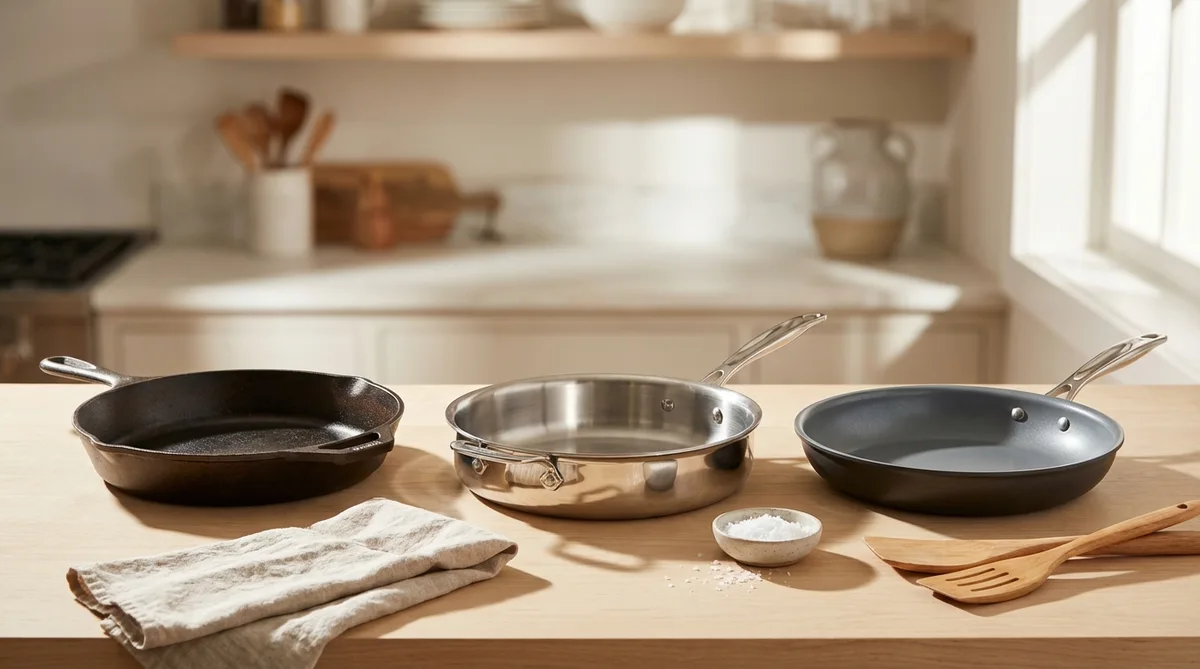
Most home kitchens have a pan situation that developed accidentally.
There’s a nonstick skillet from a set bought years ago, a stainless steel pan that gets used for boiling, and maybe a cast iron skillet that came from someone’s grandmother and lives on the back burner. None of it was chosen deliberately. The cook uses whatever’s in reach and adjusts technique to compensate for the pan’s limitations without realizing that’s what they’re doing.
Here’s the deliberate version: what each type of pan actually does, where it fails, and how to decide which one belongs on your stovetop.
The Three Materials
Cast Iron
What it is: A thick, heavy pan made from molded iron, seasoned with polymerized fat to create a cooking surface.
How it heats: Slowly and unevenly at first — cast iron is a poor conductor. But once hot, it retains heat better than any other common cookware material. It reaches equilibrium slowly and then maintains it.
What this means in practice: Cast iron takes 3 to 5 minutes of preheating to reach cooking temperature evenly. Adding cold food to a properly preheated cast iron doesn’t drop the temperature significantly — the thermal mass is too large. This is what produces the aggressive sear that makes cast iron famous.
Strengths:
– Best sear of any pan — the heat retention means consistent, aggressive browning
– Transitions from stovetop to oven to outdoor fire without complaint
– Gets better with use — the seasoning develops and improves over years
– Essentially indestructible with reasonable care
– Cheap relative to its longevity
Weaknesses:
– Heavy — a 12″ Lodge weighs nearly 8 pounds
– Slow to heat and slow to cool — not the right tool when you need to quickly adjust temperature
– Reactive with acidic foods cooked for extended periods (tomato sauce, wine braises left overnight)
– Requires specific maintenance — drying, light oiling, avoiding harsh soaps used aggressively
Right for: Searing protein. Stovetop-to-oven cooking. Outdoor use. Cornbread. Anything that benefits from high, sustained heat and doesn’t need precise temperature modulation.
Stainless Steel
What it is: An alloy of steel with chromium (and often nickel), typically with an aluminum or copper core for heat conductivity.
How it heats: Much faster than cast iron. The aluminum or copper core distributes heat quickly and evenly across the surface. A stainless pan reaches cooking temperature in 60 to 90 seconds and responds to temperature changes much faster than cast iron.
The sticking problem: Stainless steel sticks aggressively when proteins hit the surface before the pan is properly preheated. This is the most common complaint and the most common misuse. The fix: preheat longer than you think necessary, add oil, let the oil shimmer, then add food. The “water droplet test” — water drops that form tight balls and skitter across the surface (Leidenfrost effect) indicate the pan is at temperature. Do the test before the food goes in.
Strengths:
– Excellent heat distribution with a quality pan (fully-clad or disk-bottom construction)
– Responsive — temperature changes when you change the heat
– Safe for acidic foods — tomato sauces, wine-based braises, citrus — without the reactivity concerns of cast iron or carbon steel
– Dishwasher safe in most cases
– Develops fond (the browned bits at the bottom of the pan) better than any other material — these are the foundation of good pan sauces
Weaknesses:
– Sticks when used incorrectly (under-preheated)
– More expensive than cast iron for quality
– Requires understanding of the preheating process that most casual cooks don’t have
Right for: Pan sauces. Sautéed vegetables. Cooking acidic dishes that need a long braise. Anything where precise temperature control matters. The serious home cook’s workhorse.
Nonstick
What it is: A pan with a synthetic coating — PTFE (Teflon) or ceramic — that prevents food from adhering to the surface.
How it heats: Depends on the base pan. Most nonstick pans use aluminum bases — fast to heat, even distribution, responsive.
The coating compromise: Nonstick coating is genuinely useful for specific tasks. It degrades. PTFE-based coatings begin to break down around 500°F and release compounds that are unpleasant to inhale and potentially harmful in high quantities. Ceramic coatings are more heat-stable but less durable — they lose their nonstick properties faster than PTFE.
Every nonstick pan has a lifespan. Most last 2 to 5 years with regular use before the coating is scratched, chipped, or worn to the point of not working. At that point, the pan is replaced. Cast iron and stainless are replaced almost never.
Strengths:
– Genuinely nonstick out of the box with no technique required
– Ideal for delicate tasks: eggs, fish fillets, pancakes, crepes
– Easy cleanup
– Low skill floor — forgiving of improper preheating
Weaknesses:
– Can’t be used at high heat without coating degradation
– Can’t be put in a very hot oven (most have temperature limits around 400°F to 450°F)
– Can’t be cleaned with metal implements
– Degrades over time and must be replaced
– Produces no fond for pan sauces
Right for: Eggs. Pancakes. Delicate fish. Anything sticky and low-temperature where the nonstick property is genuinely necessary rather than just convenient.
The Three-Pan Kitchen
If you’re building a kit from scratch, three pans cover almost every cooking situation:
A 12″ cast iron skillet: For searing, stovetop-to-oven cooking, and anything high heat. The Lodge 12″ is the reference-point recommendation — well made, affordable, and improves with every cook.
A 10″ or 12″ stainless skillet: For everything where temperature responsiveness and acid-safety matter. A fully-clad All-Clad D3 or comparable is the investment piece. Deglazes beautifully for pan sauces.
An 8″ or 10″ nonstick: For eggs and delicate tasks only. Buy a mid-range one and expect to replace it in 3 to 5 years.
That’s the kitchen. Three pans, three specific roles, nothing overlapping unnecessarily.
The One-Pan Kitchen
If you’re buying one pan to rule them all: it depends on how you cook.
Mostly proteins and high-heat cooking: Cast iron. The sear is unmatched and the durability justifies the investment.
Mostly vegetables and sauces with varied techniques: Stainless. The temperature responsiveness and acid-safety cover more ground.
Mostly eggs and delicate cooking at low heat: Nonstick. But add a cast iron or stainless when the budget allows — nonstick alone limits what’s possible.
The Maintenance Reality
The investment in a quality cast iron or stainless pan returns full value only with basic maintenance.
Cast iron: Dry after washing, light oiling, periodic oven seasoning. Covered fully in the cast iron care guide on this blog.
Stainless: Occasional Bar Keepers Friend for staining and discoloration. Avoid dishwasher for best results though technically safe.
Nonstick: Gentle cleaning only. No metal utensils. No high heat. No dishwasher. Accept the lifespan and budget the replacement.
The pan that gets maintained performs better than the one that doesn’t. That applies to all three.
Grumpy Dad Co. — The right tool for the right cook.
Browse the full outdoor cooking and kitchen collection at grumpydadco.com