Paring vs Petty Knife: The Tiny Knife You’re Using Wrong (Honest Comparison)

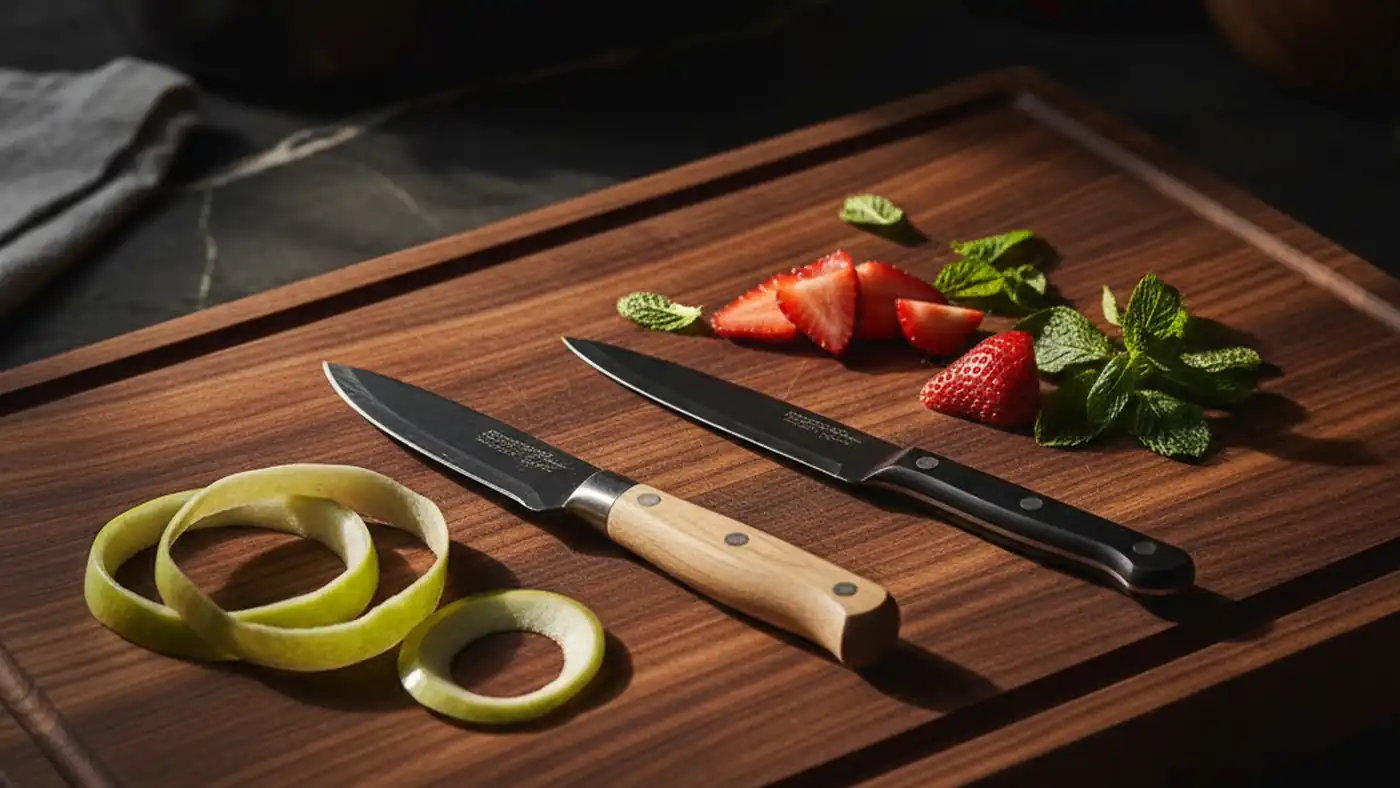
Open your knife block. The little knife — the one with the 3-inch blade — is the paring knife. You use it for peeling apples, hulling strawberries, and whatever else feels too small for the chef’s knife. Most dads own one, use it occasionally, replace it every five years when the tip snaps. That’s the paring knife’s whole career arc.
Then somebody hands you a petty knife. It looks similar at first glance — small blade, light, in-hand work — but it’s longer (4–6 inches), thinner, and built differently. You use it once and realize this is what you actually wanted from a small knife. The paring suddenly feels stubby. The petty handles 80% of paring tasks and 50% of chef’s knife tasks.
Here’s the honest truth nobody at the cookware store will tell you: most home cooks own a paring knife when a petty knife would serve them better. They’re not the same tool. They overlap. They have different strengths. And the wrong one for your kitchen is the one currently in your block.
This is the no-nonsense breakdown. What each knife is. What each does well. Which tasks are paring-specific vs petty-specific. The reality of “you need both” vs “you need one.” And which ones are worth buying.
The 30-second answer
Paring knife (3–3.5″): peeling, hulling, in-hand cutting work. Small, controlled, fits in your palm. Petty knife (4–6″): board-and-hand crossover. Slicing fruit, mincing herbs, smaller proteins, board work where a chef’s knife is overkill. If you’re going to own only one small knife, get a 5–6″ petty knife. It does most of paring’s job plus more.
What a paring knife actually is
A paring knife is a 3–3.5″ small blade designed primarily for in-hand work. The hallmark tasks:
- Peeling apples, potatoes, pears, peaches.
- Hulling strawberries.
- Removing seeds from peppers.
- Coring tomatoes.
- Devening shrimp.
- Trimming small details (eyes from potatoes, blemishes from fruit).
- Decorative work (radish flowers, citrus twists).
The blade is short and rigid. The shape is typically a “spear point” (symmetrical taper to a point) or a “sheepsfoot” (flat top, curved edge). Western paring knives often have a slight belly; Japanese-style paring (sometimes called “petty” — yes, the language is confusing) is straighter and longer.
The grip is hand-only — your thumb and index finger pinch the blade or handle, the work is held in your other hand, and the knife maneuvers in tight three-dimensional space.
What a petty knife actually is
A petty knife is a 4–6″ Japanese-style utility blade. The name comes from French “petit” (small), borrowed into Japanese kitchen vocabulary. It’s the bridge between paring and chef’s knife.
The hallmark tasks:
- Slicing fruit (apples, pears, citrus).
- Mincing herbs and aromatics (garlic, ginger, shallots).
- Trimming smaller proteins (chicken thighs, fish portions).
- Cutting small vegetables (cherry tomatoes, mushrooms, scallions).
- Sandwich and snack prep.
- In-hand peeling and trimming when needed.
- Anything where a chef’s knife feels too big and a paring knife feels too small.
The blade is longer and thinner than a paring knife. The shape is typically straight-edged or with a gentle curve, with a sharp pointed tip. The handle is sized for full-grip work on a cutting board, but the blade is short enough for in-hand work too.
This is the petty’s secret weapon: it works equally well on a cutting board and in your hand. Paring knives are mostly hand-only. Chef’s knives are mostly board-only. The petty does both.
Side-by-side comparison
| Feature | Paring Knife | Petty Knife |
|---|---|---|
| Blade length | 3–3.5″ | 4–6″ |
| Best for | In-hand work | In-hand + board work |
| Profile | Slight belly, pointed tip | Straight-ish, sharp tip |
| Apple peeling | Excellent | Good |
| Mincing garlic | Tedious | Excellent |
| Slicing strawberries | Doable | Faster |
| Cutting a sandwich | Tight | Easy |
| Trimming silver skin | Workable | Better |
| Coring a tomato | Excellent | Good |
| Hand-only feel | Excellent | Good |
| Replaces chef’s knife for small tasks | Rarely | Often |
| Typical price | $15–$80 | $40–$200 |
The “you have it backwards” moment
Most home cooks have an 8″ chef’s knife and a 3″ paring knife. The gap between them is huge. Almost every “should I use the chef’s knife or the paring knife” task lands in the middle, where neither is great:
- Cutting a single apple into slices: chef’s knife is overkill, paring is short.
- Mincing 2 cloves of garlic: chef’s knife is fine but feels like overkill.
- Slicing a small pile of mushrooms: chef’s knife is awkward on small items, paring takes too long.
- Trimming chicken thighs: chef’s knife is too wide; paring is too short.
The petty fits the gap perfectly. 5″ of blade, sharp point, board-and-hand versatility. Once you have one, you reach for it constantly — the paring becomes an occasional specialist tool and the chef’s knife stays in its slot for big jobs.
The “you only need one” decision
If you’re outfitting a starter kitchen with only a chef’s knife and one small knife, here’s the honest framework:
Pick paring if:
- You peel a lot of fruit (apples, potatoes, peaches).
- You do a lot of in-hand work.
- Counter space is extremely limited.
- You’re on a tight budget (paring knives are cheaper).
Pick petty if:
- You do mixed prep (some board, some hand).
- You cut a lot of small fruits and vegetables.
- You mince herbs and aromatics often.
- You want one small knife that handles 80% of “not the chef’s knife” tasks.
For most home cooks, the petty wins. The petty handles paring tasks adequately (peeling apples is a little awkward but doable with a 4–5″ petty); the paring handles board work poorly. One-tool versatility favors the petty.
The “you need both” reality
Some kitchens benefit from both. If you:
- Bake (paring knives are great for fruit work, scoring dough).
- Make a lot of garnishes or decorative cuts.
- Process a lot of small fruits and berries (strawberries, grapes).
- Do detailed protein work (deveining shrimp, butterflying small cuts).
…then both knives earn their drawer space. A 3″ paring + a 5″ petty + an 8″ chef’s knife is the smart three-knife kitchen for most home cooks. Add a bread knife and you’ve covered 95% of cooking tasks.
Paring knife styles
Standard / spear point
The most common shape. Symmetrical taper to a point. Mild belly. Wüsthof Classic, Mercer Renaissance, Henckels Pro. Versatile for general paring tasks.
Sheepsfoot paring
Flat top, curved edge. Better for board-style cutting (small fruits and vegetables). The Bird’s Beak (sometimes called a “tourné” knife) is a curved variant for decorative cuts.
Bird’s beak / tourné
Curved blade for peeling round fruit and decorative work. Specialty tool. Not necessary for most home cooks.
Forged vs stamped
For paring knives, the difference matters less than for chef’s knives. A stamped paring (Mercer, Victorinox) at $15–$25 performs nearly identically to a forged paring at $50+. Spend the money on the chef’s knife instead.
Petty knife styles
Standard 4–5″ petty
The default for home cooks. Tojiro DP Petty, Mac Pro Petty, Misono UX10. Straight-ish blade with subtle curve, sharp tip, comfortable handle. $50–$200.
Long petty (5.5–6″)
Closer to a small chef’s knife. Better for someone replacing some chef’s knife duties. Can feel awkward in the hand for paring work.
Sujihiki-style (longer slicer)
Technically a different category but sometimes confused — sujihiki is a longer (240–300mm) Japanese slicer for proteins. Not a petty.
Honesuki (poultry knife)
Triangular, similar size, but built for chicken work. Different tool. (Covered in our Boning Knife Basics.)
The Grumpy Dad recommendation by tier
Under $30: paring knife only
Mercer Renaissance 3.5″ Paring ($15) or Victorinox Fibrox 3.25″ Paring ($12). Honest workhorses. Replace every 4–7 years.
$40–$80: petty knife sweet spot
Tojiro DP Petty 5″ ($60) or Mac Pro Petty 5″ ($85). Real upgrade for daily small-blade work. The honest “best small knife for most home cooks” tier.
$100–$200: premium
Misono UX10 Petty 5″ ($170) or Shun Classic Petty 4.5″ ($120). Beautiful, sharp, lifetime knife if cared for.
Both knives:
Mercer Renaissance Paring + Tojiro DP Petty 5″ = $75 total. Covers paring and petty roles for most kitchens.
Steel and care (similar to other knives)
Paring and petty knives respond to the same steel families as bigger knives:
- X50CrMoV15 (Wüsthof, Mercer): soft stainless workhorse. Easy sharpening, frequent honing.
- VG-10 (Tojiro, Mac): Japanese mid-tier. Holds edge longer, sharpens easily.
- Carbon (Sabatier, traditional Japanese): sharper, requires care, develops patina.
(See our Knife Steel Cheat Sheet for the full breakdown.)
Care basics are identical to chef’s knives:
- Hand-wash, dry immediately, store properly.
- Hone before regular use.
- Sharpen every 3–6 months for typical use.
- Magnetic strip or in-drawer organizer (sleeves for tip protection).
Special note: tips on small knives are extra fragile. The leverage of a thin pointed blade snapping under sideways pressure is high. Don’t pry. Don’t twist. Don’t drop.
How to use each knife correctly
Paring knife technique
- Hold the food in your non-dominant hand.
- Pinch grip on the blade — thumb and forefinger near the bolster.
- Cut away from yourself, always. Pull the blade through the food toward your thumb (which acts as a stop).
- Use small controlled motions. The cuts are short.
- For peeling: thumb tracks along the food just behind the blade, pinching the peel as it comes off.
Petty knife technique
- For board work: standard pinch grip on the blade, full-grip on the handle. Same as a chef’s knife but on smaller scale.
- For in-hand work: same as paring — pinch grip near bolster, food in opposite hand, cut away from yourself.
- The petty’s longer blade means you can use heel-to-tip slicing motions a paring knife doesn’t allow.
- Mincing technique: rock the blade tip with one hand on the spine of the petty.
Common mistakes
- Using a paring knife on a cutting board. The short blade and the lack of knuckle clearance make this tedious and slightly dangerous. Use a chef’s knife or petty for board work.
- Using a petty knife as a chef’s knife. The blade is too short for big cuts, large vegetables, or volume prep. The chef’s knife exists for a reason.
- Pulling a paring knife toward your thumb without controlled pinch. A slip ends in your thumb. The pinch grip is non-negotiable.
- Storing small knives loose in a drawer. Tips snap fast. Sleeves or magnetic strips only.
- Sharpening with a pull-through. Particularly bad for thin small blades — it grinds away the geometry that makes them precise.
- Letting kids use the paring as their “first knife.” Sharp small blades plus inexperience equals injuries. Train kids on a paring knife only with adult supervision and a cut-resistant glove on the holding hand.
Marketing traps to avoid
- “Bird’s beak paring knife essential set.” The bird’s beak is a specialty knife for decorative cuts. Most home cooks never use it. Skip the set.
- “Damascus paring knife” at premium prices. The Damascus pattern doesn’t help on a paring knife — the cuts are short and the cladding is barely visible. Save Damascus money for the chef’s knife.
- “Self-sharpening paring knife with built-in honer.” The honer is a small ceramic pull-through. It misaligns the edge over time. Skip.
- “15-piece paring knife set” for $35. Cheap stamped steel, plastic handles, dull within a year. Buy one $15 Mercer instead.
- “Decorative ceramic paring knife.” Ceramic is brittle. Tips break on first awkward cut. Steel only.
The “petty as your only kitchen knife” experiment
Some home cooks downsize to a single petty knife for daily work, with a chef’s knife in the block for bigger jobs. The petty handles:
- Mincing garlic, ginger, shallots.
- Slicing all small-to-medium vegetables.
- Trimming proteins.
- Sandwich and snack prep.
- Most fruit work.
- Light board cooking.
What it can’t replace:
- Big chopping (cabbage, butternut squash, large onions).
- Volume mincing (whole bunch of parsley).
- Long slicing (brisket, pork loin).
- Bread (need serrated).
For a small household with limited storage, a single petty + bread knife covers more than you’d expect.
If you only remember five things
- Paring is in-hand. Petty is hand + board. Different tools.
- If buying one small knife, the petty is more versatile.
- Most home cooks own a paring when a petty would serve them better.
- 3-knife kitchen: chef’s + petty + bread covers 95% of cooking.
- Don’t pay Damascus money for paring knives. Save it for chef’s knives.
FAQ
Are utility knives the same as petty knives?
Western “utility knives” (5–6″ inches, mild belly, often serrated or partially serrated) overlap with petty knives but aren’t identical. Petty knives are usually thinner with sharper points. Utility knives are sturdier and more general-purpose. The categories blur.
Can a 4″ petty replace a paring knife?
For most tasks, yes. The 4″ petty has enough length for slicing and mincing, plus it’s nimble enough for hand work. Apple peeling is slightly less elegant than with a 3″ paring but workable.
Should the petty be Western-handled or wa-handled?
Personal preference. Western-handled petty knives feel familiar to American cooks (Tojiro DP, Mac Pro). Wa-handled (Japanese octagonal) feels lighter and more nimble but takes adjustment. Try both if you can.
Why does my paring knife tip keep snapping?
Most likely: dishwasher rack contact, drawer storage with metal utensils, or being used as a pry bar. Paring tips are the thinnest, most fragile part of any knife. Protect them with sleeves and never lever with the tip.
Are paring knife sets worth it?
Almost never. “5-piece paring sets” are usually 5 stamped low-quality knives. One quality $15–$25 paring knife outperforms five $5 ones combined.
What’s the biggest mistake people make with petty knives?
Using them for too-big tasks. The petty is a small knife — it’s not a tiny chef’s knife. Don’t try to break down a butternut squash with one. Recognize its lane.
Is a petty knife necessary if I have a santoku?
Santoku and petty overlap somewhat. The santoku is bigger (5–7″), better for vegetable volume work. The petty is smaller, better for in-hand and detail work. They’re complementary rather than redundant.
The Grumpy Dad Promise
Audit your small knife situation. If you have only a paring knife and you’re constantly reaching for the chef’s knife on small jobs, the petty is the missing link. If you have only a petty and you’re peeling apples awkwardly, add a $15 paring. The right pair is small but specific to how you cook.
Skip the paring sets. Skip the bird’s beak. One paring + one petty + one chef’s = 95% of home cooking handled. Now go peel an apple. Or mince some garlic. Or both.