Nakiri vs Chef’s Knife: Which One Do You Actually Need

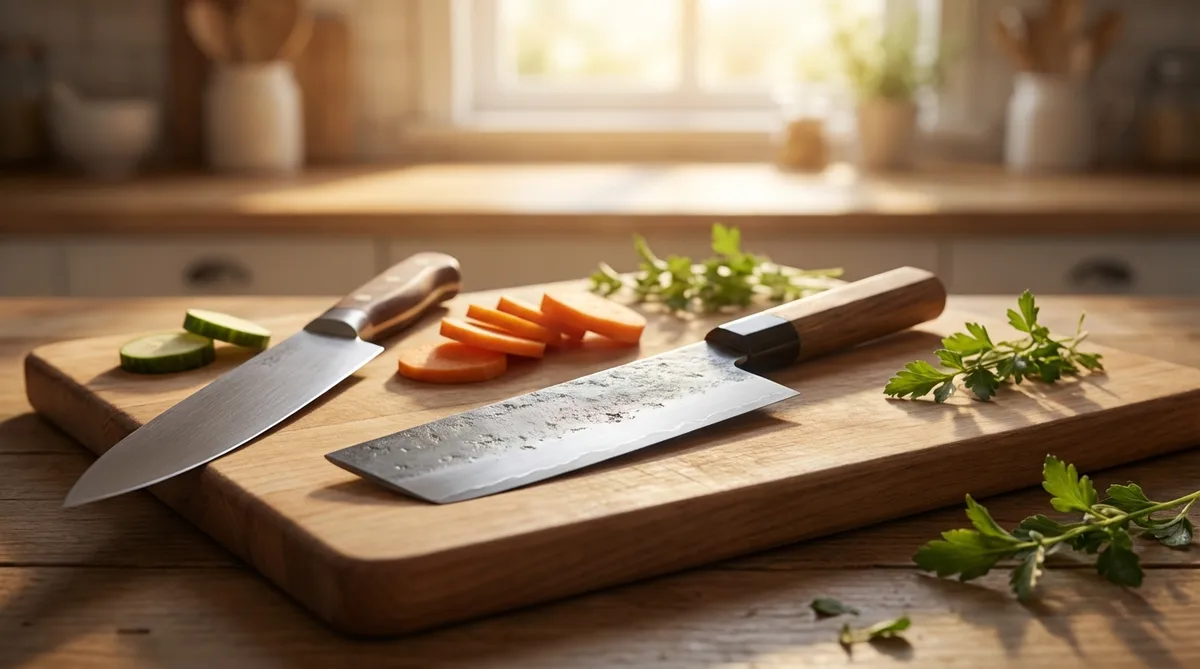
Two knives. Both cut vegetables. Both are made from high-quality steel. Both show up on the same wish lists, the same YouTube videos, the same “what should I buy” forums.
Different tools entirely.
The confusion makes sense — at a glance, they’re similar. But using a nakiri for the first time when you’ve only ever used a chef’s knife is a specific kind of surprise. The way it moves through a dense carrot. The way it doesn’t wedge in a thick-skinned butternut squash. The flat blade contact with the board on every single stroke. It doesn’t feel like a variation on what you already know. It feels like a different instrument.
This article explains the difference clearly enough that you can make the call yourself — without needing to buy both to find out which one you wanted.
What a Chef’s Knife Is Actually Doing
A Western chef’s knife — 8 to 10 inches, curved belly, pointed tip — is designed to rock. That curve along the cutting edge is intentional. When you chop with a rocking motion, the tip stays near the board while the heel rises and falls, driving cuts through food in a continuous forward-and-back motion.
This rocking technique is fast, natural for most people who learned to cook in Western kitchens, and versatile. The pointed tip lets you make precision cuts — scoring meat, deveining shrimp, working around bones. The full length of the blade is usable for different tasks: the heel for tough cuts, the tip for detail work, the knuckle area for soft foods.
Japanese-style chef’s knives — gyutos — share this profile with modifications. Thinner behind the edge, harder steel, flatter belly. Still a rocking knife, still versatile, but optimized for a push-cut technique rather than a full rock. A gyuto is what a chef’s knife looks like when the focus shifts from versatility to precision.
The chef’s knife does a lot of things well. It’s the reason most home cooks own one chef’s knife and nothing else, and function fine for years. Vegetables, proteins, herbs — the chef’s knife handles all of it without asking for anything in return except an occasional trip to the whetstone.
The thing it doesn’t do exceptionally well: tall, dense vegetables that require repeated straight-down cuts with full blade contact on every stroke.
What a Nakiri Is Actually Doing
A nakiri is a Japanese vegetable knife. The name roughly translates to “leaf cutter” — a reference to greens, though the knife’s real strength is broader than that.
The profile is immediately distinct: rectangular blade, flat edge from heel to tip, blunt squared-off end. There is no curve. There is no point. The entire cutting edge is a straight line.
This design is built for a specific technique: the push cut, where the blade moves straight down through the food and slightly forward, with the full edge making contact with the board on every stroke. No rocking. No pivot point. Just a clean, vertical, full-contact cut.
For vegetables — and specifically for the dense, awkward, hard-to-cut ones that a chef’s knife handles by brute force — this matters enormously.
The tall blade height (typically 55 to 65mm, compared to 45 to 50mm on a gyuto) means the knuckle of your guiding hand stays well away from the board. You can move fast without worrying about your fingers. This is particularly useful for repetitive, high-volume prep work — julienning carrots, slicing onions, breaking down a full head of cabbage.
The flat profile means the entire edge contacts the board on every stroke. With a curved chef’s knife doing push cuts (not rocking), the middle of the blade lifts slightly, leaving a section of food uncut that you have to go back over. The nakiri eliminates that gap. Every cut is complete.
The thin blade — nakiris are typically thin behind the edge, sometimes dramatically so — means less wedging in dense vegetables. A fat blade pushes food apart as it enters. A thin blade parts it. The difference is most obvious in hard squash, daikon, sweet potato. The nakiri glides. The thick chef’s knife pushes.
Where Each One Wins
Chef’s knife wins:
– Protein work — breaking down chicken, slicing beef, anything with bones nearby
– Detail work requiring a tip — scoring, trimming, intricate cuts
– Herbs — the rocking technique is faster for fine chiffonade than push cuts
– General purpose cooking where you don’t want to think about which knife to grab
– If you’re buying your first serious knife
Nakiri wins:
– High-volume vegetable prep — any meal that starts with a cutting board full of produce
– Dense, thick-skinned vegetables where wedging is a problem
– Repetitive slicing tasks — thin, even slices of cucumber, radish, carrot
– Reducing food waste — the thin, straight blade loses almost nothing at the edge of a vegetable
– Households that cook mostly plant-forward meals
Where the comparison breaks down:
Asking “which is better” is the wrong question. They’re not competing for the same job. A chef’s knife is a generalist. A nakiri is a specialist. The better question is: what does most of your kitchen work look like?
If you spend three nights a week breaking down proteins and making sauces where you also need to chop an onion — chef’s knife.
If you spend three nights a week cooking vegetable-forward meals that start with a pile of produce and end with most of the work done at the board — nakiri.
If you cook both and have the budget — nakiri and gyuto, used for what each does best.
Steel and Construction: What to Look For
Both knife types are available in a range of steels and construction quality. The principles apply to either.
Japanese steel hardness — nakiris are almost exclusively made with harder Japanese steels: Shirogami (White Paper steel), Aogami (Blue Paper steel), or VG-10 stainless. Harder steel takes a keener edge and holds it longer. It also chips more easily if misused — no twisting, no prying, no bones. The nakiri’s straight edge and thin profile assume you’re cutting what it was designed to cut.
Reactive vs non-reactive — White Paper and Blue Paper steels are carbon steels. They’re reactive: they’ll patina and can rust if not cared for. The upside is an edge keenness that stainless can’t fully match at equivalent hardness. VG-10 is a stainless option that gets close to carbon steel performance without the maintenance requirements. Which you choose depends on whether you’ll maintain a carbon knife correctly. If the answer is maybe, buy stainless.
Full tang vs partial tang — Full tang means the steel runs through the handle for its full length. More durable, better balance. Most quality nakiris from Japanese makers are full tang.
Blade geometry — This matters more than most people realize. A nakiri with thick blade geometry (behind the edge) loses the wedging advantage that makes the knife worth buying. Look for thin, flat grinds. The blade should almost seem too thin for its height.
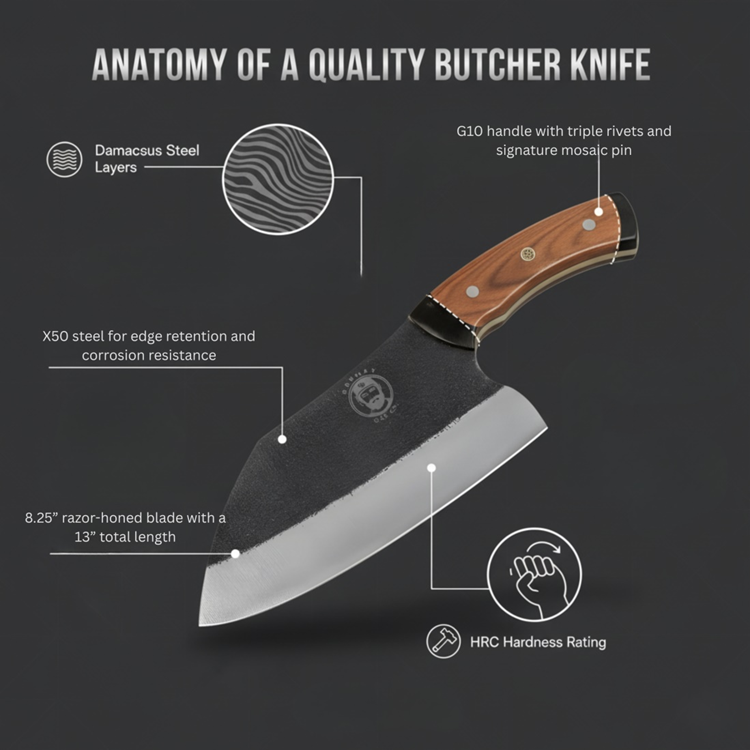
The Yoshida Hamono Nakiri in the Grumpy Dad catalog is a relevant example here: handmade, properly thin behind the edge, with the balance and geometry that lets the knife do what a nakiri is supposed to do rather than just look like one.
Using a Nakiri for the First Time
The first thing most people notice: it’s fast.
Not in an aggressive way. Fast in the sense that it removes friction from the process. The board contact is complete. The cuts are clean. You’re not adjusting your stroke or going back over cuts that didn’t fully separate. The flow of prep work changes.
A few things to know:
Don’t rock it. The flat profile isn’t designed for rocking technique. If you rock a nakiri, you’re using the heel to cut while the rest of the blade floats. Use a push-cut or a draw-cut straight down. The motion is different from what most Western-trained cooks are used to, and it takes about a week to feel natural.
Don’t use it for hard squash with a thick rind without proper technique. The thin blade is an asset on carrots and daikon. A thick-rinded kabocha squash with the full weight of your hand behind it can cause a thin nakiri to flex. Start the cut slowly, let the knife do the work, and keep the motion straight.
Don’t put it in the dishwasher. Carbon steel nakiris will rust in a dishwasher. Even stainless nakiris take unnecessary wear from dishwasher heat and chemicals. Hand wash. Dry immediately. Ten seconds.
Sharpening: The straight edge of a nakiri is easier to sharpen freehand than a curved chef’s knife — you don’t need to manage an angle change through the curve. Consistent angle on a whetstone, heel to tip. The thinness behind the edge means it comes sharp quickly and responds well to light stropping.
The Decision, Simplified
If you don’t own a quality chef’s knife yet: buy that first. A good chef’s knife is the foundation. Everything else is a specialist on top of it.
If you own a quality chef’s knife and you cook vegetables regularly — and especially if you’ve noticed that the dense ones require more force than feels right, or that your cuts aren’t as clean as they could be — the nakiri is the natural next purchase.
If you cook mostly meat and the occasional salad: you probably don’t need a nakiri. Your chef’s knife has it covered.
If you run a plant-forward kitchen, meal prep for the week on Sundays, or have ever thought “this would go faster if I had a better tool” while working through a pile of root vegetables: the nakiri is exactly the tool you were missing.
One more thing worth saying: both knives perform only as well as they’re maintained. A sharp nakiri and a sharp chef’s knife are both exceptional. A dull version of either is just a different shape of the same problem. A quality whetstone — the Shapton Glass 1000 is a reliable starting point — and 10 minutes every few months is all it takes.
The knife is the investment. The whetstone is the maintenance cost. Both matter.
Grumpy Dad Co. — The right knife for the right work.
Browse the full knife collection — including the Yoshida Hamono Nakiri — at grumpydadco.com