The Coffee Gear Guide: What’s Worth It and What Isn’t

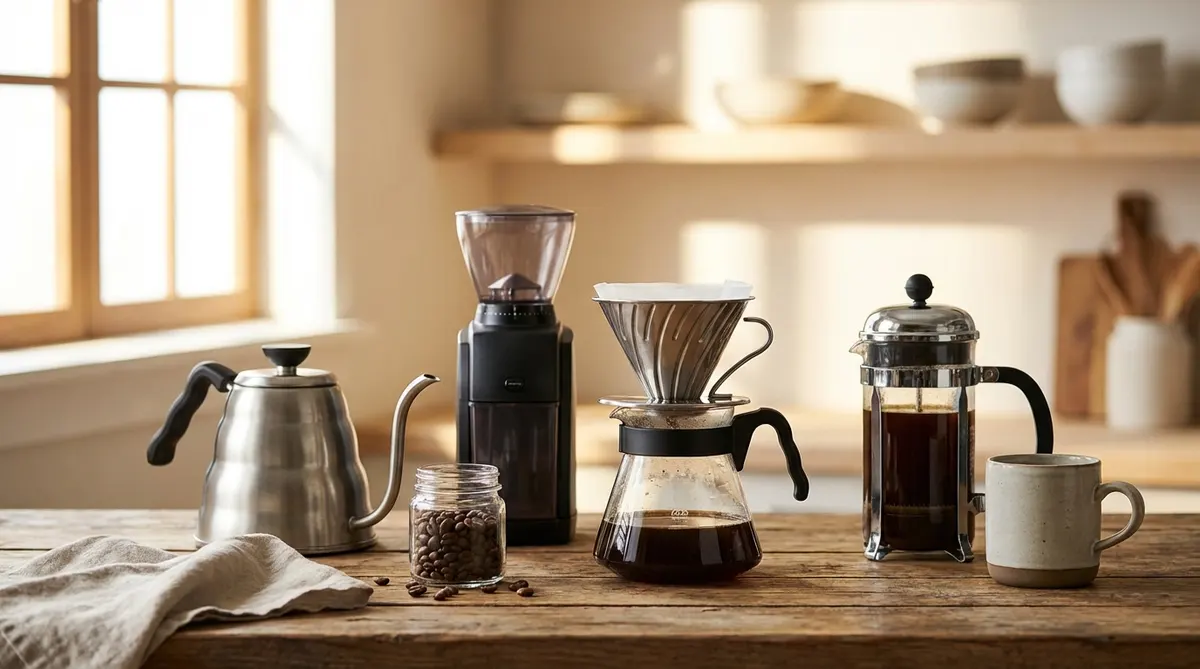
The coffee gear market has a problem.
There are products at every price point, with marketing that sounds identical regardless of whether they’re $15 or $1,500. Every kettle claims precision. Every grinder claims consistency. Every coffee maker claims to be “barista quality.” None of them are lying, exactly — they’re just not telling you where in the quality curve you’re actually buying.
This guide is the honest version. What moves the needle. What doesn’t. Where spending more makes a real difference in the cup and where you’re paying for stainless steel housing on a component that performs the same as the cheaper one.
One rule before we start: equipment doesn’t fix bad coffee. A $400 grinder and a $300 kettle used on stale pre-ground beans produces a worse cup than a $50 hand grinder used on freshly roasted whole beans. Start with good coffee. Then improve the equipment. In that order.
The Hierarchy: What Actually Matters
Not all gear is equal. Before spending anything, understand the order of impact:
1. The grinder — biggest single impact on cup quality
2. Water temperature and quality — second most important
3. The brewing device — matters, but less than the above two
4. The scale — small investment, outsized return
5. Everything else — nice to have, diminishing returns
Shop in that order. A bad grinder ruins good coffee. A good grinder elevates average equipment. This isn’t opinion — it’s physics. Grind consistency determines extraction evenness, and extraction evenness determines everything in the cup.
The Grinder
What you’re actually buying
A grinder’s job is to produce consistent particle size. Every particle that passes through the brewing water should be approximately the same size so that extraction happens evenly across the grounds. Too many fines (powder-sized particles) and you get bitterness — they over-extract almost instantly. Too many boulders (chunk-sized particles) and you get sourness and flatness — they under-extract. The ideal is a narrow, consistent distribution around your target size.
Blade grinders don’t do this. They chop randomly and produce a chaotic mix. The visual result — grounds that look fine — masks the problem. Some of that “fine” powder is microscopic. Some of it is pea-sized. Both end up in the brewer.
Burr grinders crush between two abrasive surfaces held at a fixed distance. Every particle that passes through comes out close to the same size. That’s all you need to understand.
Where to spend
Entry level — Manual hand grinders ($50–$150)
The Timemore C2 ($50) and the 1Zpresso JX ($90) are the two best value options in this category. Both produce grind quality that competes with electric burr grinders at twice the price. The trade-off is time — hand grinding 20 grams of coffee takes 60 to 90 seconds of actual work. That’s not nothing at 6 a.m., but it’s not a dealbreaker if you’re brewing one cup at a time.
The Comandante C40 ($180) is the premium hand grinder benchmark. If you travel with your coffee setup or want maximum quality in a manual form, this is it.
Mid range — Electric burr grinders ($150–$250)
The Baratza Encore ($170) is the reference-point recommendation at this level and has been for a decade. It’s not because nothing better exists — it’s because it’s well-built, consistently calibrated from the factory, produces genuinely good grind quality for drip and pour-over, and Baratza has exceptional customer service including spare parts. It’s a tool that works and keeps working.
The Baratza Virtuoso+ ($250) is the step up — a better burr set, tighter grind distribution, timer-based dosing. Worth the extra $80 if you’re also brewing for multiple people and want repeatable doses without weighing every time.
High end — When the Encore isn’t enough ($300+)
The Niche Zero ($500) is the single-dose grinder benchmark — you put in exactly the beans you want to brew, no hopper, no stale retention. Produces excellent grind distribution for pour-over and espresso. It’s a serious piece of equipment for people who have decided this matters to them.
The DF64 Gen 2 ($400) is a flat burr grinder producing a wider, more even distribution than most conical burr grinders at this price. Coffee nerds argue about flat vs. conical. For pour-over, both work. The DF64 consistently surprises people at its price point.
Skip: Any blade grinder, any “all-in-one” coffee maker with a built-in grinder under $200, any grinder that doesn’t specify burr type.
The Kettle
What you’re actually buying
Temperature control and pour precision. That’s it. The kettle doesn’t brew the coffee. It delivers water at the right temperature with enough control to manage the flow rate.
For drip machines — where the machine controls the pour — a standard kettle is fine as long as you can manage temperature. For pour-over, where you control the pour manually, a gooseneck spout is the difference between a controlled circular pour and sloshing water in roughly the right direction.
Where to spend
Budget option — Standard gooseneck, no temperature control ($25–$40)
An unbranded gooseneck kettle on any stovetop gives you pour control without temperature precision. Acceptable for French press. Workable for pour-over if you’re disciplined about waiting 45 seconds off the boil before pouring. You’ll be close to 200°F. Close is good enough to start.
The right answer — Temperature-controlled gooseneck ($50–$90)
The Bonavita 1L Variable Temperature Gooseneck ($50) is the honest best-value recommendation. It heats to a set temperature, holds it, and has a gooseneck spout for controlled pours. It’s not beautiful. It does everything the more expensive options do.
The Fellow Stagg EKG ($150) is the version you buy when the Bonavita annoys you aesthetically. It heats faster, holds temperature more precisely, has a stopwatch built in, and looks like something that belongs on a thoughtfully designed counter. For a lot of people, the experience of using a well-made tool every morning is worth the premium. Not everyone. But some.
Skip: Regular kettle without temperature control used for specialty coffee. Electric kettles with no temperature setting — you’re guessing every morning.
The Brewing Device
Pour-over
Hario V60 ($20–$30, ceramic) — The most forgiving and responsive pour-over available. Small changes in grind size and pour rate show up clearly in the cup, which makes it the best tool for learning pour-over technique. Once you know what you’re doing, it produces an exceptionally clean cup.
Chemex ($45–$55) — Thicker paper filter, heavier body, slightly slower draw-down than the V60. The cup is clean but more full-bodied than a V60. Also the best-looking brewer on this list. Sits on the counter like it means something.
Kalita Wave ($30–$45) — Three-hole flat-bottom design, more forgiving than the V60. Less responsive to technique errors, which makes it a slightly easier starting point. Some experienced pourers prefer the more even extraction from the flat bottom.
Verdict: Start with a V60 if you want to learn. Start with a Kalita Wave if you want consistency immediately. Get the Chemex eventually regardless — it earns its counter space.
French Press
Bodum Brazil ($25) — The reference-point budget French press. Does everything a French press is supposed to do.
Frieling Double-Wall Stainless Steel ($80) — Keeps coffee hotter for longer. More durable. Worth the step up if you brew a full press and drink it over 20 to 30 minutes.
Verdict: French press works well for natural-processed coffees with body and sweetness. Less ideal for delicate washed single origins where clarity is the point.
AeroPress ($35)
Portable. Nearly indestructible. Produces a clean, concentrated cup that’s adaptable to multiple recipes. Not the best tool for tasting a subtle Geisha for the first time — too much compression for a delicate cup. Excellent for everything else. The AeroPress Go ($35) adds a travel case. If you camp, hike, or spend time in hotels and care what your coffee tastes like, just buy one and keep it in a bag permanently.
Automatic Drip
Most drip machines don’t brew at the right temperature. The ones that do are worth significantly more than the ones that don’t.
Technivorm Moccamaster ($330) — Brews at the correct temperature (196–205°F), distributes water evenly, produces a clean and properly extracted cup. It’s the only drip machine in this price category that consistently delivers what a good pour-over delivers, with less effort. Made in the Netherlands since 1968. The build quality is immediately apparent. This is a buy-once appliance.
OXO Brew 9-Cup ($200) — SCA-certified, brews at proper temperature, more accessible price than the Moccamaster. A reasonable step down in build quality but genuinely performs well. If the Moccamaster price is a hurdle, this is the honest alternative.
Everything else in the drip category: we’ll skip the list. If it doesn’t mention brew temperature or SCA certification, the answer is no.
The Scale
A kitchen scale that reads in grams to one decimal place. Any brand. $15 to $25. End of section.
The scale matters because ratio matters — 60 grams of coffee per liter of water — and hitting that ratio consistently with a scoop requires a level of standardization most people don’t have. A scale removes the variable. You weigh once, you calibrate your instincts, and then you can freehand it accurately because you know what accurate feels like.
The most common scale recommendation in specialty coffee is the Acaia Pearl ($150). It’s beautiful, connects to an app, has a built-in timer, and is completely unnecessary for most people. A $15 OXO kitchen scale produces the same number on the display.
Buy the cheap one. Spend the difference on better beans.
The Coffee Itself
All of this equipment is downstream of the coffee. Here’s the honest version of how to buy:
Whole bean, always. Pre-ground coffee begins losing volatile aromatics within minutes of grinding. By the time a bag of pre-ground coffee has been on a shelf for two weeks, most of what made it interesting is gone.
Roast date matters more than best-by date. A coffee is at peak flavor 5 to 21 days post-roast. After 30 days, it’s declining. After 60 days, it’s stale. Many supermarket bags don’t list roast dates — they list best-by dates, which tell you nothing useful. Buy from roasters who print the roast date.
Specialty, traceable origin. Not because it’s fashionable. Because when you know where the coffee came from, you can predict what it tastes like, learn from the cup, and build a preference over time. Morning Tolerance — a washed Geisha from Volcán, Chiriquí, Panama — is an example of exactly this: roast date printed, origin specific, variety disclosed.
Storage: Airtight container at room temperature. Not the freezer — freezing introduces moisture cycling on thaw that degrades flavor. Not on the counter in a glass jar if it’s near a window — light and heat accelerate staling. A dedicated coffee canister with a one-way valve is worth the $15 to $20.
The Summary
Here’s how to build a setup at each level, spending where it matters:
Start here (under $100):
– Timemore C2 manual grinder (~$50)
– Hario V60 ceramic dripper (~$25)
– Any gooseneck kettle ($20–$30)
– Basic kitchen scale (~$15)
Total: ~$110. Produces a genuinely excellent cup. No compromises on what matters.
Step up (under $300):
– Baratza Encore electric grinder (~$170)
– Chemex 6-cup (~$45)
– Bonavita temperature-controlled kettle (~$50)
– Kitchen scale (~$15)
Total: ~$280. Same quality, more convenience. Daily grind time drops from 90 seconds to 20.
If you want automatic drip:
– Technivorm Moccamaster (~$330)
– Baratza Encore (~$170)
– Scale (~$15)
Total: ~$515. Hands-off, consistent, genuinely excellent every morning.
Don’t buy:
– Pod coffee machines (locked into proprietary pods, extraction is mediocre by design, cost per cup is high)
– Blade grinders for specialty coffee
– Any coffee maker without a disclosed brew temperature
– Smart coffee makers that connect to your phone but don’t mention their brew temperature
The cup is either good or it isn’t. The phone connection doesn’t change that.
Grumpy Dad Co. — The right tools for the morning cup.
Browse our full Coffee, Tea & Espresso collection — and try Morning Tolerance — at grumpydadco.com