
Coffee Roast Levels Explained: Light, Medium, Dark and What They Actually Mean

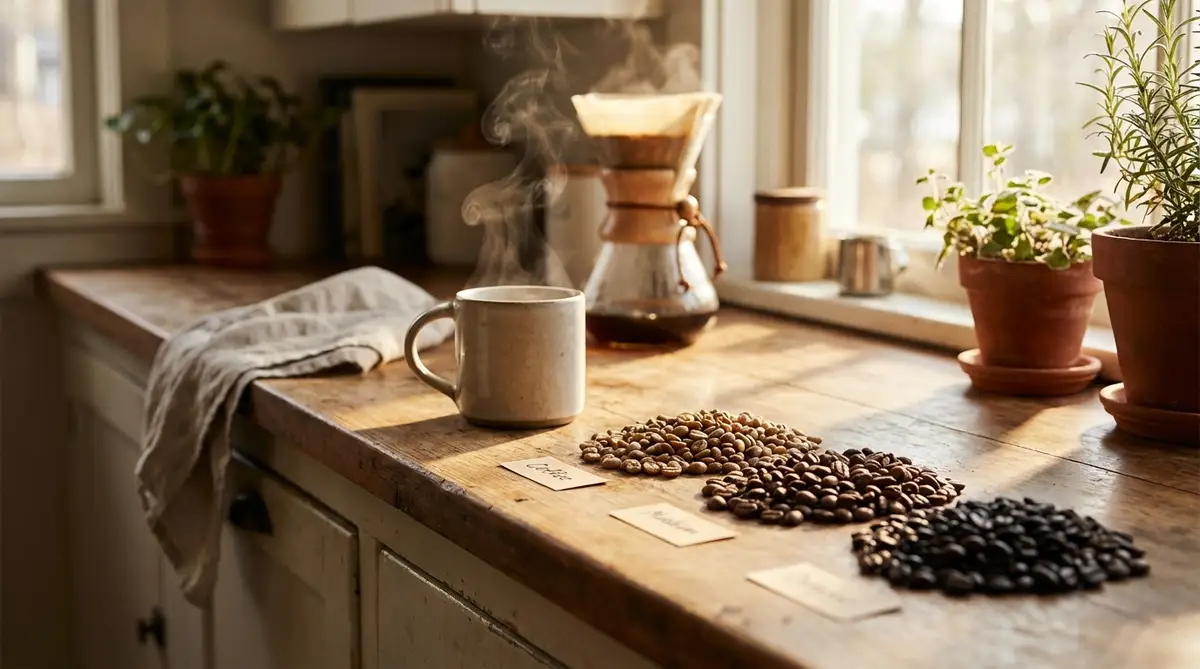
Roast level is the most visible variable on a coffee bag.
It’s right there — light, medium, dark — usually accompanied by a shade guide or a number on a scale. It’s the first thing most people look at when buying coffee. For a lot of people, it’s the only thing.
It’s also one of the most misunderstood variables in the cup.
Most people treat roast level as an intensity dial — dark means strong, light means weak. Neither of those is accurate. Roast level affects flavor profile, acidity, body, and caffeine content in specific, predictable ways that have nothing to do with “strength” as most people define it.
Understanding this changes how you buy coffee. It changes how you understand what’s in your cup. And it explains why the roast level on a specialty coffee bag like Morning Tolerance is a deliberate decision rather than a default.
What Roasting Actually Does
A green coffee bean — the raw, unroasted seed inside the coffee cherry — looks and tastes nothing like coffee. It’s dense, grassy, almost flavorless on its own. Everything that makes coffee taste like coffee is created during roasting.
The roasting process applies heat — typically in a rotating drum at temperatures from 350°F to over 450°F — over 8 to 15 minutes. During that time, a cascade of chemical reactions transforms the bean:
Maillard reactions begin around 300°F. The same reaction that browns a steak or toast — amino acids reacting with reducing sugars — produces hundreds of flavor compounds in the coffee bean. These reactions are responsible for the caramel, bread, nutty, and roasted notes in coffee.
Caramelization begins around 340°F. The sucrose accumulated during cherry ripening (more of it at altitude, as covered in the altitude guide) breaks down and transforms into caramelized sugars. These contribute sweetness, caramel notes, and color to the bean.
First crack happens around 385°F to 400°F. The bean reaches an internal steam pressure that causes it to crack audibly. This is the beginning of the light roast range. The bean is now fully developed for drinking, and roasters can pull it here.
Development time after first crack determines roast level. Pulling the bean immediately after first crack produces a light roast — maximum origin character preserved, bright acidity, complex aromatics. Extending the roast produces medium, then medium-dark, then dark as the bean darkens, oils migrate to the surface, and roast-forward flavors develop.
Second crack happens around 430°F to 450°F. Another audible crack as the cell structure of the bean begins to break down. Roasting past second crack produces a dark or very dark roast — oils heavily on the surface, roast character dominant, origin character largely obscured.
The roast is a transformation. The roaster’s job is to complete that transformation at the point where the bean is fully developed and the desired balance of origin character versus roast character is achieved.
Light Roast: What It Is and What It Tastes Like
Internal bean temperature at pull: approximately 385°F to 400°F
Visual: Light to medium brown. Dry surface — no surface oils visible.
Sound: Pulled between or just after first crack.
Light roast preserves the most origin character of any roast level. The Maillard and caramelization reactions have proceeded but haven’t dominated — there’s a balance between the roast-generated flavors and the flavors that came from the bean’s origin, variety, and processing.
Flavor profile: Bright acidity. Complex aromatics. Fruit, floral, herbal, and tea-like notes that reflect the bean’s origin. Lighter body than medium or dark. The specific flavors on the bag’s tasting notes are most accessible at this roast level.
Caffeine: Contrary to popular belief, light roasts retain slightly more caffeine than dark roasts. Caffeine is relatively stable during roasting, but the longer a bean roasts, the more caffeine is lost to heat. Light roast = marginally more caffeine by weight. The difference is small but real.
Body: Light to medium. The roasting process that would produce more body hasn’t had time to complete.
Best for: High-quality single origins where origin character is the point. Ethiopian Yirgacheffes, washed Kenyan SL28s, Geisha from Panama. Varieties and terroirs that have something specific to say — light roasting lets them say it.
Brewing: Light roasts extract best at slightly lower temperatures — 195°F to 200°F. Pour-over and drip methods that allow full aromatic expression: V60, Chemex, Kalita Wave.
The misunderstanding: Light roast does not mean weak coffee. Brewed at the correct ratio with the correct extraction, a light roast cup is as bold and flavorful as any dark roast. It’s just bold in a different direction — origin character rather than roast character.
Medium Roast: What It Is and What It Tastes Like
Internal bean temperature at pull: approximately 400°F to 430°F
Visual: Medium brown. Dry to slightly oily surface.
Sound: Pulled after first crack, before or at the beginning of second crack.
Medium roast is the balance point. Origin character and roast character coexist. The caramelization and Maillard reactions have progressed enough to produce sweetness, body, and caramel notes without overwhelming the flavors that came from the bean’s origin.
Flavor profile: Balanced. Sweetness forward. Caramel, brown sugar, mild fruit, chocolate undertone depending on origin. The acidity is present but more subdued than in a light roast — it reads as balance rather than brightness. Body is fuller than light roast.
Body: Medium to full. More substantial in the cup.
Best for: Single origins with character that benefits from some development — Central American coffees, Colombian lots, Costa Rican honey-processed beans, coffees where the sweetness profile is the point. Also the right roast level for daily-driver coffees used in drip machines and Moccamasters, where extraction isn’t as precise as pour-over.
The Morning Tolerance connection: Morning Tolerance is a medium roast. This is not a default. The Panama Geisha at medium roast is the deliberate calibration point where the variety’s aromatic compounds are fully developed — enough roasting to produce the caramelization and body that make the cup feel complete — while preserving the floral aromatics and stone fruit acidity that define the Geisha profile. A light roast Geisha is more transparent but can feel under-developed. A medium-dark roast Geisha loses the jasmine. Medium is where this variety and this origin are at their best.
Dark Roast: What It Is and What It Tastes Like
Internal bean temperature at pull: approximately 430°F to 460°F+
Visual: Dark brown to near-black. Oily surface — the cell structure is breaking down and oils are migrating to the exterior.
Sound: Pulled at or after second crack.
Dark roast is where roast character dominates. The origin flavors — the varietal aromatics, the terroir-specific acidity, the processing character — have been largely overwritten by the chemistry of extended heat exposure. What you taste is primarily the roast itself.
Flavor profile: Smoky, dark chocolate, bitter, charred. Low acidity — the organic acids have broken down at high temperatures. Heavy, persistent body. The finish tends toward lingering bitterness. The specific origin character is minimal.
Body: Heavy. The cell structure breakdown and surface oils contribute to a thicker, heavier mouthfeel.
The honest assessment: Dark roast is not bad coffee. It’s a legitimate flavor profile with a large and loyal following. It’s the right choice for espresso-based drinks where the roast character cuts through milk and the bitterness is balanced by fat. It’s the right choice for people who prefer the roast character over the origin character.
It is the wrong choice for specialty, single-origin, traceable coffee where you paid for the origin. Dark roasting a Panama Geisha, an Ethiopian Yirgacheffe, or a Kenyan SL28 is paying for the specific flavors those origins produce and then burning them off in the roaster. The result is just dark roast. Nothing specific. Nothing traceable.
Caffeine: Slightly less than light or medium roast by weight, but since dark roast beans are lighter (they’ve lost more mass to roasting), you use more beans by volume to hit the same brew ratio — which somewhat offsets the difference.
Best for: Espresso, milk drinks, French press where heavy body is a feature, people who prefer the roast character over the origin. Blends designed for espresso use. Morning coffee for people whose palate prefers roast over origin.
The Specialty Coffee Position on Roast Level
The specialty coffee industry has largely moved toward lighter roasts over the past 15 years. This is not fashion. It’s a response to the fact that the unique and interesting characteristics of high-quality single-origin coffees are expressed most fully at light to medium roast levels.
If a roaster sources a carefully selected lot from a specific farm at 1,900 MASL, honey processed in Costa Rica, with a specific flavor profile they paid a premium for — roasting it dark produces a cup that tells you nothing about any of that. You can’t taste the altitude. You can’t taste the honey process. You can’t taste the farm. You taste the roast.
Lighter roasting is the only way to let the origin speak. This is why specialty roasters, who invest in traceable, high-quality sourcing, default to light and medium roasts. The roast isn’t the product. The origin is the product. The roast is how you access it.
The Starbucks Effect and Why It Matters
Starbucks built a consumer culture around dark roast coffee. Not because dark roast produces the best coffee, but because dark roast produces consistent coffee — when you roast dark, the origin differences between a Guatemalan lot and a Brazilian lot and a Sumatran lot largely disappear under the dominant roast character. You get consistency across sourcing decisions that might otherwise produce noticeable variation.
This built a generation of coffee drinkers whose reference point for “good coffee” is dark, roast-forward, low-acidity, heavy body. When those drinkers encounter a well-made light roast for the first time, they often describe it as sour, thin, or weak — because it doesn’t match their reference point.
It’s not sour. It’s acidic in the way good fruit is acidic — brightness, not unpleasantness. It’s not thin — it’s clean, which is different. It’s not weak — it’s full of compounds that taste like somewhere specific rather than compounds that taste like roasted grain.
The adjustment takes a few cups. The reference point shifts. Once it does, going back to a very dark roast single origin feels like tasting a photograph of the coffee rather than the coffee itself.
Matching Roast Level to Brewing Method
Light roast: Pour-over (V60, Chemex, Kalita Wave). The precision of these methods lets the complex aromatics come through cleanly. Temperature: 195°F–200°F. Grind: medium-fine.
Medium roast: Pour-over, drip (Moccamaster or equivalent), AeroPress. The most versatile roast level — works across methods. Temperature: 200°F–205°F. Grind: medium.
Dark roast: French press, espresso, Moka pot, automatic drip. Methods that produce heavier extraction and don’t prioritize aromatic clarity. Temperature: 200°F–210°F (the acidity is already low, temperature matters less). Grind: varies by method.
Morning Tolerance is medium roast — intentionally versatile. It produces an excellent pour-over. It works in a Moccamaster. It’s approachable in a standard drip machine. The medium roast makes it accessible without compromising what makes the Geisha worth buying.
The Short Version
Light roast: tastes like origin. Bright acidity, complex aromatics, lighter body.
Medium roast: tastes like origin and roast in balance. Sweetness, caramel, full body. The most versatile.
Dark roast: tastes like roast. Smoky, bitter, heavy. Best for espresso and milk drinks.
The specialty coffee rule: buy the darkest roast that still lets the origin character come through for what you’re drinking. For pour-over single origins: light to medium. For espresso and milk: medium-dark to dark.
Morning Tolerance at medium roast is where the Panama Geisha’s floral aromatics and stone fruit are preserved without under-development. That’s not an accident. That’s the decision.
Grumpy Dad Co. — The roast is the messenger. The origin is the message.
Browse Morning Tolerance and the full Coffee, Tea & Espresso collection at grumpydadco.com