Damascus Steel: What It Is, What It Isn’t, and What You’re Paying For

Damascus steel is everywhere in the kitchen knife market right now.
Walk into any kitchen store, browse any knife retailer, search any cookware site — you’ll find Damascus-patterned knives at every price point. $30. $80. $300. $600. All of them showing the same rippling, wavy pattern. All of them marketed with words like “ancient,” “legendary,” and “mastercraft.”
Most of what’s sold as Damascus steel has nothing to do with the ancient material those words are referencing. Some of it is genuinely well-made. Most of it is not. And the price difference between a $40 Damascus knife and a $200 Damascus knife often has nothing to do with the Damascus.
Here’s the honest version of what Damascus steel is, how to evaluate a Damascus knife before you buy it, and why the Grumpy Dad Damascus knives are priced and built the way they are.
The History: What Damascus Steel Actually Was
The original Damascus steel — sometimes called wootz steel — was produced in the Middle East and South Asia from roughly the 3rd century to the 18th century. It was made from a specific type of crucible steel with a high carbon content and a distinctive carbide banding structure. The resulting material had a natural surface pattern — flowing, watery lines visible on a polished blade — and was reputed to hold an exceptional edge.
Blades made from this material appeared in European markets, reportedly imported through the city of Damascus, hence the name. The steel was genuinely exceptional for its time — harder, more flexible, and sharper-holding than most European steel of the same period.
The production method was lost. There are competing theories about exactly what made the original wootz Damascus exceptional — the carbide banding, the nanoparticles in the grain structure, the specific trace elements in the ore used. Metallurgists have been trying to definitively replicate it for decades. They’ve gotten close. Nobody has definitively recreated it at scale.
What’s sold as Damascus today is something different.
Modern Damascus: Pattern-Welded Steel
What the knife market calls “Damascus” is pattern-welded steel — multiple layers of two or more types of steel forge-welded together, folded, worked, and acid-etched to reveal the contrast between the layers.
It is not the same material as historical wootz Damascus. It doesn’t claim to be, technically — but the marketing around it borrows the historical mystique freely. The two have in common: a visible surface pattern and a layered construction. That’s where the direct connection ends.
Pattern-welded steel is a legitimate and sometimes excellent construction method. Understanding what it does and doesn’t contribute helps you evaluate whether a Damascus knife justifies its price.
What pattern welding does:
Aesthetic: The etched surface pattern is striking. It’s the reason Damascus knives sell — the visual is distinctive, immediately recognizable as different from a plain stainless blade, and attractive in a way that most kitchen knives aren’t.
Construction benefit — if done well: Quality pattern-welded steel uses a hard high-carbon core steel for the cutting edge (the part that actually needs to hold a sharp angle) and softer, tougher outer layers (which provide flexibility and impact resistance). This is the same principle as laminated Japanese knives (San-mai construction) — hard steel for the edge, tough steel for the body. The result is a blade with excellent edge performance that’s less prone to catastrophic brittle failure.
Construction benefit — if done poorly: A cheap Damascus knife with inconsistent layer welding, mismatched steels, and a random core has the aesthetic without the structural benefit. The pattern is stamped or applied after the fact rather than being a result of genuine layer welding. This is a significant portion of the sub-$50 Damascus market.
What pattern welding doesn’t do:
It doesn’t automatically make the knife sharper. Edge sharpness is a function of the edge geometry and the steel hardness at the cutting edge — not the number of layers. A 67-layer Damascus knife is not inherently sharper than a mono-steel knife. It might be, depending on the core steel. The layers above the edge contribute construction quality and aesthetics, not edge keenness directly.
It doesn’t make the knife more durable across the board. A Damascus knife with a hard core steel is brittle at the edge in the same way any hard-steel knife is — proper use is required. The tough outer layers help, but they don’t make a Damascus knife appropriate for tasks it wasn’t designed for.
How to Read a Damascus Knife Listing
When evaluating a Damascus knife, ignore the layer count and the historical marketing. Ask these questions instead:
What is the core steel?
This is what the cutting edge is made from. It should be listed. VG-10 is a common Japanese stainless core — good edge retention, moderate hardness (60 HRC), low maintenance. AUS-10 is similar. White paper (Shirogami) and blue paper (Aogami) are high-carbon options with excellent edge keenness but more maintenance requirements. If the listing doesn’t specify a core steel — just says “Damascus steel” or “high-carbon Damascus” without detail — treat it as a red flag.
What are the cladding layers?
The outer layers should be specified, even if briefly. “410 stainless cladding” over a VG-10 core is a specific, honest description. “Damascus steel construction” is not.
What is the HRC rating?
Rockwell hardness tells you how hard the steel is at the edge. 58–60 HRC is solid. 62–64 HRC is on the harder end, takes a finer edge, holds it longer, chips more easily if misused. Below 56 HRC on a marketed specialty knife is a signal the edge steel is lower quality than the Damascus pattern implies.
Is the handle construction appropriate?
A quality blade deserves a quality handle. Full-tang construction. G10, stabilized wood, or traditional Japanese handle materials. Handles that are plastic or lightweight composite with visible seams on a $50+ knife suggest corners were cut across the entire piece.
The Grumpy Dad Damascus Lineup: What You’re Actually Buying
The 8″ Damascus Chef Knife ($55)
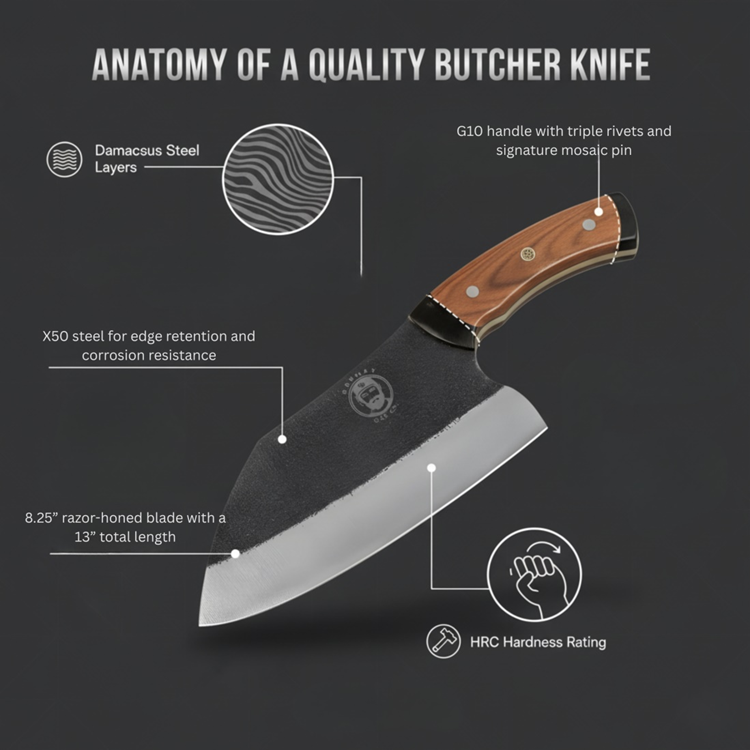
67 layers of folded steel around a VG-10 stainless core at 60 HRC. Full G10 handle, triple riveted. Properly thin behind the edge — the geometry that makes a knife actually cut rather than just push.
At $55, this knife is priced significantly below what most Damascus chef’s knives sell for in the specialty knife market. The reason: direct sourcing and a brand that isn’t paying for retail shelf space or a name that adds $100 to the sticker.
The Damascus on this knife is functional — the VG-10 core is a legitimate edge steel with a genuine performance profile. The 67 layers produce real construction benefit, not just aesthetics. The pattern is etched from the actual layered construction, not applied after the fact.
This is the recommendation for a household that wants a quality Damascus chef’s knife at an honest price. It performs above its price point because the price reflects production cost rather than marketing overhead.
The 3.5″ Damascus Fruit Knife ($30 / currently $29.98)
Same VG-10 core, same layered Damascus construction, smaller format. The fruit knife is the detail work knife — citrus, apples, cheese, small produce, the tasks where an 8-inch blade is overbuilt. At $30, it’s the easiest recommendation in the Grumpy Dad catalog. It goes in the gift basket, the camping kit, the kitchen drawer that needs a capable small blade.
The Pattern-Welded Price Spectrum: Honest Assessment
At different price points, here’s what Damascus construction actually indicates:
Under $40: The Damascus pattern is almost certainly decorative — applied via etching on a single steel, or produced by stamping a pattern rather than forge welding. The blade may perform adequately for light kitchen use. It won’t perform like a properly constructed pattern-welded knife. The value is aesthetic.
$40 to $100: This range contains both genuinely well-constructed entry-level Damascus knives and aesthetically convincing knives with poor core steels. At this price point, the core steel specification is the critical variable. Know what you’re buying.
$100 to $250: Where most quality production Damascus knives live. Japanese makers like Yoshida Hamono, Shun, and Miyabi produce reliable Damascus construction at this range. The Grumpy Dad 8″ Damascus operates here in terms of actual build quality, at $55 due to the direct pricing model.
Above $250: Custom and semi-custom knives from skilled smiths who hand-select their steels, control the forge welding themselves, and produce a knife where the Damascus is a result of genuine craft rather than factory production. The pattern is unique to each knife. The performance reflects the smith’s skill. Worth the price for people who care about that provenance.
The Honest Verdict on Damascus
The Damascus pattern is beautiful. That’s real. A kitchen knife you want to pick up and use is marginally but genuinely better than one you don’t notice — the aesthetics of a tool you use daily have modest but real value.
The Damascus construction, when done correctly, is also functionally sound. A hard core steel with tough cladding layers is a legitimate approach to knife construction with genuine performance benefits.
The historical mystique is marketing. The layer count is marketing. The word “ancient” on a knife that was made in a factory last year is marketing.
Buy the blade, not the story. Specify the core steel. Check the hardness. Pick up the knife and feel whether the geometry and balance work for your hand and your cutting style.
If those answers are good and the Damascus pattern happens to look excellent on the cutting board — which it does — that’s a knife worth buying.
Grumpy Dad Co. — The blade matters. The story is secondary.
Browse the full Damascus and Japanese knife collection at grumpydadco.com