
Morning Tolerance: The Story Behind the Coffee and Why We Made It

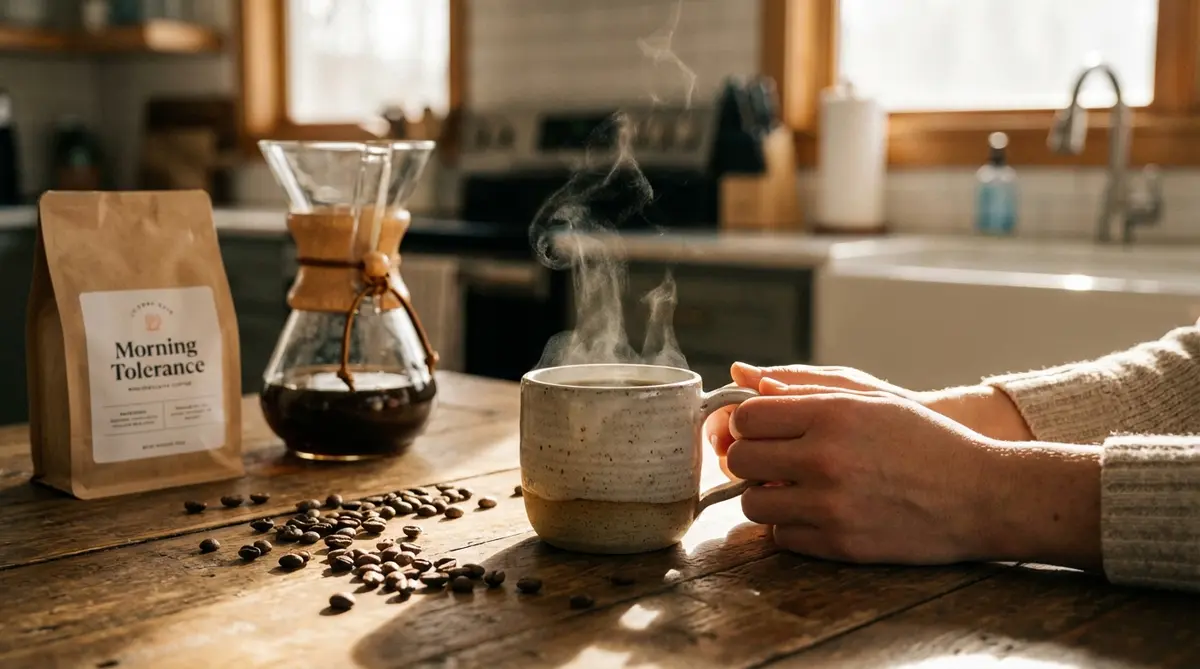
The name comes first.
Not from a branding session. Not from a focus group. From the honest description of what the first part of every morning actually requires: a degree of tolerance. For the alarm. For the noise. For everyone who needs something before you’ve had a chance to need anything yourself.
Morning Tolerance is what you build before the day starts. And the cup — the first, quiet, hot cup before anything else — is where that tolerance comes from.
That’s the name. Here’s the coffee.
Why We Got Into Coffee
Grumpy Dad Co. started with knives. Sharp tools for real kitchens, built to be used rather than displayed, priced honestly rather than for the brand premium.
The same customer who wanted a knife that actually held an edge turned out to want coffee that actually tasted like something. The connection isn’t accidental — the person who has decided to stop tolerating tools that underperform has usually made that decision across multiple parts of their life. The knife that stays sharp. The pan that sears correctly. The morning cup that tastes like somewhere real.
Coffee was the natural next category not because we’re a lifestyle brand but because the morning cup is the most consistent daily ritual in most households, and most people are drinking something that doesn’t deserve the occasion.
We’re not a coffee brand that also sells knives. We’re a brand for people who’ve stopped settling, in the kitchen and at the counter and in the first 20 minutes of the morning.
Why Panama Geisha
The variety was chosen before the origin. We knew we wanted to start with something that made an immediate argument — a coffee specific enough and distinctive enough that a first cup would change what the person expected from every cup after it.
Panama Geisha from the Chiriquí Highlands does that.
The Geisha variety produces floral aromatics and stone fruit acidity at a level that most Arabica varieties don’t approach. Jasmine on the nose. Peach and apricot in the cup. A clean, long finish that stays pleasant as the cup cools. The first time most people taste it, they stop and ask what it is.
That reaction was the goal. Not sophistication for its own sake — a cup that announces itself as different without requiring the drinker to have any background in specialty coffee to notice.
Why Volcán, Chiriquí
Boquete gets the most press in Panama coffee. It’s the region that made the Hacienda La Esmeralda Geisha famous after the 2004 Best of Panama competition. The reputation is legitimate — Boquete produces exceptional coffee.
Volcán, on the other side of the Barú Volcano, operates at equivalent altitude with less marketing pressure. The farms there are producing for quality rather than for a reputation that’s been built up by a decade of coverage. The lot we source from sits at 1,600 to 1,900 MASL in volcanic soil, with the cloud cover and diurnal temperature variation that slow cherry ripening and build the flavor compounds the Geisha variety is capable of.
Less famous. Same altitude. Same geology. Better value for what’s in the cup.
Why Washed, Why Medium Roast
The Geisha variety’s aromatic profile — the thing that makes it worth the price — is best expressed through washed processing and restrained roasting.
Washed processing removes all the fruit before drying. No fermentation byproducts, no fruit contact. The bean expresses itself directly — the variety’s genetics, the altitude’s conditions, and nothing else. Natural processing would add fruit character that blurs the Geisha’s specific signal. Honey processing would add sweetness that competes with the variety’s own stone fruit notes.
Medium roast preserves the aromatic compounds built during the long, slow ripening at altitude. Light roast leaves the bean slightly underdeveloped — the sweetness hasn’t fully formed. Dark roast burns off the floral aromatics that make the Geisha worth buying. Medium roast is the window where the Chiriquí terroir and the Geisha genetics are both fully expressed without one overwriting the other.
Every decision in the Morning Tolerance specification was made to serve the cup, not to meet a category expectation.
What It’s For
Not special occasions. The name says it clearly — this is a morning coffee. The 15 to 20 minutes before anything else has a claim on the day.
It’s not meant for people who already care deeply about specialty coffee, though those people will appreciate it. It’s meant for the person who has decided the morning cup should be better than it’s been, doesn’t know exactly where to start, and wants something that delivers on its first cup without requiring a learning curve.
Buy the bag. Brew it the way you already brew coffee. Notice the difference. That’s the whole pitch.
The Roast Date
On the bottom of every bag: the roast date.
Not a best-by date. The date the beans were roasted. Because specialty coffee is a perishable product with a peak window — 5 to 21 days post-roast — and a bag without a roast date is a bag whose freshness is a secret the roaster decided not to share.
The date is there because you deserve to know what you’re buying.
That’s the Morning Tolerance standard. And it’s the standard everything else we make is held to.
Grumpy Dad Co. — Built for the morning that matters.
Order Morning Tolerance at grumpydadco.com