How to Make Great Coffee for a Crowd (Without Losing Your Mind)

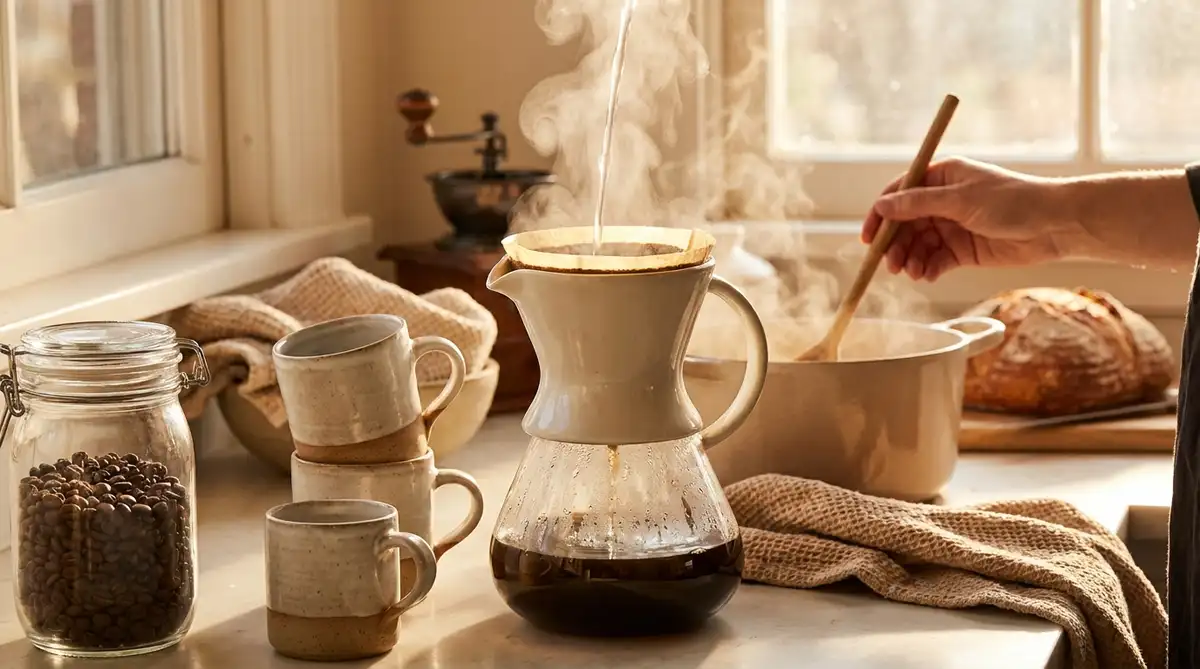
At some point between Thanksgiving and New Year’s, you will be responsible for coffee for a group.
It might be a holiday brunch. A Christmas morning with everyone in the house. A New Year’s Eve gathering that runs late enough that someone needs coffee before they drive home. Whatever the occasion: twelve people, eight cups, one kitchen, limited equipment, and at least two people asking how long it’s going to be.
Making coffee for a crowd is a different problem than making it for two. The math scales. The attention doesn’t — or shouldn’t. This is the guide for approaching it correctly: which method to use, how to calculate what you need, how to keep it hot without it going stale, and what order of operations keeps you out of the kitchen while everyone’s in the living room.
The Fundamental Problem With Scaling Coffee
Home coffee brewing is optimized for small batches. A pour-over V60 makes one to two cups. A standard drip machine makes 8 to 10 cups if you’re lucky. A single AeroPress makes one.
The problem with scaling is not just volume — it’s that most coffee starts declining in quality within 20 to 30 minutes of brewing. A batch brewed at 9 a.m. for people who show up between 9 and 11 a.m. produces coffee that’s excellent for the first group and deteriorated for the second.
Three solutions to this problem, in order of elegance:
1. Brew in batches that match consumption rate. Make eight cups, serve them, make eight more. Requires more active attention but produces fresher coffee.
2. Use a method that holds well. French press coffee in a stainless double-wall press holds for 45 minutes without significant quality loss if you decant it immediately after pressing. A Moccamaster or similar quality drip machine into a thermal carafe does the same.
3. Prepare cold brew concentrate in advance. Made two days ahead, served hot or cold on demand by diluting the concentrate with hot water. No degradation between batches. Tastes the same at 11 a.m. as at 9 a.m.
Method One: The Moccamaster (Best for Drip)
The Technivorm Moccamaster ($330) is the only home drip machine recommended on this blog, and holiday crowds are the primary reason.
It brews a full 10-cup (40 oz) batch at the correct temperature (196°F to 205°F) in approximately 6 minutes. Into a thermal carafe that holds the coffee at drinking temperature for 60 to 90 minutes without a heating element that continues cooking the grounds.
For a holiday gathering, the Moccamaster workflow is:
- Measure and grind coffee (60 grams per liter — for a full 1.25L batch: 75 grams, or about 5 tablespoons of properly measured, freshly ground coffee)
- Press the brew button
- Walk away for 6 minutes
- The carafe is on the table, self-serve, for the next hour
A second batch takes the same 6 minutes whenever the carafe is running low. This is as close to hands-free crowd coffee as drip brewing allows.
The machine’s reputation is built on this use case — a hotel breakfast, a brunch, a morning gathering where people arrive at different times and expect coffee to be available. One machine, properly used, handles a party of ten to fifteen without drama.
The beans: Use at least a quality medium roast. Morning Tolerance at medium roast performs beautifully in the Moccamaster — the machine’s even extraction and correct temperature lets the Geisha’s stone fruit and clean finish come through in a way that cheaper machines don’t manage. For a larger gathering where cost-per-cup matters: a quality Colombian or Costa Rican medium roast provides the balanced, accessible cup profile that works for a mixed room.
Method Two: Cold Brew Concentrate + Hot Water (Best for Flexibility)
Cold brew concentrate diluted with hot water is not commonly known, but it’s one of the most practical solutions for large-scale holiday coffee service.
Why it works: Cold brew concentrate is made two to three days in advance. It keeps in the refrigerator for two weeks. Serving it requires only heating water and diluting 1:1 (one part concentrate to one part hot water). The result is a smooth, low-acid cup that tastes identical at 11 a.m. as at 9 a.m. No brewed-to-order timing. No quality degradation from sitting in a carafe.
Making the concentrate for a crowd:
For 10 to 12 cups of finished coffee:
– 120 grams of coarsely ground coffee
– 480ml (2 cups) of cold filtered water
– Combine, stir, refrigerate 16 to 20 hours, filter through paper
This produces approximately 400ml of concentrate. Diluted 1:1 with hot water: approximately 800ml, or about 8 cups.
For 20 cups: double the recipe. Make it in a French press or a large jar. The concentrate keeps — you don’t have to serve it all at once.
The service setup: A thermal carafe of hot water on the table (or a simple hot water dispenser). The cold brew concentrate in a small pitcher. A card explaining the dilution ratio. Guests help themselves. You’re not in the kitchen.
Method Three: Multiple French Presses (Best for Quality)
For the gathering where the coffee is a feature rather than a background necessity — a smaller brunch with guests who care about what they’re drinking — multiple large French presses in rotation produce the highest-quality crowd coffee available at home.
The math: A standard 34-oz (8-cup) French press uses 50 grams of coarsely ground coffee. Brew time is 4 minutes. One press per round of service, staggered by 4 to 8 minutes.
For 12 people at two cups each (approximately):
– 3 rounds from one large press, or
– 2 rounds from two presses in rotation
The quality advantage: French press coffee brewed correctly — coarse grind, 4 minutes, immediate decant after pressing — is arguably the best large-format brew method for flavor complexity. The metal filter retains oils that paper filters remove, producing a heavier body that many people prefer at a gathering where the coffee is meant to be noticed.
Decant immediately: The most important French press technique for crowd service. After 4 minutes, press and pour the entire batch into a thermal carafe or large thermal mug. Coffee left on the grounds after pressing continues extracting and goes bitter within 10 minutes. Decanted into a thermal vessel, it holds well for 45 minutes.
The Math: How Much Coffee for a Crowd
The standard ratio applies regardless of method: 60 grams of coffee per liter of water.
| People | Estimated Cups | Water (liters) | Coffee (grams) |
|---|---|---|---|
| 6 | 8 | 1.0L | 60g |
| 10 | 14 | 1.75L | 105g |
| 15 | 20 | 2.5L | 150g |
| 20 | 28 | 3.5L | 210g |
Add 20% to the coffee quantity to account for people who have second cups, guests who arrive late, or the host’s cup that happens at the end.
For an 8-hour gathering: Plan for 1.5 cups per person per hour for the first two hours (morning arrival energy), then 0.5 cups per person per hour afterward. A 15-person brunch running 10 a.m. to noon: 15 people × 3 cups average = 45 cups = approximately 2.8 liters = 168 grams of ground coffee. Round up to 200 grams. Buy accordingly.
Keeping It Hot
The heating plate on most drip machines is the enemy of good coffee. Keeping brewed coffee on a heating element — even at low heat — cooks the coffee continuously, burning off volatile aromatics and turning the organic acids bitter. Coffee left on a hot plate for 20 minutes tastes noticeably worse than the same coffee poured immediately into a thermal carafe.
The solution: Always brew into a thermal carafe, never a glass carafe with a heating plate underneath. The Moccamaster’s thermal carafe is the built-in answer. For French press or other methods: decant immediately into a quality thermal carafe (Zojirushi, Thermos, any double-wall stainless vessel rated for long-term heat retention).
Coffee in a good thermal carafe holds drinking temperature for 60 to 90 minutes with minimal quality degradation. That window covers most brunch service without anyone getting cold coffee or stale coffee.
Morning Tolerance for a Crowd
Morning Tolerance — the washed Panama Geisha — is the right choice for a gathering where at least some of the guests will pay attention to what’s in the cup. Guests who typically drink whatever’s on the counter will find it pleasant without necessarily noticing why. Guests who care about coffee will ask what it is.
For a very large gathering (15+ people) where the cost per cup needs to stay modest: a quality Colombian or Costa Rican medium roast provides the accessible, balanced cup that works for the whole room without the Geisha’s specialty price point.
For a smaller, intentional gathering — a holiday brunch where the coffee matters as much as the food: Morning Tolerance in a Moccamaster or large French press is the answer. The cup will be the best thing on the table.
The Setup on the Day
One hour before guests arrive:
- Grind the full batch (use scale, not scoops)
- Set up the brewing station with carafe, equipment, and hot water
- Have second-batch supplies pre-measured in a separate container
When the first group arrives: brew, serve, start the second batch pre-grind while the first is being consumed.
When everyone is there: the second batch goes on. You’re already in the room talking to people, not in the kitchen grinding more beans.
This is the whole system. Batch-prep the grind. Use a method that holds. Brew ahead of demand. Be in the room.
That’s how good coffee gets served to a crowd without the crowd noticing the effort.
Grumpy Dad Co. — Coffee for the morning that matters.
Browse Morning Tolerance and the full Coffee, Tea & Espresso collection at grumpydadco.com