4th of July BBQ: The No-Nonsense Grilling Playbook

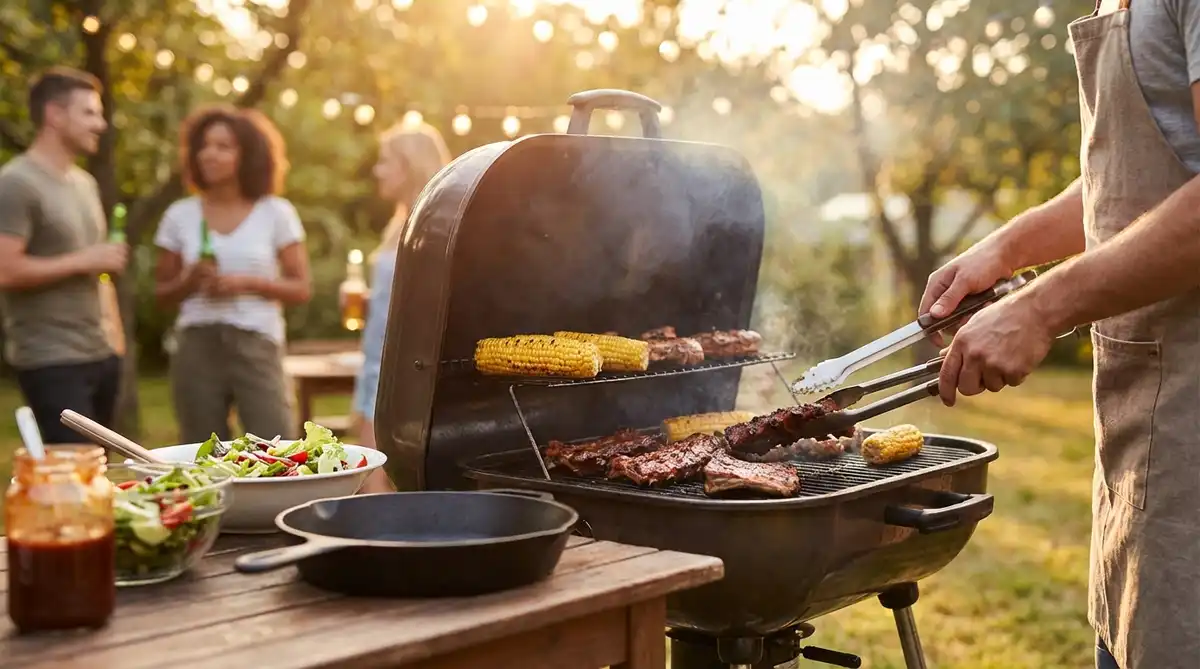
July 4th is the biggest cookout of the year.
Not Father’s Day. Not Memorial Day. July 4th. The crowd is larger. The expectation is higher. The day goes longer. And unlike a Thanksgiving or Easter where the kitchen does most of the work, July 4th is entirely on the grill — which means it’s entirely on you.
This is the playbook. What to cook. How to time it. How to handle a crowd without turning the afternoon into a logistics operation that keeps you away from every conversation happening ten feet away.
The First Decision: How Many People
Everything else flows from this. The quantities, the number of proteins, the timing window, the number of grill surfaces you need.
Under 10 people: One centerpiece protein plus burgers or dogs as backup. A rack and a half of ribs, or four to six steaks, plus a fast-cook option for kids or later arrivals.
10 to 20 people: Two centerpiece proteins, or one large centerpiece (whole brisket, pork shoulder) plus multiple fast-cook supports. The cook complexity increases, the timing requires a written plan.
20+ people: You need either two grills or a plan that staggers serving rather than trying to feed everyone simultaneously. A brisket that was started the night before plus burgers and hot dogs for the overflow covers most crowds of this size.
Know the number before you plan the menu. The number determines the menu.
The Menu Framework
July 4th menus fail for one reason: too many proteins requiring simultaneous attention. The host tries to manage slow ribs, fast steaks, and burgers at the same time, and nothing gets the attention it deserves.
The playbook is: one slow protein started early, one fast protein cooked to order, one foolproof backup.
The slow protein goes on in the morning and handles itself with only periodic checks. It’s done before the crowd is fully assembled and stays warm while you manage everything else.
The fast protein cooks to order — 10 to 15 minutes, done, plate it. Handles the timing flexibility a crowd requires.
The foolproof backup is what you fall back on when timing drifts, when more people show up than expected, or when the slow protein takes longer than planned. Hot dogs, bratwurst, chicken drumsticks — things that are hard to ruin and fast to execute.
The Proteins
The Slow Protein Options
Pork shoulder (Boston butt) — The most forgiving large-format cookout meat and the best choice for crowds that skew toward people who want pulled pork.
A 8 to 10-pound bone-in pork shoulder, rubbed the night before with a simple mix of kosher salt, black pepper, brown sugar, smoked paprika, and garlic powder. Into the smoker or grill at 225°F at 8 a.m. on July 4th. The internal temperature target is 200°F to 205°F for pull-apart texture — expect 1.5 to 2 hours per pound, plus a rest.
At 200°F, the shoulder can be held in a foil-wrapped cooler for three to four hours without meaningful quality loss. This is the key feature: a pork shoulder is done when it’s done, and it holds. If it finishes at noon and you’re eating at 3, it’s fine. If it pushes to 2:30 and you’re eating at 3, it’s fine. The flexibility is built in.
Pull with meat-shredding claws or two forks. The bone will slide out cleanly when properly cooked. Serve with sauce on the side — let people apply their own.
Baby back ribs — For the crowd that wants to eat with their hands. Faster than pork shoulder: baby backs at 225°F take 4.5 to 5.5 hours, or use the 2-2-1 method (2 hours unwrapped, 2 hours foil-wrapped, 1 hour unwrapped). More active management than a pork shoulder, but the result is self-evident — ribs at a cookout look like what a July 4th cookout is supposed to look like.
Brisket — The high-commitment choice. A full packer brisket means starting the night before. For July 4th service at 3 p.m.: fire at 9 p.m. on July 3rd, smoke overnight, pull around noon to 2 p.m., rest in a cooler until service. This is the most impressive result and the most demanding timeline. It’s also the kind of cook that people talk about a year later.
The Fast Protein Options
Smash burgers — The most efficient feeding system at a large cookout. 80/20 ground beef, loosely formed 3 to 4-ounce balls (not pre-formed patties), cast iron skillet at screaming heat on the grill side burner. Smash flat with a heavy spatula immediately on contact. Cook 2 minutes. Flip. Add cheese. 1 more minute. Done.
The smash technique produces more surface area contact with the hot pan than a formed patty, which means more Maillard reaction, which means more crust, which means a better burger. It’s faster than traditional burger cooking. It produces more consistent doneness across varying thicknesses because there is no varying thickness — they’re all flat.
Four to six smash burgers per cast iron can be done in 6 minutes. That’s feeding speed.
Grilled chicken thighs — Bone-in, skin-on. The forgiving version. Indirect heat at 350°F for 35 to 40 minutes, move to direct heat for the last 5 to get skin color. Target internal temperature 175°F — higher than the safe threshold of 165°F because at 175°F, the connective tissue in the thigh has broken down and the meat is actually tender rather than just cooked.
Marinate in the morning: olive oil, lemon, garlic, dried oregano, salt. Thighs handle an aggressively seasoned marinade better than breasts.
Hot dogs and bratwurst — Call them what they are: insurance. Every July 4th cookout needs a fast, crowd-pleasing, low-maintenance option for kids, late arrivals, and the three people who always say “I don’t really feel like a full plate.” Direct heat, 3 to 4 minutes, turn once. Done.
The Timing Sheet
For pork shoulder as centerpiece:
- July 3rd evening: Apply rub, refrigerate overnight
- July 4th, 7:00–8:00 a.m.: Fire on, shoulder goes on at 225°F
- 11:00 a.m.: Check internal temp, push through stall if needed
- 2:00–3:00 p.m. (est.): Pull at 200°F–205°F, rest in cooler
- 3:00 p.m.: Unwrap, pull, serve
For baby back ribs as centerpiece:
- July 4th, 9:30 a.m.: Fire on, ribs on at 225°F
- 11:30 a.m.: Into foil
- 1:30 p.m.: Out of foil, sauce on
- 2:30–3:00 p.m.: Done, rest 15 minutes, serve
For brisket as centerpiece:
- July 3rd, 9:00 p.m.: Fire on, brisket goes on
- July 4th, 9:00 a.m.–noon: Monitor, push through stall
- Noon–2:00 p.m.: Pull at 203°F, rest in cooler
- 3:00 p.m.: Slice, serve
Fast proteins: Cook to order throughout service. The burgers and dogs don’t go on until people are actively eating and asking for more.
Managing the Grill Station
The grill station needs three things to function properly: the right tools, a clear workspace, and a host who isn’t trapped there.
Tools at the station:
A wireless probe thermometer (MEATER Plus or equivalent) is the single most liberating piece of equipment for the host. Set the target. Walk away. Come back when the phone alerts. You don’t have to babysit the slow protein. The probe does it.
A bristle-free grill brush — cleaned before service, cleaned after. Start the day with a clean grate.
Long-handled tongs (16 inches minimum) — your primary tool for everything that isn’t a burger. Forks puncture. Spatulas tip. Tongs grip.
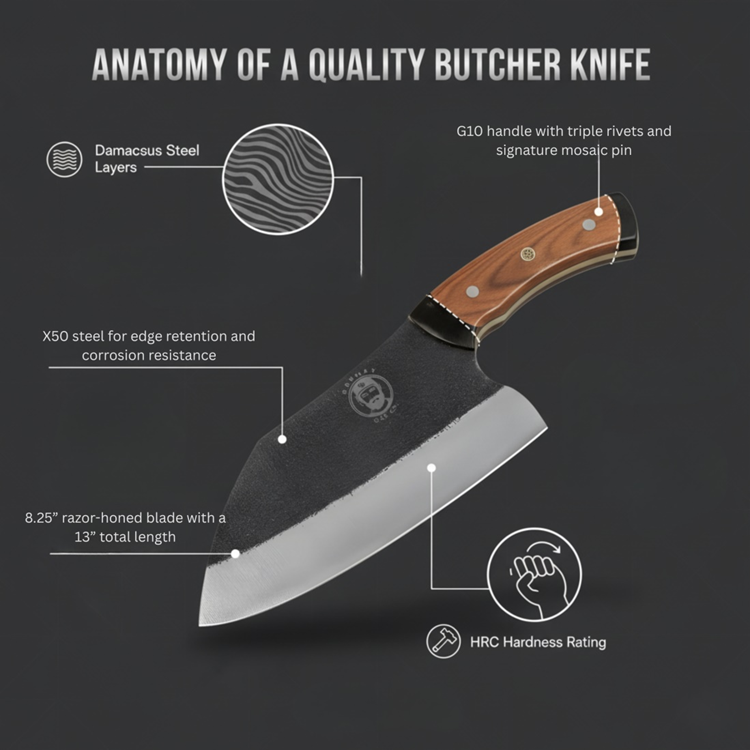
A sharp heavy knife for the cutting board — the Grumpy Dad Heavy-Duty Butcher Knife is the right tool here. A pork shoulder being pulled, a brisket being sliced, ribs being portioned — this is the work it was built for.
A cast iron skillet for the burgers — the Lodge 12″ on the side burner. Nothing else produces the same crust.
The workspace:
A folding table next to the grill with: paper towels, tongs, the knife, a cutting board, foil, sauce, the phone for the probe thermometer. Everything within reach. No trips to the kitchen for a tool that should have been outside already.
The host:
The probe is running. The slow protein is hours from done. The burgers go on in batches. You have 10 to 15 minutes between active grill work for most of the afternoon. Use it.
Be in the conversation. Have the cold drink. The whole point of planning the cook is to earn back your afternoon.
What Else Goes on the Table
July 4th sides don’t need to be complicated. They need to be there when the protein is ready.
Corn on the cob: Soaked in husks, grilled 15 to 20 minutes. No attention required. Comes off the grill when the protein does.
Coleslaw: Made the day before. Better the next day anyway. Out of the refrigerator when needed.
Potato salad: Same — day before is correct. Potato salad made the morning of is always slightly underdeveloped.
Baked beans: If you’re doing pork shoulder, make baked beans the night before and warm them in a cast iron pan on the grill during the last 30 minutes. The rendered pork fat from the shoulder drippings goes in the beans. This is not optional. It’s the move.
Watermelon: Cut the day of. No preparation required beyond a sharp knife and a moment. The Grumpy Dad Damascus chef knife through a cold watermelon is exactly the kind of satisfying cut that makes you glad you have a knife that works.
The Part That Actually Makes the Day
July 4th has been running since before most of us were born, in backyards across the country, with varying degrees of culinary ambition and identical results in terms of what people remember.
Nobody leaves a July 4th cookout remembering the rub on the ribs. They remember whether it was fun. They remember the afternoon. The conversations. The kids running in the yard. The hour after dinner when nobody left yet.
The food is the frame for all of that. It should be good — worth the preparation, worth the timing, worth doing right. But good food that required you to be stressed, absent, and sweating over a grill all afternoon is a worse day than slightly simpler food cooked by someone who was actually there for the party.
Plan the cook so the cook takes care of itself. Then take care of the rest.
Grumpy Dad Co. — Good fire. Right tools. Present for the people.
Browse the full outdoor cooking and grilling collection at grumpydadco.com