The Only Grill Thermometer Guide You’ll Ever Need

Your grill has a built-in thermometer. It’s probably wrong.
The dial thermometer mounted in the lid of most gas and charcoal grills measures temperature at the lid — which is 6 to 10 inches above the cooking grate where your food sits. The temperature at grate level, where the food actually is, can be 25°F to 75°F different from what the lid says. On a cool day, on a windy day, with the lid opened and closed repeatedly — the lid thermometer is a rough approximation at best.
This is why knowing what you’re measuring matters before you buy a thermometer. There are two different things to measure on a grill, and they require two different tools.
The Two Measurements
Grill ambient temperature: The air temperature inside the closed grill, at grate level. This tells you the environment your food is cooking in. Relevant for indirect cooking, smoking, and anything where cook time depends on the grill’s ambient temperature.
Internal meat temperature: The temperature inside the protein itself. This tells you the actual doneness of the food. It’s the only reliable way to know when something is done — not time, not touch, not cutting into it.
These are two completely different measurements. Most cooking problems come from people tracking the wrong one, or not tracking either.
Tool One: A Grill Clip Thermometer
For the ambient temperature problem: a separate thermometer that clips to the grate or sits at grate level inside the grill.
Most quality grill clip thermometers run $15 to $30. They’re simple — a probe that hangs at grate level connected to a dial or digital readout — but they tell you what the lid thermometer doesn’t: what temperature your food is actually experiencing.
This matters most during two-zone indirect cooking, smoking, and any low-and-slow cook where maintaining a specific ambient temperature is the whole method.
What to buy: Any grill clip thermometer from a reputable brand. This is not where to spend a lot of money. It’s a calibration tool.
Tool Two: A Probe Meat Thermometer
The more important of the two. This is the tool that tells you when the food is done — not based on time or visual cues, but based on the actual internal temperature of the protein.
Three types, in order of usefulness:
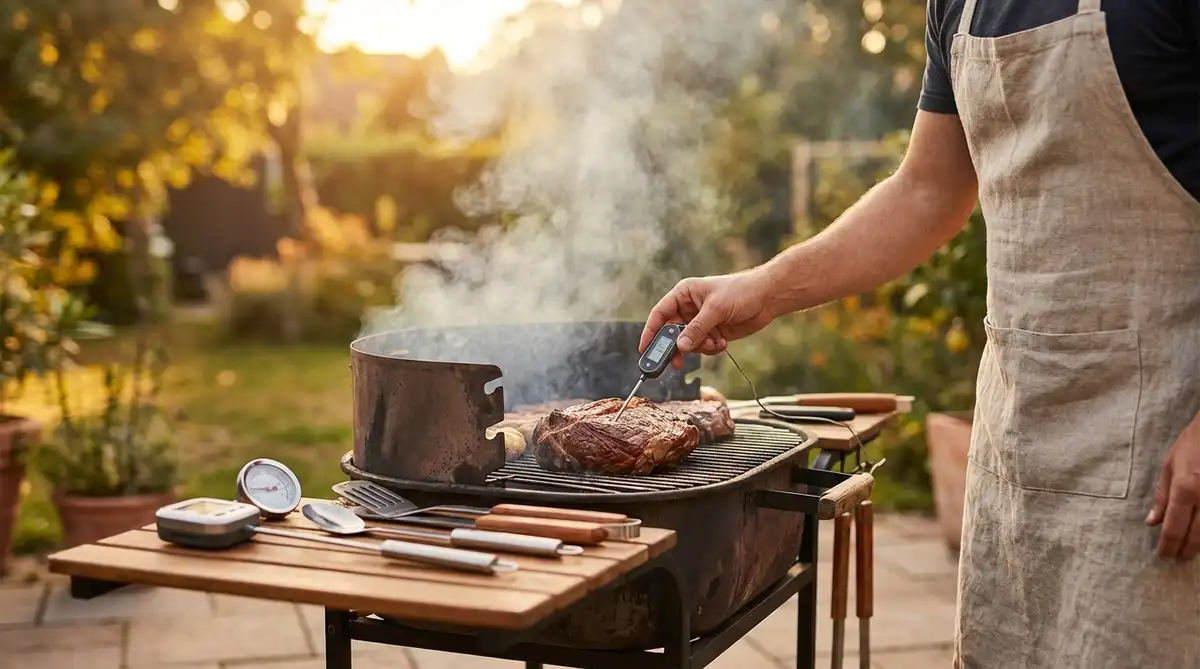
Wireless probe thermometer (the recommendation): A metal probe that stays in the meat throughout the cook. Reads internal temperature continuously. Sends alerts to your phone when you hit the target. The MEATER Plus is the benchmark — it reads both internal meat temperature and ambient grill temperature simultaneously from a single probe, which means it replaces the grill clip thermometer as well. Set your target temperature, walk away from the grill, and get a phone notification when the protein is done. No hovering. No lid-lifting.
At $139.90, this is the grill investment that changes every cook indefinitely. It’s used every single time there’s protein on the grill — the frequency of use over a season makes the cost-per-use negligible.
Wired probe thermometer: A probe that stays in the meat, connected by a cable to a display unit outside the grill. Accurate and reliable. No Bluetooth or wireless range. Works perfectly and costs significantly less ($25 to $50 for quality options). The right choice for cooks who want probe thermometer functionality without the app and wireless features.
Instant-read thermometer: A probe that you insert into food to get a quick temperature reading. Used for spot-checking — verifying doneness when you want a second opinion, checking multiple spots on a large cut, testing thin cuts quickly. The Thermapen ONE (~$105) is the accuracy benchmark. A basic instant-read at $15 to $25 gives you the functionality with less precision and slower response.
Why Time Is Not a Substitute
“10 minutes per pound” and similar timing rules are averages. They don’t account for grill temperature variation, starting temperature of the meat, wind, exterior temperature, or the specific cut’s thickness and density.
A chicken breast that comes off the grill at 8 minutes looks done. It may be 145°F internally. Safe by some standards, not others. Dry? Possibly. The same breast at 165°F (measured) is unambiguously safe and, if properly cooked, still moist.
A pork shoulder that needs to reach 200°F for pull-apart texture will get there at different times on different days. The clock says 8 hours. The probe says 178°F. The clock is wrong.
Temperature is the only reliable measure of doneness for any protein. Time is a planning tool. Temperature is the output.
The Simple Setup
For the weekend griller cooking burgers and dogs: an instant-read thermometer at $20. Spot-check anything uncertain. Done.
For the cook who does chicken, pork, and occasional thick steaks: a wired probe thermometer at $30 to $50 for continuous monitoring, plus an instant-read for spot-checking.
For the cook who grills seriously, does low-and-slow, or wants to be doing something other than watching the grill: a MEATER Plus. The wireless alerts mean you’re in the conversation, not at the grill.
The lid thermometer is decorative. Don’t plan a cook around it.
Grumpy Dad Co. — Know the temperature. Know the result.
Browse the MEATER Plus and the full outdoor cooking collection at grumpydadco.com