How to Hold a Knife Correctly (Most People Are Doing This Wrong)

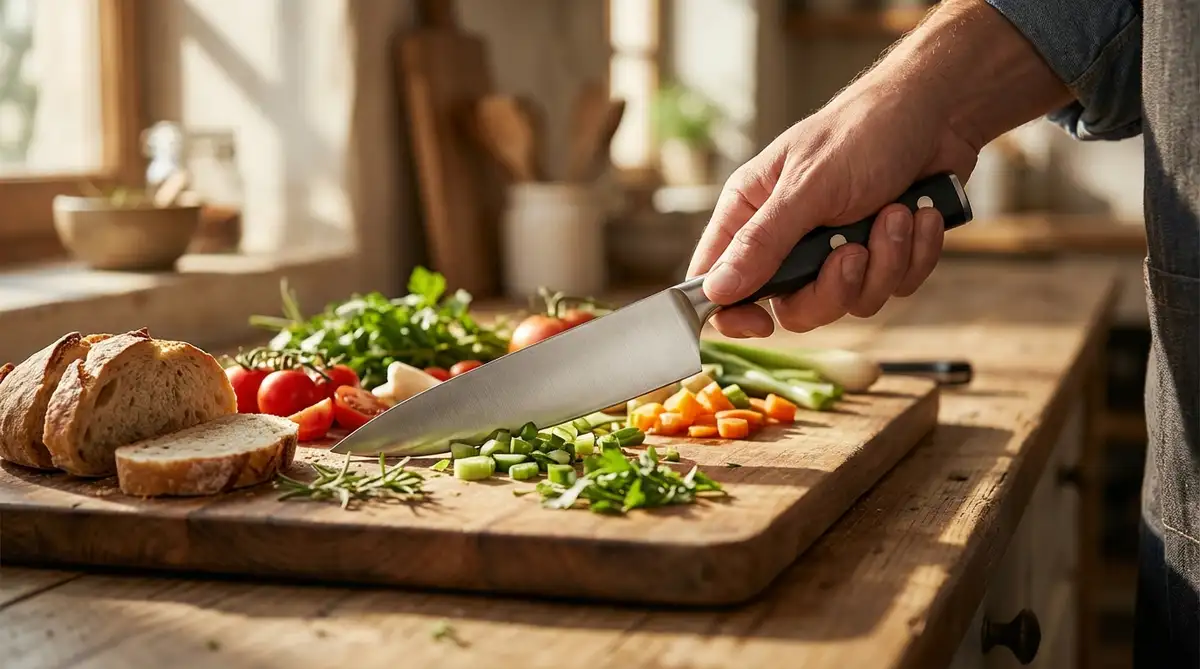
Most home cooks hold a knife by the handle.
That feels natural — it’s a handle, handles are for holding. But gripping the handle positions your hand too far back from the blade, reduces control over the tip, and requires more force to make cuts than necessary. Every professional cook, trained butcher, and serious home chef uses a different grip.
It takes about a day to feel natural. After that, it changes how every knife in the kitchen performs.
The Pinch Grip
The pinch grip — also called the blade grip — positions the thumb and index finger pinching the blade itself, just ahead of the bolster (the thick junction where blade meets handle). The remaining three fingers curl around the handle.
How to do it: Slide your index finger forward onto the flat of the blade, resting it against the side. Bring your thumb to the opposite side of the blade, pinching gently. Your other three fingers naturally wrap around the handle. The blade is an extension of your hand.
Why it works:
More control: Your grip point is closer to the blade’s balance point. The knife pivots more naturally because your hand is at the fulcrum. Precision cuts — fine dicing, thin slicing — become easier because you’re steering the blade directly rather than through the lever arm of a full handle grip.
Less fatigue: Gripping further back on the handle requires more muscular tension to control the blade’s position. The pinch grip is more efficient — less grip strength required, less fatigue over a long prep session.
Better awareness: You can feel the blade’s angle and position through your fingertips. When the angle drifts, you feel it and correct it. With a handle grip, you feel the handle, not the blade.
The Guiding Hand
The grip of the knife hand is only half the equation. The guiding hand — the one not holding the knife — is equally important for safety and precision.
The claw: Curl the fingertips of the guiding hand inward, so the knuckles are the most forward part of the hand and the fingertips are tucked back. The blade rests against the knuckles as you cut, which controls the slice width and protects the fingertips from the edge.
The claw takes about a week to feel natural if you’ve been extending your fingers. The instinct is to reach forward. Resist it. Once the claw becomes automatic, it’s the reason a good cook can dice an onion quickly without looking at their hands — the knuckle guides the blade, and the blade doesn’t wander.
Anchoring: The guiding hand should stay in contact with the food throughout the cut. Don’t lift and reposition with every stroke. Keep contact, move the knuckle back incrementally, let the blade follow.
The Rocking Cut vs The Push Cut
Two primary cutting techniques. The grip is the same for both; the motion differs.
Rocking cut: The tip of the blade stays near the board. The heel rises and falls, driving each cut. The hand rocks with the blade. Natural for a Western chef’s knife with a curved belly. Efficient for herbs, onions, and anything that benefits from a continuous chopping rhythm.
Push cut: The blade moves straight down and slightly forward, with the full edge making contact. The hand doesn’t rock — it pushes. More efficient on a flat-profiled Japanese knife (santoku, nakiri, bunka). Produces cleaner, more precise cuts on dense vegetables and proteins.
Most home cooks use one or the other by default. Knowing both gives you the option to match the technique to the knife and the task.
Practice Drill
The fastest way to build the grip and the claw simultaneously: dice an onion slowly, paying attention to both hands. Not for speed. For position.
Pinch the blade. Claw the guiding hand. Make one cut at a time, fully controlled, maintaining contact with the onion throughout. Ten minutes of slow, deliberate onion work ingrains both techniques faster than any amount of reading about them.
The next onion after that practice session will go faster than the one before, with more control and less risk.
That’s all it takes.
One More Thing
A sharp knife makes every technique easier. A dull knife requires more pressure, which reduces control and increases the risk of the blade slipping. The pinch grip and the claw are the correct techniques. A maintained, sharp knife is the tool that lets them work.
Both matter. Neither one works as well without the other.
Grumpy Dad Co. — The right grip on the right blade.
Browse the full knife collection at grumpydadco.com