Do You Actually Need a Coffee Scale? (Honest Answer: Yes)

Here’s the short version: yes, you need a coffee scale. It costs $15. It removes the most common variable in inconsistent home coffee. Buy it.
Here’s the longer version, for the people who want to understand why before they spend $15.
What a Scale Actually Does
A coffee scale does one thing: tells you exactly how much coffee and water you’re using.
This matters because the ratio of coffee to water determines the strength and extraction balance of the cup. The standard specialty coffee ratio is 60 grams of coffee per 1 liter of water (1:16). Vary the ratio and you vary the cup — more coffee produces a stronger, denser extraction; less coffee produces a thinner, weaker one.
Most people measure by scoop. A scoop is a reasonable approximation, but grounds settle differently depending on the grind size, the roast level, and how tightly you pack the scoop. A “level tablespoon” of a coarsely ground medium roast and a “level tablespoon” of a finely ground dark roast contain different amounts of coffee by weight. Your cup is different every time, not because your technique changed, but because your measuring method is imprecise.
The scale removes that variability. You measure 18 grams of coffee. Every time it’s 18 grams. The cup is consistent because the input is consistent.
The Case Against (And Why It Doesn’t Hold)
“I’ve been making coffee by eye for years and it’s fine.”
It’s probably fine. It’s also probably slightly different every day in ways you’ve normalized. Once you start measuring and compare it to your previous method, the cup made by weight is usually noticeably more consistent and often noticeably better — because the ratio is actually at the target rather than close to it.
“It takes too long.”
Weighing 18 grams of coffee takes approximately 8 seconds longer than scooping. That’s the time cost. For a cup that’s measurably better and consistent every morning: 8 seconds.
“My drip machine has marks on the water reservoir.”
Those marks measure water volume. You still need to know how much coffee you’re adding. Volume marks on a reservoir solve half the ratio problem. A scale solves all of it.
What to Buy
Entry level (~$15): Any kitchen scale that reads in grams to one decimal place. An OXO kitchen scale, a basic Ozeri, a generic Amazon digital scale — any of them. The reading needs to be accurate to one gram. That’s the only requirement.
Step up (~$25–$50): A scale with a built-in timer (useful for pour-over, where total brew time matters) and a faster response rate. The Hario V60 Drip Scale (~$50) is the most commonly recommended in this category — it reads quickly and the timer is integrated, which removes one more thing to track.
Enthusiast (~$150): The Acacia Pearl. Beautiful, precise, connects to an app. Completely unnecessary for most home coffee situations. The $15 scale produces the same number on the display.
Start with the $15 one.
How to Use It for Pour-Over
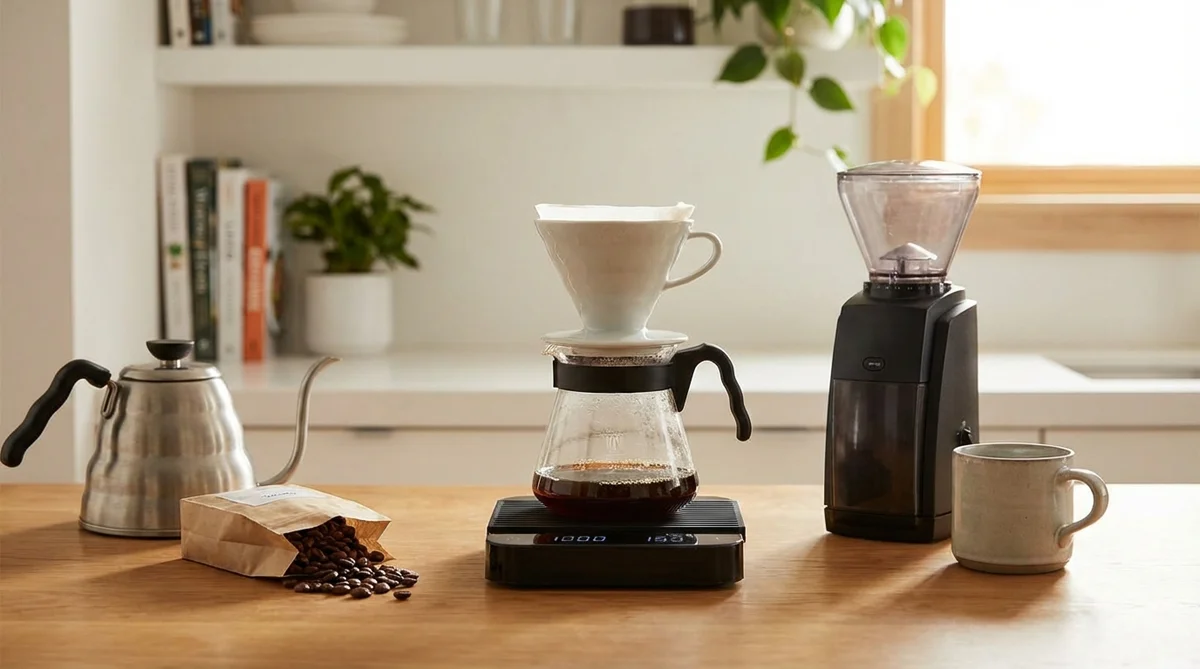
Place the dripper on the scale, on top of your mug or carafe. Tare (zero) the scale. Add ground coffee. Note the weight. Tare again. Begin pouring water, watching the scale to track total water added.
For a single cup using Morning Tolerance:
– 18 grams of medium-coarse ground coffee
– Bloom: 36 grams of water (twice the coffee weight), wait 30 seconds
– Continue pouring to reach 288 grams total water
– Total brew time: 3:00 to 3:30
That sequence, repeated exactly, produces the same cup every morning. That’s the scale’s value.
One More Thing Worth Knowing
Once you have a scale, you’ll start using it for more than coffee. Baking, dry rubs, marinade ratios — measuring by weight instead of volume produces more consistent results in any recipe where the input quantity matters.
The scale costs $15. It pays for itself in the first consistent cup.
Grumpy Dad Co. — Small tool. Consistent morning.
Browse Morning Tolerance and the full Coffee, Tea & Espresso collection at grumpydadco.com