The 5 Things on Your Counter That Are Making Your Coffee Worse

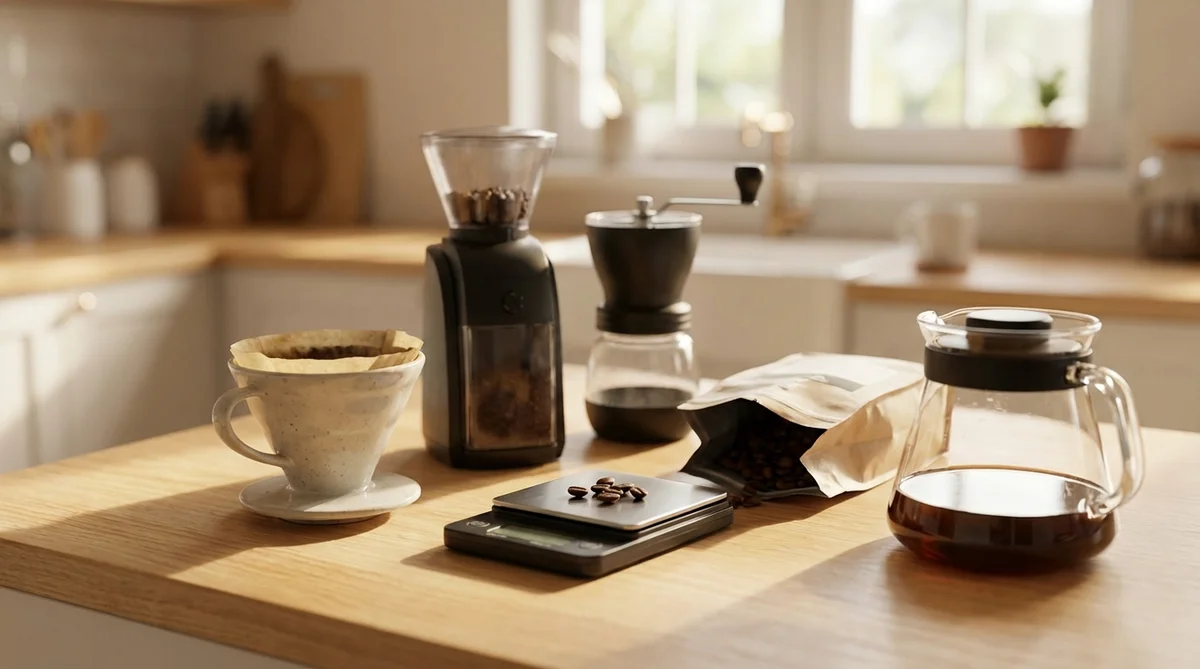
Most people troubleshoot their coffee by adjusting technique. They slow down the pour. They try a different ratio. They change the brew time.
The technique isn’t the problem.
The problem is almost always one of five pieces of equipment sitting on the counter, quietly undermining every cup without announcing itself. You can’t brew around bad equipment. You can only fix it.
Here are the five most common culprits — what each one does wrong, and what replaces it.
1. The Blade Grinder
If there’s a single piece of equipment responsible for more disappointing home coffee than any other, it’s the blade grinder.
You know the one. It looks like a miniature food processor. A spinning metal blade chops the beans into particles of wildly inconsistent size — some powder-fine, some nearly whole. When you brew that chaotic mix, the fine particles over-extract in the first 30 seconds (producing bitterness), while the coarse chunks under-extract throughout (producing flatness and sourness). The cup averages out to mediocre.
The fix is a burr grinder — two abrasive surfaces held at a fixed distance that crush every bean into a consistent particle size. Consistent particle size means consistent extraction. Consistent extraction means a better cup from the same beans.
What to buy: The Timemore C2 manual grinder (~$50) for the budget-conscious fix. The Baratza Encore electric burr grinder (~$170) for hands-free convenience. Either one removes the blade grinder problem permanently.
This is not a marginal improvement. Switching from a blade grinder to a burr grinder is the single most impactful equipment change in home coffee. More impactful than the brewing device. More impactful than the kettle.
2. The Kettle Without Temperature Control
Most electric kettles do one thing: boil water to 212°F.
For specialty coffee — particularly light to medium roast single origins — boiling water is too hot. At 212°F, it scorches the grounds and over-extracts bitter compounds before the desirable aromatics have a chance to develop. The top notes of a washed Geisha, the brightness of a Kenyan SL28, the floral complexity of an Ethiopian Yirgacheffe — all of it gets blasted out in the first seconds of contact with boiling water.
The target range for most specialty coffee is 195°F to 205°F. The workaround with a standard kettle — boil, then wait 45 to 60 seconds — works approximately. But “approximately” compounds over time into a cup that’s never quite as good as it should be.
What to buy: The Bonavita 1L Variable Temperature Gooseneck Kettle (~$50) sets and holds a precise temperature. The Fellow Stagg EKG (~$150) does the same with more precision, faster heating, and a design that makes the morning ritual feel deliberate rather than improvised. Either one solves the temperature variable for good.
The gooseneck spout is also part of the answer — it controls the pour rate in a way that a standard spout doesn’t, which matters for pour-over brewing specifically.
3. The Glass Carafe With a Heating Plate
A drip machine that brews into a glass carafe and keeps it warm on a hot plate is, after brewing, slowly ruining the coffee.
The heating element continues applying heat to the coffee after brewing is complete. This cooks the coffee continuously — burning off volatile aromatics, converting the organic acids into bitter compounds, and producing the scorched flavor that makes an hour-old pot of office coffee taste the way it does.
The fix isn’t a better drip machine necessarily — it’s a drip machine that brews into a thermal carafe. The thermal carafe uses insulation rather than heat to maintain temperature. The coffee stays warm for 60 to 90 minutes without continuing to cook.
If you already have a drip machine you like: buy a compatible thermal carafe and use it instead of the glass one. Many major brands sell thermal carafes separately.
If you’re ready to replace the machine: the Technivorm Moccamaster ($330) brews at the correct temperature into a thermal carafe. It’s the reference-point recommendation for quality automatic drip, covered in the full gear guide on this blog.
4. Beans Past Their Window
This one doesn’t look like equipment. But stale beans are the quietest, most pervasive problem in home coffee — and the coffee on most kitchen counters is significantly past its peak.
Coffee’s volatile aromatic compounds begin off-gassing and oxidizing the moment the beans are roasted. The peak window for whole bean specialty coffee is 5 to 21 days post-roast. By four weeks, the complexity has noticeably faded. By eight weeks, most of what made the coffee interesting is gone. You’re left with caffeine and roasted grain flavor — no brightness, no specific character, nothing to notice.
The tell: a bag with no roast date on it. “Best by” dates that are 12 months out tell you nothing about freshness. If there’s no roast date, the roaster doesn’t want you to know when it was roasted.
The fix: Buy whole bean coffee with a printed roast date. Grumpy Dad Morning Tolerance prints the roast date on the bag. Order in smaller quantities more frequently rather than buying a large bag and using it for three months.
This is the one fix on this list that costs the same as what you’re already spending. You’re just spending it on something that hasn’t been sitting on a warehouse shelf since the previous administration.
5. The Dirty Brewer
Coffee equipment accumulates oil residue. Ground coffee contains natural oils that, left on the surfaces of a French press, pour-over dripper, or automatic drip machine, oxidize and go rancid over days and weeks.
Every cup you brew in an oily, uncleaned brewer carries a background note of stale, rancid coffee fat. It’s subtle enough that most people don’t identify it directly — they just notice that their coffee “always tastes a little off” and assume it’s the beans or the method.
What clean looks like:
- French press: Fully disassemble after every use. The plunger mesh and the inner glass should be washed with warm soapy water and rinsed completely. Old grounds trapped in the mesh are the primary source of off-flavors.
- Pour-over dripper: Rinse after every use. Deep clean with mild dish soap once a week. The paper filter removes most residue, but the dripper itself accumulates oil at the rim and walls over time.
- Automatic drip machine: Run a cycle of equal parts water and white vinegar monthly, followed by two plain water cycles to flush the vinegar. This removes mineral scale and coffee oil buildup from the internal components. Most machines that “aren’t making coffee as well as they used to” just need this treatment.
- Grinder: Brush the burrs and the grounds chute with the included cleaning brush every few uses. Some grinders benefit from an occasional run of commercial grinder cleaner tablets (Grindz).
None of this takes more than a few minutes. The return on those minutes shows up in every cup.
The Common Thread
These five problems share a characteristic: none of them announces itself. The blade grinder grinds. The hot plate warms the carafe. The old beans make coffee. The dirty brewer brews. Everything appears to function.
The cup is telling you otherwise. A cup that’s always slightly off, always slightly bitter, always slightly flat — that’s not your technique. That’s the equipment.
Fix the equipment. Technique follows.
Grumpy Dad Co. — The right gear changes what’s possible.
Browse the full Coffee, Tea & Espresso collection and Morning Tolerance at grumpydadco.com