What Is a Bunka Knife and Why Every Home Cook Should Know

Most people can name three types of kitchen knives: chef’s knife, bread knife, paring knife.
That’s a reasonable working set. It covers most kitchen tasks adequately. It doesn’t cover all of them well — and it doesn’t include some of the most capable tools in the Japanese knife tradition.
The bunka is one of those tools. It’s not new — it’s been a standard in Japanese home kitchens for decades. It’s relatively new to Western cooking culture, where it’s appeared in specialty knife shops and among serious home cooks over the past ten years.
If you’ve never heard of it, this article explains what it is. If you’ve seen it and wondered whether it was worth the interest, this article answers that too.
What a Bunka Knife Is
A bunka (文化包丁 — literally “culture knife” or “everyday knife”) is a Japanese multi-purpose kitchen knife. It’s the Japanese equivalent of a Western chef’s knife in terms of intended use: it handles vegetables, proteins, herbs, and most general kitchen work.
Where it differs from a chef’s knife is in the profile.
A Western chef’s knife has a curved belly — the cutting edge arcs from heel to tip. This curve enables the rocking motion that most Western-trained cooks use intuitively: the tip stays near the board, the heel rises and falls, and the cut happens on the downstroke.
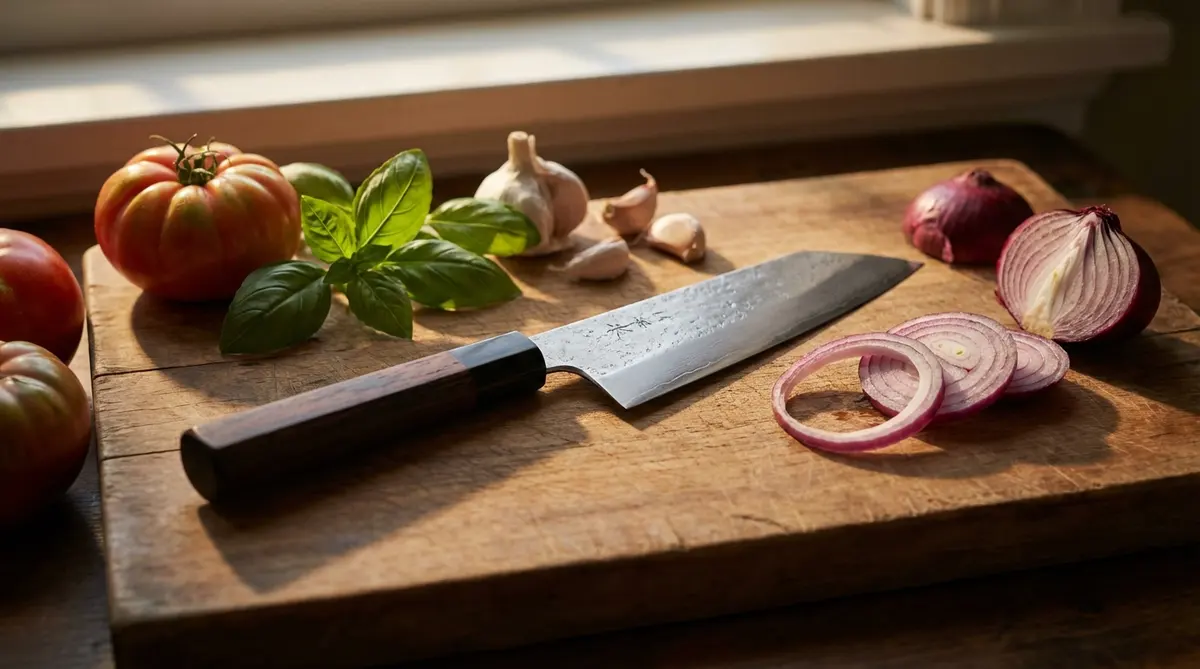
A bunka has a significantly flatter profile. Less belly. The cutting edge runs closer to straight from heel to the mid-blade. Then the blade rises to a distinctive reverse-tanto tip — a straight spine that drops sharply to an angular k-tip point.
That tip is the most distinctive feature. It’s angular, aggressive, and precise. It looks like it was designed to do work — because it was.
What the Bunka Does That a Chef’s Knife Can’t
The reverse-tanto tip is the functional differentiator. It provides:
Precise cutting near the tip. The angular point contacts the board at a sharper angle than a curved chef’s knife tip. For fine work — scoring fish skin, trimming meat close to bone, precise cuts on delicate proteins — the bunka tip allows control that a rounded tip doesn’t. You’re working with the geometry rather than compensating for it.
A push-cut-friendly profile. The flatter blade profile is designed for the push cut rather than the rock. Push cutting — driving the blade straight down with a slight forward motion — is more efficient on many Japanese knives because the blade geometry is optimized for it. For cooks who’ve learned the push-cut technique (or who are willing to), the bunka’s profile rewards this naturally.
Dual-purpose tip work. The k-tip point functions almost like having a small precision knife built into the end of a full-size knife. Japanese recipes often call for fine decorative cuts, precise julienning, and detailed protein preparation that a rounded chef’s knife tip makes slower and less accurate.
What It Has in Common With a Chef’s Knife
The bunka is not a specialist. It’s a multi-purpose knife that happens to have a specific tip geometry and a flatter profile than its Western counterpart.
It handles the same range of tasks:
– Vegetable prep — the flat profile and blade height are excellent for push-cutting through carrots, onions, cabbage, anything dense
– Protein work — slicing raw fish, trimming silver skin, portioning boneless proteins
– Herbs — chiffonade, rough chop, fine mince
– Bread (in a pinch) — the flat profile doesn’t rock through bread the way a serrated knife does, but it slices cleanly through soft loaves
For a cook who wants a single high-quality knife that does most kitchen work exceptionally well with a slightly different approach than the Western default: the bunka is a strong answer.
The Bunka vs. Other Japanese Knives
Three comparisons that come up regularly:
Bunka vs. Gyuto:
A gyuto is the Japanese chef’s knife — a thin-bladed, hard-steel knife that looks similar to a Western chef’s knife but with a flatter belly and harder steel. Both are multi-purpose knives for Japanese cutting technique. The primary difference is tip geometry: the gyuto has a curved, sweeping tip more similar to a Western knife; the bunka has the angular k-tip. If you primarily rock-cut: gyuto. If you push-cut and want tip precision: bunka.
Bunka vs. Kiritsuke:
The kiritsuke is a longer, single-bevel traditional Japanese knife — historically a chef’s knife for professional use, traditionally only used by head chefs. The modern “kiritsuke gyuto” is a double-bevel version available to home cooks. It shares the k-tip geometry with the bunka but is longer (typically 240mm to 270mm versus 165mm to 210mm for bunka), designed for a longer pulling draw cut, and less maneuverable for detailed work. The bunka is more accessible for most home cook tasks.
Bunka vs. Nakiri:
Different instruments. A nakiri is a dedicated vegetable knife — rectangular blade, flat profile, no tip to speak of. Exceptional for push-cutting through produce, limited in any task that needs tip work. A bunka does much of what a nakiri does for vegetables while also handling protein and detail work. If your kitchen is vegetable-heavy: nakiri. If you want a do-everything Japanese knife: bunka.
The Kurumi Shikaku Bunka: Why This Specific Knife
The Hand-Forged Kurumi Shikaku Bunka in the Grumpy Dad catalog isn’t a production bunka. It’s made by hand.
Hand forging allows the smith to optimize blade geometry in a way that machine stamping can’t. The cross-section of the blade — how thick it is above the edge, how it tapers from spine to cutting edge — is controlled by the forging process and the final grinding, not by a fixed die. A skilled smith thins the blade in the places where thinness matters for performance and keeps it slightly thicker where rigidity is needed.
The Kurumi Shikaku specifically: walnut handle in the traditional octagonal Japanese style. The octagonal grip feels different from a Western handle — it seats naturally in the hand and allows the cook to roll the knife between fingers to adjust cutting angle without repositioning the grip. The steel is high-carbon — it takes an edge keener than most stainless options and holds it well. It requires slightly more care than stainless (dry after washing, occasional Camellia Oil application to prevent rust) but rewards that care with edge quality that stainless alternatives at the same price can’t match.
At $175, this is not an impulse purchase. It’s a deliberate one — a knife bought once, maintained properly, and used daily for years. That’s the Grumpy Dad calculation: the cost-per-use on a quality tool used daily for a decade is lower than the cost of replacing a mediocre one twice.
Who the Bunka Is Right For
It’s the right knife for you if:
- You’re interested in Japanese cutting technique (push cut, pull cut) and want a multi-purpose knife designed for it
- You do a significant amount of protein work that requires tip precision — trimming, scoring, working close to bone
- You already own a quality chef’s knife and want a different approach in the kitchen
- You cook across a wide range of foods and want one knife that handles all of it well
- You’re ready for high-carbon steel and willing to maintain it correctly
It’s probably not the right knife if:
- You’re buying your first quality knife (buy a chef’s knife first — it’s the more intuitive starting point for most cooks)
- You primarily cook proteins and want something heavier for the work (the butcher knife is a better choice for that role)
- You’re set on a rocking cut technique and don’t want to adjust — the bunka accommodates a moderate rock but is better suited to push cuts
- You cook in a kitchen where knives get shared and may not be maintained correctly — high-carbon steel needs more care than stainless
The Learning Curve
There is one, and it’s worth being honest about.
Most Western home cooks have developed a rocking-cut habit over years of using Western chef’s knives. The bunka doesn’t prevent rocking, but it’s designed for push cuts. The habit shift takes about a week — not a long time, but a real adjustment.
The payoff of the push-cut technique: more control on each individual stroke, cleaner cuts, and a more efficient motion for high-volume prep work. Push cutting through a pile of vegetables is faster and more precise than rocking once the motion becomes natural.
The tip adjustment is faster. Most people pick up the feel of the k-tip within the first cooking session — it’s a specific, obvious point, and the angle it presents to the food is immediately intuitive once you’ve used it once.
The Short Version
A bunka is a Japanese multi-purpose knife with a flat cutting profile and a distinctive angular tip. It handles the same range of tasks as a chef’s knife, does precision tip work better than any chef’s knife, and is designed for the push-cut technique preferred in Japanese cooking.
The Kurumi Shikaku Bunka is the hand-forged, high-carbon version of this knife — made once, maintained correctly, used daily for a long time. The kind of tool that gets better as you get better at using it.
If you’ve been cooking with a Western chef’s knife for years and are curious about what a different approach feels like: this is the knife to try. The learning curve is a week. The payoff is the rest of your cooking life.
Grumpy Dad Co. — The right tool changes what’s possible.
Find the Hand-Forged Kurumi Shikaku Bunka and the full Japanese knife collection at grumpydadco.com