How to Build a Proper Dry Rub (And Why Wet Rubs Are Mostly Marketing)

There are a lot of opinions about dry rubs.
Some pitmasters swear by salt and pepper only — the Central Texas tradition, where the beef is supposed to taste like beef and the smoke is supposed to taste like smoke, and anything between them is interference. Others use ten-ingredient rubs that have been tuned over decades of competition experience. Both approaches are defensible. Both produce excellent results when used correctly.
What doesn’t produce excellent results: grabbing a bottle off a shelf without knowing what’s in it, shaking it on without thinking about the protein and the cook time, and hoping the label’s confidence translates to the plate.
This guide gives you the framework to build a dry rub that’s calibrated to what you’re cooking — so that the result isn’t generic BBQ flavor but the specific flavor you were trying to create.
What a Dry Rub Is Actually Doing
A dry rub performs three functions. Understanding what each ingredient is doing helps you adjust the formula intelligently rather than by trial and error.
1. Seasoning the interior: Salt is the only ingredient in a rub that penetrates the meat. Applied in sufficient quantity and with enough time — at least an hour, overnight for optimal results — salt draws moisture from the protein via osmosis, dissolves in that moisture, and gets reabsorbed. It seasons from within, not just the surface. This is why properly rested, salted meat tastes seasoned all the way through rather than just on the outside.
2. Building the bark: The bark — the dark, crusty exterior on well-smoked brisket or ribs — is the result of sugar and spices from the rub undergoing Maillard reactions and caramelization during the cook. Brown sugar, paprika, and the natural sugars in dried spices all contribute. The bark is not just texture — it’s a concentrated layer of flavor that forms because the surface conditions were right.
3. Flavor balance: The supporting ingredients — spices, herbs, aromatics — build a flavor profile that complements the protein and the wood smoke. The goal isn’t to taste the rub. The goal is to taste the rub and the protein and the smoke as one coherent thing.
The Architecture of a Dry Rub
Every good dry rub has four categories of ingredients. The proportions change by protein and cook style. The categories don’t.
Salt (the foundation): Kosher salt is the standard. Large crystals, no additives, dissolves at the right rate. Table salt is too fine — it draws moisture too aggressively and can produce a wet surface that inhibits bark development. Sea salt works but offers no flavor advantage over kosher at rub application.
Quantity: more than you think. For a whole pork shoulder, 2 to 3 tablespoons of kosher salt is not excessive for a 10-pound cut. For ribs, 1 to 1.5 teaspoons per rack side. The surface area of a large cut is significant, and under-salted BBQ is the most common mistake in amateur low-and-slow cooking.
Black pepper (the structure): Coarsely ground. The volatile compounds in black pepper hold up to long cook times in a way that finely ground pepper doesn’t. Pre-ground fine black pepper loses most of its aromatic compounds quickly after grinding and contributes bitterness without complexity. A pepper grinder set to coarse, or a mortar and pestle, used fresh, before the cook.
For Texas-style brisket, the rub is equal parts kosher salt and coarse black pepper. Full stop. That’s it. The beef and the smoke do the rest. This is not minimalism as an aesthetic — it’s the correct choice for that protein and that tradition.
Heat (the depth): Cayenne, smoked paprika, black pepper, ancho chili powder, chipotle powder. These contribute warmth at different levels of intensity and different flavor profiles. Smoked paprika is the most versatile — mild heat, deep red color that builds the bark, sweet-smoky flavor. Cayenne is the heat dial. Ancho and chipotle add fruity-smoky complexity without overwhelming heat.
Sweet (the bark builder): Brown sugar is the standard — it caramelizes well, contributes to bark color, and balances the salt and heat. White sugar can work but brown sugar’s molasses content adds flavor complexity. Coconut sugar is a refined alternative with a slightly deeper caramel note.
Sugar proportions matter: too much sugar on a hot direct fire burns and turns bitter. For high-heat grilling, reduce or omit sugar from the rub. For low-and-slow cooks at 225°F to 250°F, sugar works beautifully because the temperature is never high enough to burn it.
The Rubs, by Protein
For Pork Ribs
Pork ribs want sweetness, warmth, and a balance between the two. The fat in the ribs can handle sugar and the relatively forgiving cook temperature (225°F to 250°F) means you can lean into the sweet side.
The Formula:
– 2 tablespoons kosher salt
– 1 tablespoon coarse black pepper
– 2 tablespoons brown sugar
– 1 tablespoon smoked paprika
– 1 teaspoon garlic powder
– 1 teaspoon onion powder
– 1/2 teaspoon cayenne (adjust to preference)
– 1/2 teaspoon dried thyme (optional — adds herbal complexity)
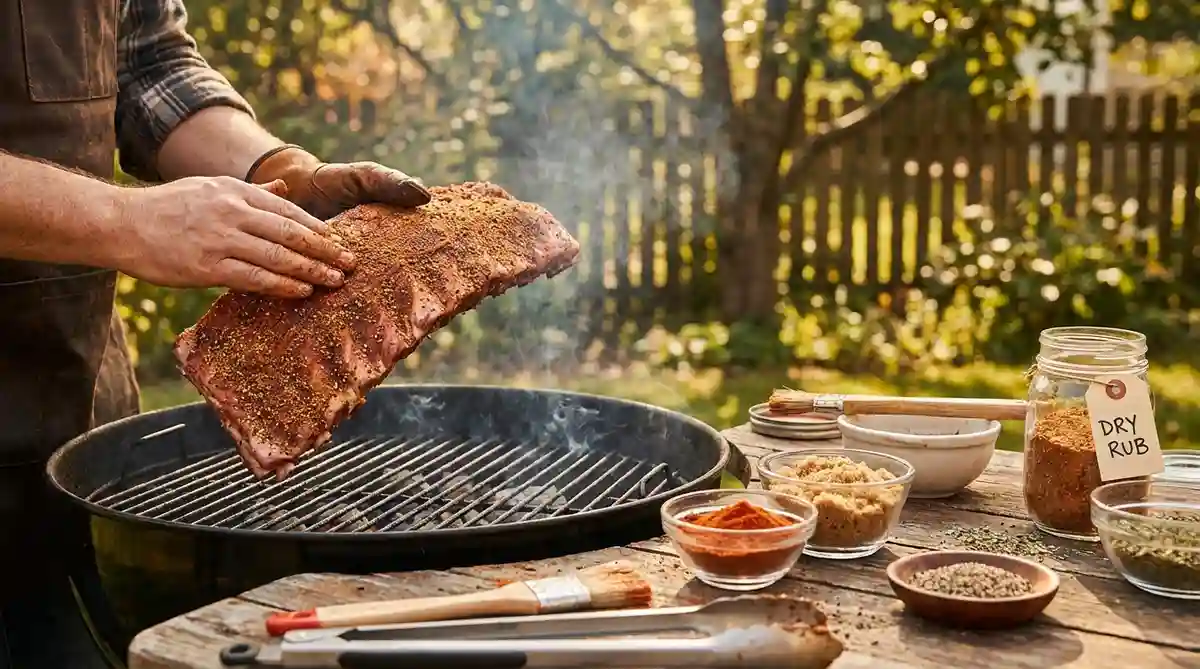
Apply the night before. Coat every surface generously. The rub will look heavy on raw ribs. It’s not. Most of it will cook into the bark and the result will be balanced.
Apply time: Overnight is ideal. Two to four hours is acceptable. Less than an hour and the salt hasn’t had time to work.
For Pork Shoulder
Shoulder needs more salt than ribs — bigger cut, more surface area, more interior mass to season. It also benefits from a more complex spice profile to carry through a 10 to 12-hour cook.
The Formula:
– 3 tablespoons kosher salt
– 2 tablespoons coarse black pepper
– 2 tablespoons brown sugar
– 1.5 tablespoons smoked paprika
– 1 tablespoon garlic powder
– 1 tablespoon onion powder
– 1 teaspoon cayenne
– 1 teaspoon cumin (adds earthiness that complements pork)
– 1/2 teaspoon dry mustard (adds sharpness that cuts through the fat)
Apply the night before or up to 24 hours ahead. Wrap tightly in plastic. Refrigerate. The rub forms a paste as it draws and reabsorbs surface moisture — this is correct.
For Brisket (Texas-Style)
Equal parts kosher salt and coarse black pepper. That’s the rub.
- 1/4 cup kosher salt
- 1/4 cup coarsely ground black pepper
Applied the night before on a well-trimmed brisket with 1/4-inch fat cap. Period.
This is not a simplified version — it’s the version preferred by the people who have spent decades refining brisket technique. The beef, the smoke, and the fat do everything else. A complex rub on a brisket competes with the beef rather than complementing it.
If Texas-style is not what you’re going for — if you want a sweeter, more complex bark — add 2 tablespoons of smoked paprika, 1 tablespoon of garlic powder, and 1 tablespoon of brown sugar to the above. That’s a reasonable middle ground. Still beef-forward, with more bark complexity.
For Chicken (Whole or Parts)
Chicken has thinner flesh and cooks at higher temperatures than low-and-slow proteins. The rub needs to be lighter on sugar (it’ll burn at direct grilling temperatures) and can carry more herbal notes.
The Formula:
– 2 teaspoons kosher salt per pound of chicken
– 1 teaspoon coarse black pepper
– 1 teaspoon smoked paprika
– 1/2 teaspoon garlic powder
– 1/2 teaspoon dried oregano
– 1/2 teaspoon dried thyme
– 1/4 teaspoon cayenne
– 1 tablespoon brown sugar (for indirect cooking only — omit for direct high-heat)
For whole spatchcocked chicken or bone-in thighs at indirect heat: full formula with sugar. For chicken breasts or wings at direct heat: omit or halve the sugar.
The Wet Rub Conversation
Wet rubs — pastes made from rub ingredients combined with oil, mustard, vinegar, or other liquids — are a legitimate technique. Mustard as a binder before a dry rub on brisket is a respected tradition; the mustard mostly cooks off and acts as a paste to hold the rub, not as a flavor component.
The claim that wet rubs penetrate deeper or season more thoroughly than dry rubs doesn’t hold up to scrutiny. Oil doesn’t carry seasoning into the meat — water does. Salt dissolved in moisture penetrates; fat-soluble aromatics sit on the surface regardless of whether they were applied dry or in an oil paste.
What wet rubs do accomplish: they adhere immediately without the need for overnight rest. If you’re seasoning and cooking within the hour, a wet rub ensures the surface is coated and the rub stays in place. For the overnight rest scenario, dry rub and wet rub produce equivalent results in terms of penetration.
The commercial wet rub market sells primarily on convenience and shelf presentation. A dry rub made from fresh spices applied the night before outperforms any bottled wet marinade on most proteins. The bottle is paying for the jar, the label, and the moisture content — not for better results in the cook.
The Bottled Rub Problem
Most pre-made bottled rubs are fine. Some are excellent. None of them are calibrated to your specific protein, your specific cook method, your specific palate preferences, or the wood smoke you’re using.
The first ingredient in most commercial rubs is sugar. The second is salt. Often there’s more sugar than the cook requires, sized for a demographic rather than a technique.
Build your own. It takes five minutes. A batch of pork rib rub costs $0.50 in ingredients. The result is a rub that does what you need it to do because you built it with that in mind.
Keep the base (salt and pepper) constant and adjust the supporting ingredients by protein and preference. You’ll land on two or three formulas that become yours — the ones you make by feel after a few seasons because you know what they need.
That’s the difference between following a recipe and knowing how to cook.
Storage and Scale
Make rubs in batches. A double or triple batch stored in an airtight jar in a cool, dark place stays fresh for three to four months. Label the jar with the protein it’s intended for and the date.
Ground spices lose potency over time. A rub made from freshly toasted and ground whole spices (whole cumin, whole coriander, whole peppercorns) is noticeably more complex than one made from pre-ground. Worth doing for a once-a-year special occasion cook. For regular weeknight and weekend grilling: quality pre-ground spices used before the three-month mark.
Buy whole spices in small quantities, grind them as needed, and your rubs will always outperform anything in a bottle.
Grumpy Dad Co. — Straightforward tools. No shortcuts on flavor.
Browse the full outdoor cooking and grilling collection at grumpydadco.com