
Washed, Natural, Honey: What Coffee Processing Actually Does to Your Cup

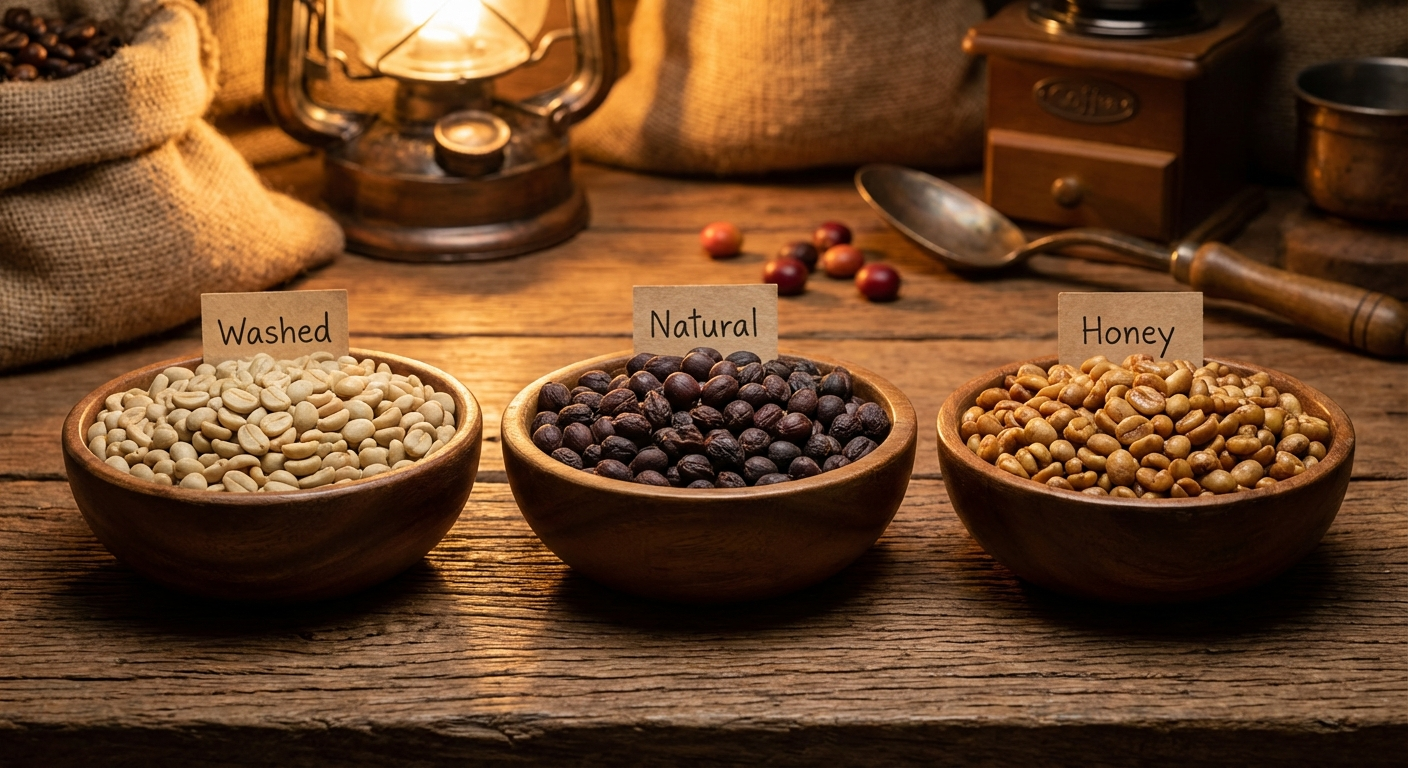
Take two coffees. Same farm. Same altitude. Same harvest. Same variety.
Process one of them washed. Process the other naturally. Brew them side by side.
They won’t taste like the same coffee.
One will be clean and precise, the kind of cup where you can pick out individual notes — jasmine, peach, something citrus. The other will be heavy and fruit-forward, like someone dropped a handful of blueberries into the grounds. Both will be good. Both will be completely different. Same beans. Different process.
That’s how much processing matters. That’s the whole argument for reading the bag.
The Part Nobody Explains at the Coffee Shop
Most people know coffee is made from beans. Fewer people know those beans start as fruit.
A coffee cherry looks something like a cranberry — small, round, red or yellow when ripe. Inside the cherry, surrounded by layers of skin, pulp, and a sticky coating called mucilage, sit two seeds facing each other. Those seeds are the coffee beans. Everything you brew is those seeds, roasted and ground.
Before those seeds get to you, the farmer has to remove all that fruit. How they do it — and how long it takes — determines what compounds stay in the bean and what gets washed away. It determines body, acidity, sweetness, and clarity. It determines whether your cup tastes like stone fruit or blueberry wine or something clean and floral.
There are three main methods. Each produces a fundamentally different result. Understanding them doesn’t make you a coffee snob. It makes you someone who knows what they’re ordering — and someone who can shop the Coffee, Tea & Espresso collection with actual intent.
Method One: Washed (Wet) Process
What it is: Everything comes off before drying. The cherry skin is removed immediately after harvest, the beans are fermented in water tanks for 24 to 72 hours to break down the remaining mucilage, then washed clean and moved to raised drying beds. They dry there — sometimes for two to three weeks — until the moisture content drops to the right level for export.
What it takes: More water. More infrastructure. More daily attention during fermentation, because the window between properly fermented and off-flavored is narrow. A farmer running washed processing is making decisions every day of the drying cycle.
What it produces: The cleanest possible cup. Because all the fruit is removed before drying, you’re tasting the bean directly — its genetics, its terroir, the altitude it grew at. The cup tends to be bright, clear, and high in acidity. The flavors are precise rather than broad.
Think of it like a photograph in sharp focus. Nothing is soft or blurred. You either see what’s there or you don’t.
When it works best: Varieties that have something worth hearing clearly. Geisha is the obvious example. Ethiopian Yirgacheffes. High-altitude Kenyan SL28s. Varieties where the aromatic compounds are complex enough that muddying them with fruit processing would be a waste. Our Morning Tolerance Panama Geisha is washed for exactly this reason — the variety has a voice, and washed processing gives it a clean room to speak in. If you want the full backstory, Panama Geisha: what it is and why it costs more is worth two minutes of your time.
What it tastes like: Floral, citrus, stone fruit, tea-like. High acidity. Clean finish. Lighter body. The cup that makes people stop and say what is that.
Method Two: Natural (Dry) Process
What it is: Nothing comes off before drying. The whole cherry — skin, pulp, mucilage, and all — dries around the bean, usually on raised beds or patios, sometimes for three to six weeks. The bean absorbs sugars and fermentation compounds from the surrounding fruit as it slowly dries.
What it takes: Less water, less equipment. More patience. More land for drying. More risk — the drying process needs constant turning and monitoring to prevent uneven fermentation or mold. A natural coffee that went wrong during drying will smell like vinegar and taste worse. A natural coffee done right is something else entirely.
What it produces: Heavy body. Intense fruit. Sweetness that hits you in the chest. The fermentation that happens inside the drying cherry creates flavor compounds you can’t get any other way — tropical fruit, berries, wine-like depth. Sometimes a mild funkiness that divides opinion cleanly into two camps: people who love it and people who think it tastes like a mistake.
If the washed process is a photograph in sharp focus, natural processing is an oil painting. Richer, more textured, less precise. You’re not picking out individual notes so much as experiencing an overall impression.
When it works best: Robust varieties that can handle the intensity. Ethiopian naturals are the benchmark — varieties like Sidama or Yirgacheffe processed naturally produce some of the most expressive cups in the world. Brazilian naturals are the workhorse of the espresso industry, providing the body and sweetness that makes a good blend pull together.
What it tastes like: Blueberry, strawberry, dark cherry, tropical fruit, chocolate, red wine. Low to medium acidity. Full, heavy body. A finish that lingers.
Method Three: Honey Process
What it is: A middle path. The skin is removed — like washed — but some or all of the mucilage is left on the bean during drying — like natural. How much mucilage stays determines the type of honey process.
Yellow honey: most mucilage removed. Dries faster. Cleaner cup, closer to washed. Red honey: more mucilage retained. Longer drying. More sweetness, more body. Black honey: maximum mucilage. Slowest drying. Closest to natural in flavor intensity.
What it takes: Precision. The farmer is making deliberate decisions at every stage about how much to strip, how long to dry, how to manage the stickiness of the mucilage without creating fermentation problems. Done well, it’s a craft. Done carelessly, it’s a mess.
What it produces: A middle-ground cup that captures sweetness and body from the fruit contact while retaining more clarity than a natural. The best honey-processed coffees have a rounded, approachable quality — not as bright as washed, not as heavy as natural, with a natural sweetness that doesn’t require anything added to your cup.
When it works best: Costa Rican coffees use honey processing more than almost any other country. The technique was largely developed there, and the region’s farms have refined it over decades. (When our Costa Rican high-altitude coffee comes to Grumpy Dad Co., pay attention to whether it’s honey or washed — it’ll tell you a lot about what the roaster was going for.)
What it tastes like: Stone fruit, caramel, brown sugar, mild berry. Medium acidity. Medium to full body. Approachable and sweet without being heavy.
Why the Same Variety Tastes Different Under Different Processes
This is the part that surprises most people when they first encounter it.
Ethiopian Yirgacheffe is the best example. Buy a washed Yirgacheffe and you’ll get one of the most delicately floral cups in the coffee world — jasmine, bergamot, lemon tea. Buy a natural Yirgacheffe from the same region, possibly from the same farm, and you’ll get blueberry and strawberry wine. The variety is identical. The terroir is identical. The process changes the flavor profile completely.
Why? Because the compounds that end up in the final bean depend on what the bean was exposed to during drying.
In a washed coffee, the bean is clean before it ever touches the drying bed. It expresses its own genetic character — the aromatic compounds produced by the variety itself, amplified by altitude and soil but not masked by fruit.
In a natural coffee, the bean spends weeks surrounded by fermenting fruit. Yeast and bacteria break down sugars in the mucilage and produce alcohols, esters, and acids that migrate into the bean. Those compounds — not just the bean’s natural chemistry — are what you taste in the cup.
Neither is superior. They’re different tools producing different results. The question isn’t which process is better. The question is what result you’re trying to achieve — and whether the processing matches the variety.
What to Look for on the Bag
If you’re buying specialty coffee and the processing method isn’t listed, that’s information too. Quality-focused roasters and farms list it because they’re proud of the decision. It’s part of the story.
When you do see it listed:
Washed (also called “fully washed” or “wet process”): expect brightness, clarity, and acidity. Best for varieties with complex aromatics.
Natural (also called “dry process”): expect fruit, sweetness, and body. Best when you want intensity over precision.
Honey (yellow, red, black): expect sweetness and balance. The lighter the honey, the closer to washed. The darker, the closer to natural.
Some bags also list anaerobic processing — a newer method where beans ferment in sealed tanks without oxygen, producing unusually intense and sometimes unusual flavors. It’s worth trying once to form an opinion. Some people love it. Some people think it tastes like coffee designed by someone who never drank coffee.
How This Changes What You Buy
Here’s the practical use of all this:
If you’re brewing a pour-over or drip, washed coffees tend to shine. The clarity of the cup translates beautifully through a paper filter — something a Hario V60 ceramic pour-over dripper makes very easy to achieve. The acidity is a feature, not a bug.
If you’re pulling espresso, naturals and honeys often perform better — the body and sweetness hold up under pressure extraction and cut through milk better than a high-acid washed coffee.
If you’re brewing French press, naturals work well — a 34oz borosilicate French press gives you the kind of full immersion that lets that body come through. The sweetness pairs with the heavier extraction method. A very delicate washed Geisha in a French press can end up tasting muddy — the method isn’t precise enough for the coffee.
A quality burr grinder matters regardless of process — something like the TIMEMORE Chestnut C2S conical burr grinder gives you consistent particle size for even extraction. A scale helps too, more than most people expect. Coffee brewing is just applied chemistry, and chemistry responds to precision. You don’t need to be obsessive about it. You just need to not ignore it entirely.
The Simple Version
If you’ve read this far and just want the short answer:
Washed = clean, bright, precise. You’re tasting the bean.
Natural = fruity, heavy, expressive. You’re tasting the bean and the fruit it grew in.
Honey = sweet, balanced, approachable. You’re tasting something in between.
Processing isn’t better or worse. It’s a decision the farmer and roaster made about what they wanted in your cup. Understanding it means you can decide whether that decision matches what you actually want to drink.
That’s not a small thing. That’s the difference between buying coffee and choosing it.
Morning Tolerance is washed. That wasn’t an accident. The Geisha variety from Volcán, Chiriquí has the kind of aromatic clarity that washed processing was made for. Anything else would have gotten in the way.
You can add it to the cart. Or keep drinking whatever you’ve been drinking.
It’ll still be here.
Grumpy Dad Co. — Built for people who’ve stopped settling. Explore Morning Tolerance and the full Coffee, Tea & Espresso collection at grumpydadco.com